If 


This can be used to prove the following proposition:
A chain map 


Proof:
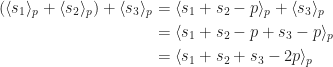
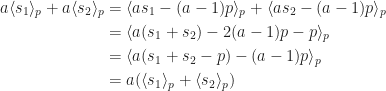
The relation 




For 



If
This can be used to prove the following proposition:
A chain map
Proof:
The relation
For
Chain Complex
A sequence of homomorphisms of abelian groups 


Elements of 

Define an equivalence relation on 


Prove
1) 

2) 
3) There is a homeomorphism 
4)
Proof:
1) 

2) Let 


3) Consider 







4) Since 
Motivation
Data is commonly represented as an unordered sequence of points in the Euclidean space 
For data points in 
From point cloud data to simplicial complexes
To convert a collection of points 

Given a set of points 


Given a set of points 

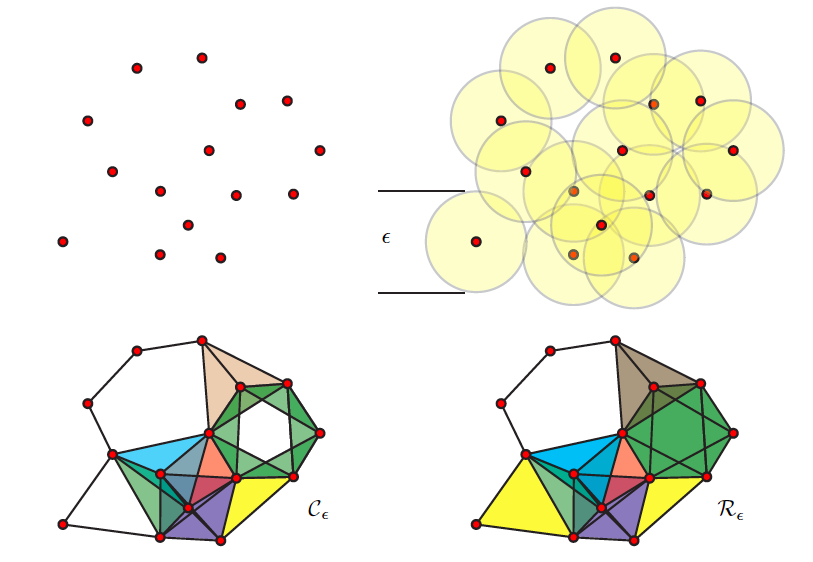
Top left: A fixed set of points. Top right: Closed balls of radius 

Yes.
Most pedagogy mistake made in Abstract Algebra teaching is in the wrong order (by historical chronological sequence of discovery):
[X ] Group -> Ring -> Field
It would be better, conceptual wise, to reverse the teaching order as:
Field -> Ring -> Group
or better still as (the author thinks):
Ring -> Field -> Group
View original post 8 more words
Take note: Find roots 根 to solve polynomial 多项式方程式equations, but find solution解to solve algebraic equations代数方程式.
Radical : (LatinRadix = root): $latex sqrt [n]{x} $
Quadratic equation (二次方程式) 有 “根式” 解:[最早发现者 : Babylon 和 三国时期的吴国 数学家 赵爽]
$latex {a.x^{2} + b.x + c = 0}&fg=aa0000&s=3$
$latex boxed{x= frac{-b pm sqrt{b^{2}-4ac} }{2a}}&fg=aa0000$
Cubic Equation: 16 CE Italians del Ferro, Tartaglia & Cardano
$latex {a.x^{3} = p.x + q }&fg=0000aa&s=3$
Cardano Formula (1545 《Ars Magna》):
$latex boxed {x = sqrt [3]{frac {q}{2} + sqrt{{ (frac {q}{2})}^{2} – { (frac {p}{3})}^{3}}}
+ sqrt [3]{frac {q}{2} -sqrt{ { (frac {q}{2})}^{2} – { (frac {p}{3})}^{3}}}}&fg=0000aa$
Quartic Equation: by Cardano’s student Ferrari
$latex {a.x^{4} + b.x^{3} + c.x^{2} + d.x + e = 0}&fg=00aa00&s=3$
Quintic Equation:
$latex {a.x^{5} + b.x^{4} + c.x^{3} + d.x^{2} + e.x + f = 0}&s=3$
No radical solution (Unsolvability) was suspected by Ruffini (1799)…
View original post 177 more words
Equivalence of 

Proof:
Reflexive: If 

Symmetry: Let 


Transitivity: Let 

Notation:
Then 


Let 


Excellent Advanced Math Lecture Series (Part 1 to 3) by齊震宇老師
(2012.09.10) Part I:
History: 1900 H. Poincaré invented Topologyfrom Euler Characteristic (V -E + R = 2)
Motivation of Algebraic Topology: Find Invariants[1]of various topological spaces (in higher dimension). 求拓扑空间的“不变量” eg.
then apply algebra (Linear Algebra, Matrices) with computer to compute these invariants (homology, co-homology, etc).
A topological space can be formed by a “Big Data” Point Set, e.g. genes, tumors, drugs, images, graphics, etc. By finding (co)- / homology – hence the intuitive Chinese term (上) /同调 [2] – is to find “holes” in the Big Data in the 10,000 (e.g.) dimensional space the hidden information (co-relationship, patterns, etc).
Note: [1]…
View original post 88 more words
Theorem:
If 


![\displaystyle A: [Z\wedge X, *; Y,y_0]\to [X, x_0; (Y,y_0)^{(Z,z_0)}, f_0]](https://s0.wp.com/latex.php?latex=%5Cdisplaystyle+A%3A+%5BZ%5Cwedge+X%2C+%2A%3B+Y%2Cy_0%5D%5Cto+%5BX%2C+x_0%3B+%28Y%2Cy_0%29%5E%7B%28Z%2Cz_0%29%7D%2C+f_0%5D&bg=ffffff&fg=1a1a1a&s=0&c=20201002)
![A[f]=[\hat{f}]](https://s0.wp.com/latex.php?latex=A%5Bf%5D%3D%5B%5Chat%7Bf%7D%5D&bg=ffffff&fg=1a1a1a&s=0&c=20201002)


![(\hat{f}(x))(z)=f[z,x]](https://s0.wp.com/latex.php?latex=%28%5Chat%7Bf%7D%28x%29%29%28z%29%3Df%5Bz%2Cx%5D&bg=ffffff&fg=1a1a1a&s=0&c=20201002)
We need the following two propositions in order to prove the theorem.
Proposition
\label{prop13}
The exponential function 

Proposition
\label{prop8}
If 







Proof of Theorem
i) 







![f[z,x]=\bar{f}(z,x)=(f'(x))(z)](https://s0.wp.com/latex.php?latex=f%5Bz%2Cx%5D%3D%5Cbar%7Bf%7D%28z%2Cx%29%3D%28f%27%28x%29%29%28z%29&bg=ffffff&fg=1a1a1a&s=0&c=20201002)

![A[f]=[f']](https://s0.wp.com/latex.php?latex=A%5Bf%5D%3D%5Bf%27%5D&bg=ffffff&fg=1a1a1a&s=0&c=20201002)
ii) 
![A[f]=A[g]](https://s0.wp.com/latex.php?latex=A%5Bf%5D%3DA%5Bg%5D&bg=ffffff&fg=1a1a1a&s=0&c=20201002)

















![H([z,x],t)=\bar{H}(z,x,t)=(H'(x,t))(z)](https://s0.wp.com/latex.php?latex=H%28%5Bz%2Cx%5D%2Ct%29%3D%5Cbar%7BH%7D%28z%2Cx%2Ct%29%3D%28H%27%28x%2Ct%29%29%28z%29&bg=ffffff&fg=1a1a1a&s=0&c=20201002)
![H_0([z,x])=(H_0'(x))(z)=(\hat{f}(x))(z)=f[z,x]](https://s0.wp.com/latex.php?latex=H_0%28%5Bz%2Cx%5D%29%3D%28H_0%27%28x%29%29%28z%29%3D%28%5Chat%7Bf%7D%28x%29%29%28z%29%3Df%5Bz%2Cx%5D&bg=ffffff&fg=1a1a1a&s=0&c=20201002)
![H_1([z,x])=(H_1'(x))(z)=(\hat{g}(x))(z)=g[z,x]](https://s0.wp.com/latex.php?latex=H_1%28%5Bz%2Cx%5D%29%3D%28H_1%27%28x%29%29%28z%29%3D%28%5Chat%7Bg%7D%28x%29%29%28z%29%3Dg%5Bz%2Cx%5D&bg=ffffff&fg=1a1a1a&s=0&c=20201002)
![[f]=[g]](https://s0.wp.com/latex.php?latex=%5Bf%5D%3D%5Bg%5D&bg=ffffff&fg=1a1a1a&s=0&c=20201002)

Loop space
If 





Suspension
If 


Corollary (Natural Equivalence relating 

If
In the world of Math education there are 3 big schools (门派) — in which the author had the good fortune to study under 3 different Math pedagogies:
“武当派” French (German) -> “少林派” Russian (China) -> “华山派” UK (USA).
( ) : derivative of its parent school. eg. China derived from Russian school in 1960s by Hua Luogeng.
Note:
武当派 : 内功, 以柔尅刚, 四两拨千斤 <=> “Soft” Math, Abstract, Theoretical, Generalized.
少林派: 拳脚硬功夫 <=> “Hard” Math, algorithmic.
华山派: 剑法轻灵 <=> Applied, Astute, Computer-aided.
The 3 schools’ pioneering grand masters (掌门人) since 16th century till 21st century, in between the 19th century (during the French Revolution) Modern Math (近代数学) is the critical milestone, the other (现代数学) is WW2 : –
France: Descartes / Fermat / Pascal (17 CE : Analytical Geometry, Number Theory, Probability), Cauchy / Lagrange / Fourier /Galois (19 CE, Modern Math : Analysis, Abstract Algebra),
View original post 189 more words

We need the following lemma:
If a space 


Proof:
Take 


Choose a basepoint 


Prove that the operation of linear combination, as in Definition 2.2.7, makes 


Proof:
We verify the axioms of a vector space.
Multiplicative axioms:
*
*
Additive Axioms:
*
*
*
Hence 
*
Distributive Axioms:
*
*
Hence 
在一个群体里, 每个会员互动中存在一种”运作” (binary operation)关系, 并遵守以下4个原则:
1) 肥水不流外人田: 任何互动的结果要回归 群体。(Closure) = C
2) 互动不分前后次序 (Associative) = A
(a.*b)*c = a*(b*c)
3) 群体有个”中立” 核心 (Neutral / Identity) = N (记号: e)
4) 和而不同: 每个人的意见都容许存在反面的意见 “逆元” (Inverse) = I (记号: a 的逆元 = $latex a^{-1}$)
Agree to disagree = Neutral
$latex a*a^{-1} = e $
具有这四个性质的群体才是
群体的 “美 : “对称”
如果没有 (3)&(4): 半群
如果没有 (4) 反对者: 么半群
以上是 Group (群 ) 数学的定义: “CAN I”
CA = Semi-Group 半群
CAN = Monoid 么半群
群是 19岁Evariste Galois 在法国革命时牢狱中发明的, 解决 300年来 Quintic Equations (5次以上的 方程式) 没有 “有理数” 的 解 (rational roots)。19世纪的 Modern Math (Abstract Algebra) 从此诞生, 群用来解释自然科学(物理, 化学, 生物)里 “对称”现象。Nobel Physicists (1958) 杨振宁/李政道 用群来证明物理 弱力 (Weak Force) 粒子(Particles) 的不对称 (Assymetry )。
 Never let success go to your head, and never let failure go to your heart.
Quite tough to be a primary school kid nowadays, even 97 marks is not enough to be admitted for Higher Chinese classes.
From experience, the main underlying reasons behind this scenario could be:
This is quite a serious issue as Chinese is no longer a minor/unimportant subject, like in the past it was. In fact, under the new PSLE scoring system, Chinese is one of the major game-changing core components, a severe Achilles’ heel for those in English-speaking families. Getting proficient in Chinese from an early age is a must for the new PSLE system, so no doubt many parents are anxious about Higher Chinese.
http://www.straitstimes.com/singapore/education/how-can-97-marks-be-not-good-enough
Parents of some children in a well-known primary school have complained about the selection process for Higher Chinese.
St Hilda’s Primary pupils are routed into Higher Chinese classes in Primary 2 based on continual assessment test results in Primary 1.
What upset the parents was that pupils who scored as high as 97 marks in Chinese last year were told that they had failed to make the cut for Higher Chinese.
Read more at: http://www.straitstimes.com/singapore/education/how-can-97-marks-be-not-good-enough
Functors
Definition:
A functor 

– For each object 

– For each 
Furthermore,
– For each object 

– For 


Definition:
A cofunctor (also called contravariant functor) 
– For each object 
– For each 
– For each object 
– For each 
Example
Given a fixed pointed space 

![F_K(X,x_0)=[K,k_0; X,x_0]\in\mathscr{PS}](https://s0.wp.com/latex.php?latex=F_K%28X%2Cx_0%29%3D%5BK%2Ck_0%3B+X%2Cx_0%5D%5Cin%5Cmathscr%7BPS%7D&bg=ffffff&fg=1a1a1a&s=0&c=20201002)


![F_K(f)\in\hom([K,k_0; X,x_0],[K,k_0;Y,y_0])](https://s0.wp.com/latex.php?latex=F_K%28f%29%5Cin%5Chom%28%5BK%2Ck_0%3B+X%2Cx_0%5D%2C%5BK%2Ck_0%3BY%2Cy_0%5D%29&bg=ffffff&fg=1a1a1a&s=0&c=20201002)
![\displaystyle F_k(f)[g]=[f\circ g]\in[K,k_0; Y,y_0]](https://s0.wp.com/latex.php?latex=%5Cdisplaystyle+F_k%28f%29%5Bg%5D%3D%5Bf%5Ccirc+g%5D%5Cin%5BK%2Ck_0%3B+Y%2Cy_0%5D&bg=ffffff&fg=1a1a1a&s=0&c=20201002)
![[g]\in [K,k_0; X,x_0]](https://s0.wp.com/latex.php?latex=%5Bg%5D%5Cin+%5BK%2Ck_0%3B+X%2Cx_0%5D&bg=ffffff&fg=1a1a1a&s=0&c=20201002)
We can check the two axioms:
– ![F_k(1_X)[g]=[1_X\circ g]=[g]](https://s0.wp.com/latex.php?latex=F_k%281_X%29%5Bg%5D%3D%5B1_X%5Ccirc+g%5D%3D%5Bg%5D&bg=ffffff&fg=1a1a1a&s=0&c=20201002)
![[g]\in[K,k_0; X, x_0]](https://s0.wp.com/latex.php?latex=%5Bg%5D%5Cin%5BK%2Ck_0%3B+X%2C+x_0%5D&bg=ffffff&fg=1a1a1a&s=0&c=20201002)
– For 

![\displaystyle F_K(h\circ f)[g]=[h\circ f\circ g]=F_K(h)\circ F_K(f)[g]\in[K,k_0; Z,z_0]](https://s0.wp.com/latex.php?latex=%5Cdisplaystyle+F_K%28h%5Ccirc+f%29%5Bg%5D%3D%5Bh%5Ccirc+f%5Ccirc+g%5D%3DF_K%28h%29%5Ccirc+F_K%28f%29%5Bg%5D%5Cin%5BK%2Ck_0%3B+Z%2Cz_0%5D&bg=ffffff&fg=1a1a1a&s=0&c=20201002)
![[g]\in[K,k_0; X,x_0]](https://s0.wp.com/latex.php?latex=%5Bg%5D%5Cin%5BK%2Ck_0%3B+X%2Cx_0%5D&bg=ffffff&fg=1a1a1a&s=0&c=20201002)
Similarly, we can define a cofunctor 
![F_K^*(X,x_0)=[X,x_0; K,k_0]](https://s0.wp.com/latex.php?latex=F_K%5E%2A%28X%2Cx_0%29%3D%5BX%2Cx_0%3B+K%2Ck_0%5D&bg=ffffff&fg=1a1a1a&s=0&c=20201002)

![\displaystyle F_K(f)[g]=[g\circ f]\in[X,x_0; K,k_0]](https://s0.wp.com/latex.php?latex=%5Cdisplaystyle+F_K%28f%29%5Bg%5D%3D%5Bg%5Ccirc+f%5D%5Cin%5BX%2Cx_0%3B+K%2Ck_0%5D&bg=ffffff&fg=1a1a1a&s=0&c=20201002)
![[g]\in[Y,y_0; K,k_0]](https://s0.wp.com/latex.php?latex=%5Bg%5D%5Cin%5BY%2Cy_0%3B+K%2Ck_0%5D&bg=ffffff&fg=1a1a1a&s=0&c=20201002)
Note that if 




Homotopy Sets and Groups
Theorem:
If
We need the following two propositions in order to prove the theorem.
Proposition 1:
The exponential function
Proposition 2:
If
About Tutor (Mr Wu): https://mathtuition88.com/singapore-math-tutor/
– Raffles Alumni
– NUS 1st Class Honours in Mathematics
Experience: More than 10 years experience, has taught students from RJC, NJC, ACJC and many other JCs.
Personality: Friendly, patient and good at explaining complicated concepts in a simple manner
Email: mathtuition88@gmail.com
Areas teaching (West / Central Singapore):
viXra (http://vixra.org/) is the cousin of arXiv (http://arxiv.org/) which are electronic archives where researchers can submit their research before being published on a journal.
The difference is that viXra allows anyone to submit their article, whereas arXiv requires an academic affiliation to recommend before submitting. There are pros and cons to viXra, the pros being freedom of submission open to everyone on the world. The cons is that, naturally, there may be more crackpots who submit nonsense.
There are, however, some serious papers on viXra.
After submitting, the viXra admin will send an email something like this:
Thank you for your submission request to viXra.org
Your submission has now been uploaded and is available at
Please check and let us know is there are any errors. If everything is OK please do not reply to this mail.
If you do not see it on some of the listing pages this may be due to caching in your web browser, please clear the cache and reload
If you need to replace the document you should use the replacement form and enter the viXra number
If you need to make any changes on the abstract page without changing the PDf document (e.g. authors, title, comment, abstract), use the change web form.
Links to the forms are provided at http://vixra.org/submit
please note that viXra.org does not do cross-listings to other subject categories
The search feature on viXra is dependent on Google and will update with changes when they reindex. This may take a few days.The details of the submission were as follows:
Thank you for using our service at viXra.org
Regards, the viXra admin
Featured book:
An Introduction to the Theory of Numbers
An Introduction to the Theory of Numbers by G. H. Hardy and E. M. Wright is found on the reading list of virtually all elementary number theory courses and is widely regarded as the primary and classic text in elementary number theory. Developed under the guidance of D. R. Heath-Brown, this Sixth Edition of An Introduction to the Theory of Numbers has been extensively revised and updated to guide today’s students through the key milestones and developments in number theory.
Prof ST Yau邱成桐, Chinese/HK Harvard Math Dean, is the only 2 Mathematicians in history (the other person is Prof Pierre Deligne of Belgium) who won ALL 3 top math prizes: Fields Medal (at 27, proving Calabi Conjecture), Crafoord Prize(1994),Wolf Prize(2010).
Key Takeaways:
1. On Math Education:
◇ Compulsary Math training for reasoning skill applicable in Economy, Law, Medicine, etc.
◇ Study Math Tip: read the new topic notes 1 day before the lecture, then after it do the problems.
◇ Read Math topics even though you do not understand in first round, re-read few more times, then few days / months / years / decades later you will digest them. (做学问的程序).
◇ Do not consult students in WHAT to teach, because they don’t know what to learn.
◇ Love of Math beauty is the “pull-factor” for motivating students’ interest in Math.
◇ Parental…
View original post 106 more words
Homotopy of paths
A homotopy of paths in a space 

(i) The endpoints 

(ii) The associated map 

When two paths 


Example: Linear Homotopies
Any two paths 
Simply-connected
A space is called simply-connected if it is path-connected and has trivial fundamental group.
A space
Path-connectedness is the existence of paths connecting every pair of points, so we need to be concerned only with the uniqueness of connecting paths.
(





(


A basic property of the product topology is that a map 



Hence a loop 


Similarly, a homotopy 

Thus we obtain a bijection 
![[f]\mapsto([g],[h])](https://s0.wp.com/latex.php?latex=%5Bf%5D%5Cmapsto%28%5Bg%5D%2C%5Bh%5D%29&bg=ffffff&fg=1a1a1a&s=0&c=20201002)
Note: The condition that 

If 


Proof:
Let 



By choosing 





Any short-cut method ? Yes, by L.C.M…
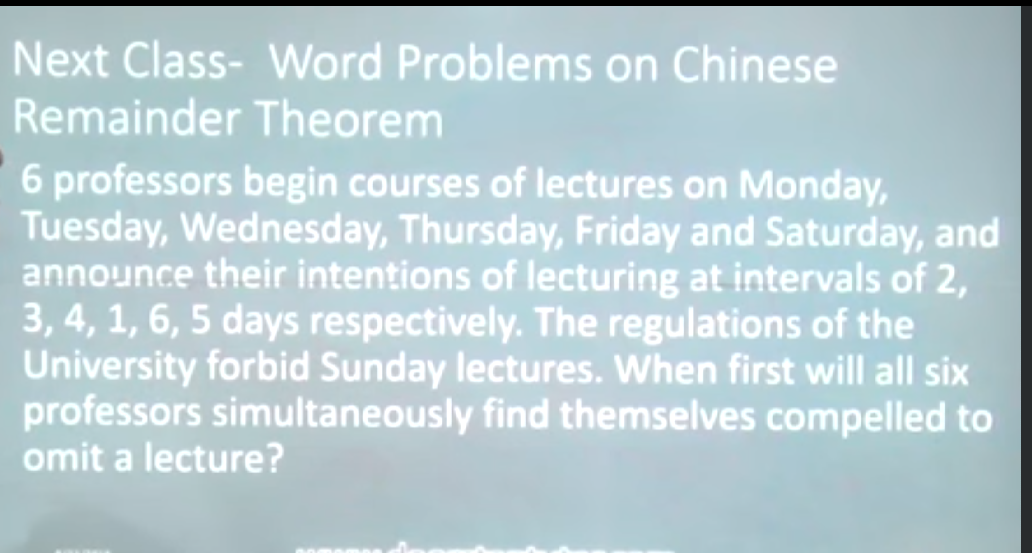
How to formulate this problem in CRT ?
Hint: Sunday = 7 , Interval 2 days = mod 2, …
Let d = week days {1, 2, 3, 4, 5, 6, 7} for {Monday (Prof M), tuesday (Prof t), Wednesday (Prof W), Thursday (Prof T), Friday (Prof F), saturday (Prof s), Sunday (Prof S)}
d : 1 2 3 4 5 6 [7] 1 2 3 4 5 6 [7] 1 2
M: m 0 m 0 m 0 [m] ==> fell on 1st sunday
t: - t 0 0 t 0 [0 ] t 0 0 t 0 0 [t ] ==> fell on 2nd sunday
W: – - w 0 0 0 [w] 0 0 0 w 0 0 [0] ==> fell on 1st sunday
T: - - - T T T [T] ==> fell on 1st sunday (TRIVIAL CASE!)
F: - - - - f 0…
View original post 626 more words
This Taiwanese Math Prof is very approachable in clarifying the doubts in an unconventional way different from the arcane textbook definitions. Below are his few key tips to breakthrough the “mystified”concepts :
1. “Dual Space“(对偶空间) : it is the evaluation of a “Vector Space”.
Example: A student studies few subjects {Math, Physics, English, Chemistry…}, these subjects form a “Subject Vector Space” (V), if we associate the subjects with weightages (加权) , say, Math 4, Physics 3, English 2, Chemistry 1, the “Weightage Dual Space” of V will be W= {4, 3, 2, 1}.
2. Vector: beyond the meaning of a physical vector with direction and value, it extends to any “object” which can be manipulated (抵消) by the 4 operations “+, – , x, / ” in a FieldF = {R or Z2 …}.
Eg. $latex alpha_{1}.v_{1} + alpha_{2}.v_{2} + alpha_{3}.v_{3}, forall alpha_{j} in…
View original post 111 more words
This equation puzzles most people. WHY ?
$latex boxed {{delta}^2 = 0 { ?}}&fg=aa0000&s=3 $
It is analogous to the Vector Algebra:
Let the boundary of {A, B} =
$latex delta (A,B) = overrightarrow{AB }$
$latex overrightarrow{AB } + overrightarrow {BA} =overrightarrow{AB } – overrightarrow {AB} = vec 0 $
Note: Co-homology: (上)同调


Euclid Geometry & Homology:

Isabell Darcy Lecture: cohomology
If 
(i)
(ii) no proper subfield of
(iii) if
(iv) ![[F:K]](https://s0.wp.com/latex.php?latex=%5BF%3AK%5D&bg=ffffff&fg=1a1a1a&s=0&c=20201002)
![[E:K]](https://s0.wp.com/latex.php?latex=%5BE%3AK%5D&bg=ffffff&fg=1a1a1a&s=0&c=20201002)
The field
Proof:
(i) Let 
![f_i\in K[x]](https://s0.wp.com/latex.php?latex=f_i%5Cin+K%5Bx%5D&bg=ffffff&fg=1a1a1a&s=0&c=20201002)



![K[x]](https://s0.wp.com/latex.php?latex=K%5Bx%5D&bg=ffffff&fg=1a1a1a&s=0&c=20201002)
(iii) If
(iv) If 
(ii) A subfield 


Finally let 


Therefore both 


Wishing all readers of Mathtuition88.com a happy new year, and may 2017 bring you peace and joy in your life.
No matter which stage of life you are in (student/career/parent/retiree), here is my sincere wishes that you will achieve your goals in 2017, and more importantly be happy in the process.
Best wishes,
Mathtuition88.com
This is an excellent quick revision of the French Baccalaureat Math during the first month of French university. (Unfortunately common A-level Math syllabus lacks such rigourous Math foundation.)
Most non-rigourous high-school students / teachers abuse the use of :
“=> ” , “<=>” .
Prove by “Reductio par Absudum” 反证法 (by Contradiction) is a clever mathematical logic :
$latex boxed {(A => B) <=> (non B => non A)} &s=3$
Famous Examples: 1) Prove $latex sqrt 2 $ is irrational ; 2) There are infinite prime numbers (both by Greek mathematician Euclid 3,000 years ago)
The young teacher showed the techniques of proving Mapping:
Surjective (On-to) – best understood in Chinese 满射 (Full Mapping)
Injective (1-to-1) 单射
Bijective (On-to & 1-to-1) 双射
He used an analogy of (the Set of) red Indians shooting (the Set of bisons 野牛):
All bisons are shot by arrows from1 or more Indians. (Surjective…
View original post 81 more words




![\displaystyle A: [SX, *; Y,y_0]\to [X, x_0; \Omega Y, \omega_0].](https://s0.wp.com/latex.php?latex=%5Cdisplaystyle+A%3A+%5BSX%2C+%2A%3B+Y%2Cy_0%5D%5Cto+%5BX%2C+x_0%3B+%5COmega+Y%2C+%5Comega_0%5D.&bg=ffffff&fg=1a1a1a&s=0&c=20201002)














 Mathtuition88