An ideal book for enlivening undergraduate mathematics…he (Dunham) has Euler dazzling us with cleverness, page after page. — Choice
Mathematician William Dunham has written a superb book about the life and amazing achievements of one of the greatest mathematicians of all time. Unlike earlier writings about Euler, Professor Dunham gives crystal clear accounts of how Euler ingeniously proved his most significant results, and how later experts have stood on Euler’s broad shoulders. Such a book has long been overdue. It will not need to be done again for a long long time. — Martin Gardner
William Dunham has done it again! In “Euler: the Master of Us All”, he has produced a masterful portrait of one of the most fertile mathematicians of all time. With Dunham’s beautiful clarity and wit, we can follow with amazement Euler’s strokes of genius which laid the groundwork for most of the mathematics we have today. — Ron Graham, Chief Scientist, AT&T
William Dunham has written a superb book about the life and amazing achievements of one of the greatest mathematicians of all time. Unlike earlier writings about Euler, Dunham gives crystal clear accounts of how Euler ingeniously proved his most significant results, and how later experts have stood on Euler’s broad shoulders. Such a book has long been overdue. It will not need to be done again for a long, long time.Martin Gardner
Dunham has done it again! In “Euler: The Master of Us All,” he has produced a masterful portrait of one of the most fertile mathematicians of all time. With Dunham’s beautiful clarity and wit, we can follow with amazement Euler’s strokes of genius which laid the groundwork for most of the mathematics we have today. — Ronald Graham, Chief Scientist, AT&T
1. Matrix (M): stretch & twist space
2. Vector (v): a distance along some direction
3. M.v = v’ stretched & twisted by M
Some directions are special:-
a) v stretched but not twisted = Eigenvector;
b) The amount of stretch = constant = Eigenvalue (λ)
Let M the matrix, λ its eigenvalue,
v eigenvector.
By definition: M.v = λ.v
v = I.v (I identity matrix)
M.v = λI.v
(M – λI).v=0
As v is non-zero,
1. Determinant (M- λI) =0 => find λ
2. M.v = λ.v => find v
Note1: Why call Eigenvalue ?
From German: “Die dem Problem eigentuemlichen Werte”
= “The values belonging to this problem”
=> eigenWerte = EigenValue
Eigenvalue also called ‘characteristic values’ or ‘autovalues’.
Eigen in English = Characteristic (but already used for Field).
Note2: Schrödinger Quantum equation’s Eigenvalue = Maximum probability of electron presence at the orbit…
New Geometry (新几何) invented by Zhang JingZhong (張景中) derived from 2 basic theorems:
1) Triangles internal angles =180º
2) Triangle Area = ½ base * height
=> derive all geometry
=> trigonometry
=> algebra
(These 3 maths are linked, unlike current syllabus taught separately)
The powerful Area (Δ) Proof Techniques:
1) Common Height:
Line AMB, P outside line
Δ PAM / Δ PBM = AM/BM
2) Common 1 Side (PQ):
Lines AB and PQ meet at M
Δ APQ /Δ BPQ = AM/BM
Chinese students typically outperform U.S. students on international comparisons of mathematics competency. Paradoxically, Chinese teachers receive far less education than U.S. teachers–11 to 12 years of schooling versus 16 to 18 years of schooling.
Studies of U.S. teacher knowledge often document insufficient subject matter knowledge in mathematics. But, they give few examples of the knowledge teachers need to support teaching, particularly the kind of teaching demanded by recent reforms in mathematics education.
This book describes the nature and development of the “profound understanding of fundamental mathematics” that elementary teachers need to become accomplished mathematics teachers, and suggests why such teaching knowledge is much more common in China than the United States, despite the fact that Chinese teachers have less formal education than their U.S. counterparts.
As Chinese we are good at memorizing poems since young (think of reciting 唐诗300首 – no sweat! ).
By chanting in Hokkien I remember complicated trigo formula:)
Cos 3A = 4Cos^3 A – 3.Cos A
($ 1.3 = $4.3 -$3 with $ =Cos in Hokkien sound).
Once I performed this ‘memory power’ in a lecture hall with me called up by the professor to solve a Physics problem. Halfway in the computation we need to open up the “Cos 3A”, the prof asked the whole class to help me, but I wrote the above down quickly on the white board to the awe of the class. Guess what, when the prof saw it, instead of praising me I got a scolding ! He said “Do not keep unnecessary things in your head”. The prof is a French, he did not know I have Hokkien language advantage… haha.
Anyway, joke aside, try to memorize minimum, go by first principle so that you will never ever forget iin whole life (yes, I remember them now after 40 years).
This math teacher is excellent in teaching the students to memorize minimum. His example is integrate secant. Most textbooks use a trick ie multiply (sec + tan) above and below, then by substitution. He goes by first principle, change sec = 1/cos, then try to use 2 common trigo sine and cosine, he multiplies cos above & below to make: sec = cos / 1-sin^2,… then integrate by part…
Think of the 4th solution, if any, for this
“Monkey & Coconuts” Problem.
It was created by Nobel Physicist Prof Paul Dirac, which he told another Chinese Nobel Physicist Prof Li ZhengDao (李政道)。
Pro Li wanted to test the Chinese young students in the first China Gifted Children University of 13 year-old kids, none of them could solve this problem (proved they are not so gifted after all for unknown problems :)
The first 2 solutions were solved by Prof Paul Richard Halmos, the 3rd solved by myself using the Singapore Modelling Math (a modified version of Arithmetics from traditional Math taught in 1970s Chinese Secondary 1 “中学数学” in Singapore).
Proto Indo-European and Chinese in the Late Neolithic Age 后新石器时代的原欧-印语与汉语
Tsung-tung Chang[張聰東] 1988:
“Indo-European vocabulary in Old Chinese: A new thesis on the emergence of Chinese language and civilization in the Late Neolithic Age”, Sino-Platonic Papers 7, Philadelphia.
This Chinese scholar wrote the 1988 paper on the Chinese language origin with the proto-Indo-European (proto IE).
Interestingly very similar ‘coincidence’ occurs in 1500 words between Chinese and proto IE:
Take -> 得 tek (ancient Chinese sound as in Fujian dialect today)
Mort -> 殁 mo
See -> 视 see
Cow -> 牛 gu
…
After the Tower of Babel, God confused the human into different languages, but by the linguistic ‘archaeology’ ‘Half Life’ Theory, we can deduce ~ 4,900 years ago the Chinese and the Germanic (English, Denmark, German …) shared the same common linguistic root.
Einstein showed by Mathematics (the Riemann Geometry) to explain Space-Time curvature and the Gravity. It was later proved by the astrological discovery in Solar Eclipse.
Here, this professor made an experiment to demonstrate Einstein’s theory.
Natural Numbers (N) = {1,2,3, 4…}
1-dimension: a Line
2-dimension: a plane
n-dimensional flat space: a Vector Space
Now imagine in a world where we replace every natural number by vector space:
1 by a Line
2 by a Plane
n by a flat space Vector Space
Sum of numbers = Direct sum of vector space.
E.g. Add a 1-D Line to a 2-D Plane = 3-D Space
Product of numbers = Tensor Product (of two vector spaces of respective dimension m & n) with dimension m.n
This new world would be much interesting and richer than the Natural Number world: vector spaces have symmetries, whereas numbers are just numbers with no symmetries. (Interesting): we can add 1 to 2 in only ONE way (1+2), but there are many ways to embed (add) a Line in a Plane (perpendicular, slanting in any angle, etc). (Richer): the Lie Group SO(3)…
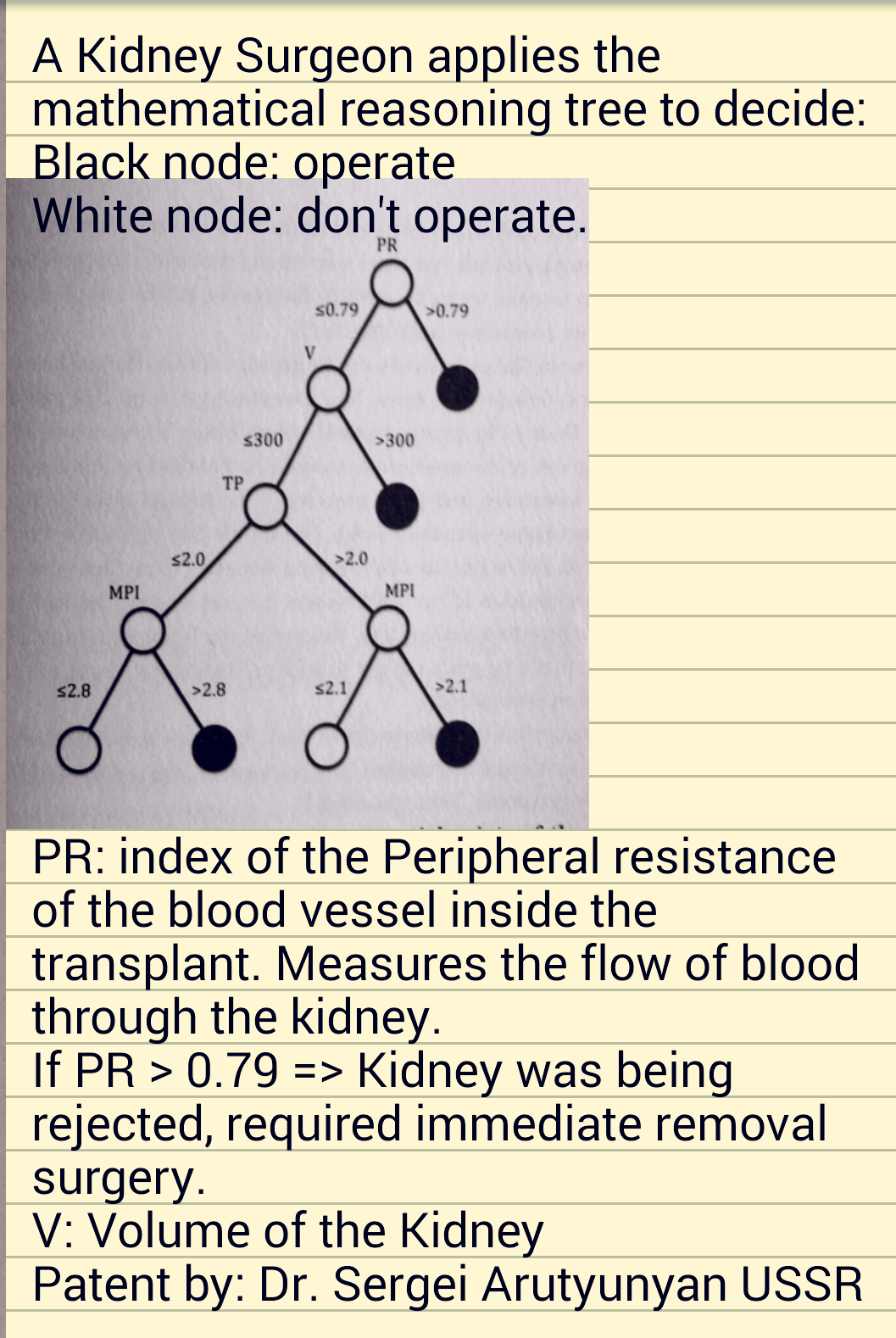
The young Russian doctor Sergei Arutyunyan was working with patients whose immune systems were rejecting transplanted kidneys.
The doctor has to decide whether to keep or remove it. If they kept the kidney, the patient could die, but if they remove it, the patient would need another long wait (or never) for another kidney.
The mathematician Edward Frankel helped him to analyze the collected data with ‘expert rules’ in a decision tree. (Note: this is like the Artificial Intelligence Rule-based Expert System, except no fuzzy math).
In Récoltes et Semailles Fields Medalist Alexander Grothendieck describes an experience of the type that Alain Connes mentions:
I can still recall the first “mathematics essay” (math test, or Composition Mathématique) , and that the teacher gave it a bad mark. It was to be a proof of “three cases in which triangles were congruent.” My proof wasn’t the official one in the textbook he followed religiously. All the same, I already knew that my proof was neither more nor less convincing than the one in the book, and that it was in accord with the traditional spirit of “gliding this figure over that one.” It was self-evident that this man was unable or unwilling to think for himself in judging the worth of a train of…
This professor criticized the lack of rigor in today’s math education, in particular, there exists universally a prevalent ‘ambiguous’ gap between high school and undergraduate math education.
I admire his great insight which is obvious to those postwar baby boomer generation.
I remember I was the last Singapore batch or so (early 70s) taking the full Euclidean Geometry course at 15 years old, and strangely in that year of Secondary 3 Math (equivalent to 3ème in Baccalaureate) my (Chinese) school had 2 separate math teacher for Geometry and Elementary/Additional (E./A.) Math.
Guess what ? the Geometry teacher was an Art teacher. It turned out it was a blessing in disguise, as my class of average Math students who hated E./A. Maths all scored 90% distinctions in Geometry. We did not treat Geometry like the other boring maths. The lady Art teacher started on the first day from Euclid’s 5 axioms…
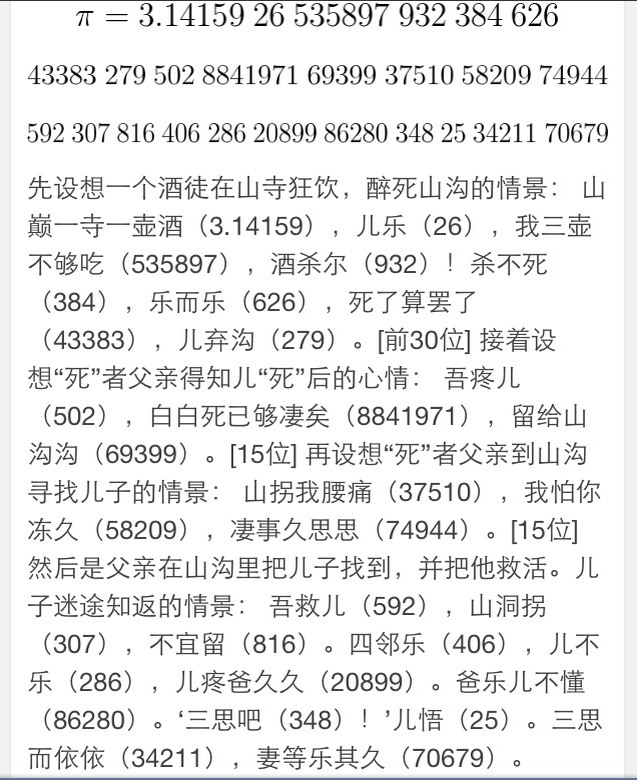
One fine day when we reach above 80 years old, if the doctor accuses us of having dementia, then prove the doctor wrong by shocking him with 100-digit Pi memory 🙂
With Chinese single-syllable sound for numbers, better still if can sing it as a song, memorizing 100-digit pi is easy!
Best way to study abstract math is to use concrete examples, visualizable 2- or 3- dimensional mathematical ‘objects’.
Groups:
(Do not need to search too far…) Best example is the Integer Group (Z) with + operation, denoted as {Z, +}. (Note: Easy to verify it satisfies the group 4 properties: CAN I“.
It has infinite elements (infinite group)
It is a Discrete Group, because it jumps from one integer to another (1,2,3…, in digital sense).
The group of rotation of a round table, which consists of all points on a circle, is an infinite group. We can change the angle of rotation continously between 0 and 360 degrees, rotating around a geometrical shape – a circle. Such shapes are called Manifolds (流形).
All points of a manifold forms a Lie group.
Example: The group of rotations of a sphere around a central…
If you are wondering which tuition agency is the best, look no further. The best tuition agency in Singapore is without a doubt Startutor.
Startutor is highly recommended by our tutor Mr Wu, and he himself is listed there.
For other subjects besides Mathematics, request for a tutor at Startutor! Startutor is Singapore’s most popular online agency, providing tutors to your home. There are no extra costs for making a request. Tutors’ certificates are carefully vetted by Startutor. (Website: http://startutor.sg/request,wwcsmt)
Startutor is suitable for English Tuition, Social Studies Tuition, Geography Tuition, Physics Tuition, Chemistry Tuition, Biology Tuition, Chinese Tuition, Economics Tuition, GP Tuition, Piano Lessons and more!
Just to reblog this earlier post on Recommended Singapore Math Books. Ideal for parents living outside Singapore who wish to teach their child the Singapore Math curriculum!
We have compiled a list of Top 5 Best selling and Top rated Singapore Math Books on Amazon. This list is more targeted towards parents and students living outside Singapore, like in the United States. Students in Singapore are already breathing and living Singapore Math!
Hope this list will help you in finding the Best Singapore Math Books for your child. The reviews are from actual customers on Amazon. 1)
This math practice book contains wonderful teaching strategies from the Singapore math program including number bonds and counting on. This would be a good book for homeschooling. We use it as an enrichment tool when we have a little extra time during vacations or on weekends.
I would recommend it to parents who would like to teach their struggling kids math, because it tells you how to teach these concepts.
The dimension of a hypersphere inside a n-dimensional space
= $latex boxed {n – 1}$
Examples:
Dim (Circle) in 2-dim plane = 1
As we approach near the neighborhood of the tangential point on the circle, the curvature of the circle disappears, there is no difference between the circle and the tangent line (dim = 1).
Hence, Dim (Circle) = 1
A point on a circle is determined by one independent variable only, which is the polar angle.
Note:
The dimension of the ambient space (2-dim plane) is not relevant to the dimension of the circle itself.
Dim (Sphere) in 3-dim Space = 2
The 2 variables (longitude, latitude) determine a position on the globe. Therefore dimension of a sphere is 2.
Interesting note: Four Dimension Space (x, y, z, t): what we get if the 4th dimension time is fixed (frozen in time) ? We get a…
Shimura and Tanyama are two Japanese mathematicians first put up the conjecture in 1955, later the French mathematician André Weil re-discovered it in 1967.
The British Andrew Wiles proved the conjecture and used this theorem to prove the 380-year-old Fermat’s Last Theorem (FLT) in 1994.
It is concerning the study of these strange curves called Elliptic Curve with 2 variables cubic equation:
Past Year Paper is an established Singapore Home Tuition Agency that brings to you quality private tutors and free exam papers for primary, secondary school to junior college level students.
http://www.ted.com In a lively show, mathemagician Arthur Benjamin races a team of calculators to figure out 3-digit squares, solves another massive mental equation and guesses a few birthdays. How does he do it? He’ll tell you.
TEDTalks is a daily video podcast of the best talks and performances from the TED Conference, where the world’s leading thinkers and doers are invited to give the talk of their lives in 18 minutes — including speakers such as Jill Bolte Taylor, Sir Ken Robinson, Hans Rosling, Al Gore and Arthur Benjamin. TED stands for Technology, Entertainment, and Design, and TEDTalks cover these topics as well as science, business, politics and the arts. Watch the Top 10 TEDTalks on TED.com, at http://www.ted.com/index.php/talks/top10
Secrets of Mental Math: The Mathemagician’s Guide to Lightning Calculation and Amazing Math Tricks
These simple math secrets and tricks will forever change how you look at the world of numbers.
Secrets of Mental Math will have you thinking like a math genius in no time. Get ready to amaze your friends—and yourself—with incredible calculations you never thought you could master, as renowned “mathemagician” Arthur Benjamin shares his techniques for lightning-quick calculations and amazing number tricks. This book will teach you to do math in your head faster than you ever thought possible, dramatically improve your memory for numbers, and—maybe for the first time—make mathematics fun.
Yes, even you can learn to do seemingly complex equations in your head; all you need to learn are a few tricks. You’ll be able to quickly multiply and divide triple digits, compute with fractions, and determine squares, cubes, and roots without blinking an eye. No matter what your age or current math ability, Secrets of Mental Math will allow you to perform fantastic feats of the mind effortlessly. This is the math they never taught you in school.
Help the Gorilla find bananas by adding the numbers correctly!
Suitable for ages 5 and above.
More games: Math Memo – click on cards to match the correct pairs Star alphabet – press letters on the keyboard to hear their names Star numbers – press digits








 .
.
























 ,
, .
.

 , we get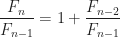
 exists for the time being, and prove it later)
 .
. , we get:


 which is the Golden Ratio!
 converges. This is a bit tricky and requires some algebra.


 Mathtuition88