
Let N = 2n > 6
哥德巴赫猜想 Conjecture “1+1”: N = p1 + p2 (pj all primes)
陈景润 Chen Theorem “1+2”: N = p1+ p2.p3

Let N = 2n > 6
哥德巴赫猜想 Conjecture “1+1”: N = p1 + p2 (pj all primes)
陈景润 Chen Theorem “1+2”: N = p1+ p2.p3
The 7 Fields Medalists are:
2014 – Maryam Mirzakhani (1977-2017) – 1st lady Fields medalist
2010 – Cédric Villani (1973- )
2006 – Grigori Perelman (1966- ) – 1st declined the award
1998 – Andrew Wiles (1953- ) [silver plaque] – Fermat’s Last Theorem
1990 – Edward Witten (1951- ) – Physicist won Fields medal
1982 – Alain Connes (1947- ) – Quantum Theory
1966 – Alexander Grothendieck (1928-2014) – Hermit mathematician
http://www.thecrimson.com/article/2018/4/27/bill-gates-event/
Bill Gates, a top Math student at Harvard entrance exams, recalled his first year Harvard “Math55” Course (Advanced Calculus & Linear Algebra) – the toughest at his time because 4 years of Math coursewares condensed into 1 year (2 semesters) !
Note: Harvard “Math55” is even tougher than the “notorious” French Classe Préparatoire, which is a 3-year Math undergraduate courseware squeezed in 2 years : 1st year (code-name “un-demi” or “1/2”) Mathématiques Supérieures; 2nd year (“trois-demi” or “3/2”) Mathématiques Spéciales.
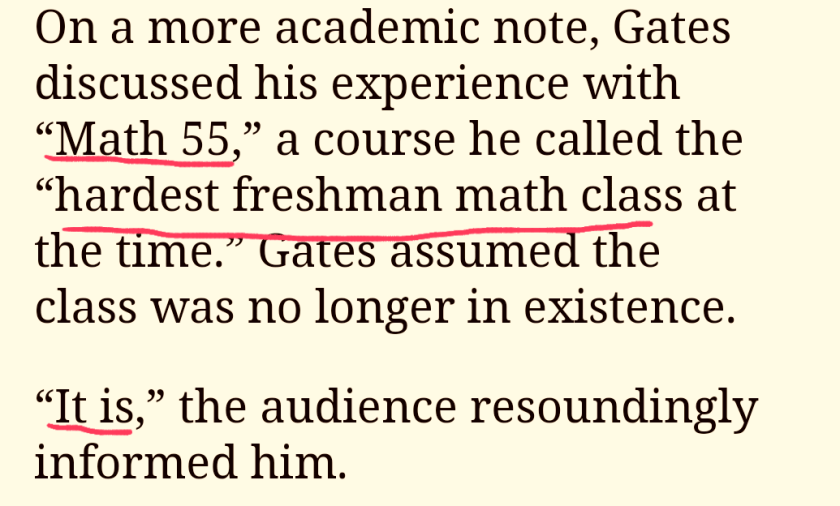
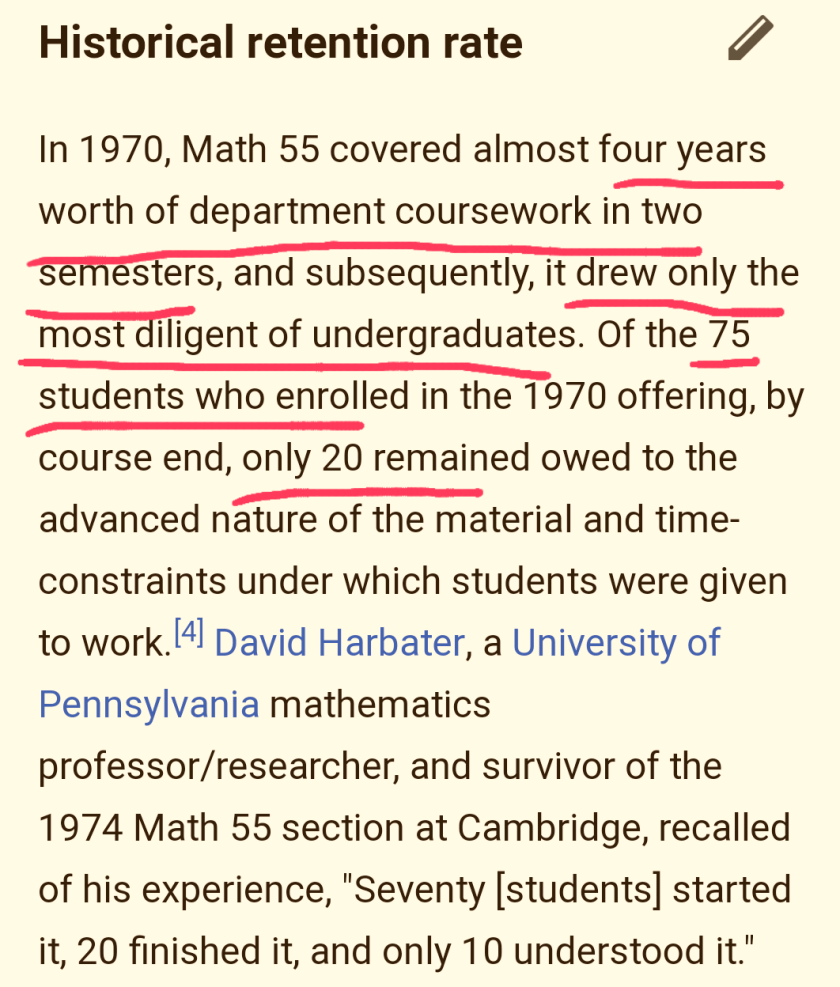
Math55 Syllabus:
Though Math 55 bore the official title “Honors Advanced Calculus and Linear Algebra”, advanced topics in complex analysis, point set topology, group theory, and/or differential geometry could be covered in depth at the discretion of the instructor, in addition to single and multivariable real analysis and abstract linear algebra. In 1970, for example, students studied thedifferential geometryofBanach…
View original post 88 more words
After 40 years of learning Abstract Algebra (aka Modern Math yet it is a 200-year-old Math since 19CE Galois invented Group Theory), through the axioms and theorems in math textbooks and lectures, then there is an Eureka “AHA!” revelation when one studies later the “Category Theory” (aka “Abstract Nonsense”) invented only in 1950s by 2 Harvard professors.
A good Abstract Math teacher is best to be a “non-mathematician” , who would be able to use ordinary common-sense concrete examples to explain the abstract concepts: …
Let me explain my points with the 4 Pillars of Abstract Algebra :
$latex boxed {text {(1) Field (2) Ring (3) Group (4) Vector Space}}&fg=aa0000&s=3$
Note: the above “1-2-3 & 4″ sequence is a natural intuitive learning sequence, but the didactical / pedagogical sequence is “3-2-1 & 4″, that explains why most students could not grasp the philosophical essence of Abstract Algebra…
View original post 383 more words
Just updated the book review on Munkres’ Topology book.
This book is the best introductory book on Topology, an upper undergraduate/graduate course taken in university. I have written a short book review on it.
Excerpt:
Book Review: Topology
Book’s Author: James R. Munkres
Title: Topology
Prentice Hall, Second Edition, 2000
It is often said that one must not judge a book by its cover. The book with a plain cover, simply titled “Topology”, is truly a rare gem and in a class of its own among Topology books.
One striking aspect of the book is that it is almost entirely self-contained. As stated in the preface, there are no formal subject matter prerequisites for studying most of the book. The author begins with a chapter on Set Theory and Logic which covers necessary concepts like DeMorgan’s laws, Countable and Uncountable Sets, and the Axiom of Choice.
The first part of the book is on General…
View original post 940 more words
This petition is important to save future lives. The traffic rules should be machine controlled, i.e. clearly dictated by traffic lights whether to turn or not. In this way, there will be less error due to human judgement.
Quote: “Two accidents involving fatalities this week have prompted this petition. Roads have been widened significantly in recent years, with new lanes added and as such it is difficult to have field of vision of so many lanes, pedestrians, mobility devices, and fast moving oncoming cars all at once to make an informed and safe judgement.
Requesting LTA to determine if it is still safe to keep to discretionary turning on green given the growth in sizes of junctions (such as the Commonwealth Ave West/Clementi Road and Upper Bukit Timah/Jln Anak Bukit junctions) and to work on improving the safety of all road users.
Thank you”
“Form” : Function with special properties – eg.
1. Non-Euclidean Geometry
1.1 Hyperbolic Plane : is the Upper-Half in Complex plane H (positive imaginary part) where :
 1.2 Group of Non-Euclidean Motions:
$latex f: H rightarrow H$
View original post 741 more words
欧氏几何: 第5公理 : 直线上过一点, 只有 n=1 条平行线
非欧几何:
https://www.technotification.com/2018/04/programming-languages-creators.html
Below the 3 hotest Functional Programming language influenced by Lisp:
11. Kotlin(Russia Andrey Breslav)
12. Scala (USA Martin Odersky)
13. Haskell (USA)
14. Clojure (USA Rich Hickey)
Singapore is being mentioned around 4:54. Very nice video. The truth is that the classroom of today is still nearly the same as the classroom of 150 years ago. There needs to be a “Educational Revolution” parallel to that of the Industrial Revolution. Many children cannot fit into the single classroom model, leading to growth in diagnosis of behavioral “problems” such as ADHD in developed nations.
Americans who are tired of “Common Core” may want to check out Singapore Math for their kids, which is highly acclaimed in the educational realm.
Source: Channel News Asia
Aarushi Maheshwari solved the famous “Cheryl’s Birthday Problem” when she was only 9. She is also a chess champion and can play blindfold chess.
Watch the video below to learn more!
Also read our previous post on The Most Accomplished 10-Year-Old (Gifted pupil).
For those who want to learn more about Olympiad Math and International Chess, check out the previous two links. Math and Chess are two of the most intellectually challenging activities that can develop the intelligence of kids.
PDE: Separation of Variables
1) Let 
2) Note that 


3) Rearrange the equation such that LHS is a function of 

4) Thus, LHS=RHS=some constant 
5) Solve the two separate ODEs.
Wave Equation


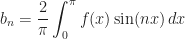
Solution of Wave Equation (with Fourier sine coefficients)

d’Alembert’s solution of Wave Equation
Heat Equation


Solution of Heat Equation


As soon as you start your freshman year in the university, you’ll be faced with countless challenges. Getting accepted into college is an accomplishment, but it is only one of the many steps you’ll need to take in order to succeed.
The good news is: there are habits you can develop and continue to practice in preparation for the challenges of college life.
But first: Before you can develop good habits that will serve you during your college years, it is essential that you establish a strong foundation for success in advance.
The best way to achieve your goals in college is to prepare for college way before you enter the university. While in high school, you can get help from the experts who can help you make smarter decisions about your higher education plans.
By working with college application consultants, you can get expert help every step of the way, including:
Once you find the right college for you, college goals such as developing good habits become easier to achieve.
It’s important for you to develop good habits early on to have a successful college experience. As an incoming freshman, here are five good habits you should develop.
When you’re so accustomed to high school life, it may become hard for you to really visualize what college life will be like. The independence needed to cope with different class requirements and strictly following your personal study schedule are some of the things you need to consider.
College is a process of preparing for your future career. You should make it a habit to set priorities, and create and follow a schedule to manage your school workload. Make a list of your priorities from the most urgent projects to those that are due later.
This way, you can tackle them one at a time and reduce stress arising from the pressure of wanting to finish them all at once.
You can also follow these valuable tips on how to adjust to college life.
Don’t show up in class just to get your attendance checked. Involve yourself by participating in class discussions.
When you go to college, large lecture halls may appear intimidating to you. Practice the habit of engaging yourself during lectures. This will help you get a better grasp of learning. If there’s a vacant seat in front, occupy it.
Grab the opportunity to sit close to the professor for you to feel more present. You shouldn’t take part just because you want to dominate discussions or to help you get a better grade. Choose to speak out for the sake of engaging yourself.
Foster relationships with professors. A close mentoring relationship with a professor is advantageous as he or she can provide you some guidance as you go about your college education.
When you get into college, be on the lookout for opportunities. Take some challenging classes to expose yourself to new fields. Be open to new things. The world is too big for you to confine yourself to the things you already know.
Branch out and try everything you can. The more you explore your interests, the earlier you’ll discover your college major. Develop the habit of constantly challenging yourself; it will teach you about the value of hard work and discipline.
In connection to the third tip, pick activities that’ll advance your knowledge and experience. Make it a habit to save great pieces or project works you’ve done during high school. These will work to your advantage the moment you apply for college.
Your portfolio will serve as a proof of how adept you are in the course you’re applying for. This will also increase your chances of getting in a university that you want.
Each student has different learning abilities. While some are visual learners, others may be auditory learners. It’s important to consider what type of learner you are.
Knowing how you learn will be beneficial to you once you start college. There will be no more spoon-feeding in college so you have to be quicker in learning new things. If you know that you are an auditory learner, grab the chance to sit in front to hear each lecture clearly.
To sum up
Every student is unique, so there really is no one-size-fits-all formula for achieving college success. But by getting expert help in finding the right college and excelling in your chosen institution by building good habits, college can be one of the best years of your life.
AUTHOR BIO
Brian Giroux is an experienced college admissions advisor and co-founder of Capital College Consulting. Brian is a Professional Member of Independent Educational Consulting Association (IECA). Brian has worked with students from over 30 countries to help provide guidance through the US admissions process.
Brian’s experience includes 18+ years in education serving multiple roles as educator, athletic director, and college admissions consultant.
Pan Annan is probably the most accomplished 10 Year-old student in Singapore, or perhaps even in the world.
Her list of accomplishments:
Any one of the above accomplishments is enough to stand out among 10 year-olds, and she has all of them! The most amazing is how she manages her time. I am familiar with Chinese Orchestra trainings, that alone is enough to account for quite a significant amount of time after school, since there is group practicing, sectional practicing, not to mention practicing alone. Possibly Chinese Orchestra alone adds up to a minimum of 5-10 hours per week.
Also, the workload from RGPS GEP is very demanding. Her schedule and timetable can only be achieved with 100% efficiency and focus. (She even does her homework in the car to maximize efficiency and save time.)
Parents may want to read my previous blog post on Book by Truly Gifted Kid (GEP Book), where a similarly prodigious child genius Moshe Kai Cavalin outlines his secret, with input from his mom on parenting. Also, as you can see, the standard for GEP students nowadays is very high, you may read Recommended Books for GEP Selection Test and How to Get Into GEP for some tips on how to do some foundational preparation for the GEP.
Sincerely all the best to Pan Annan for achieving her dreams of being a gymnastic champion.
Read more at: Channel News Asia
Malthus Model


Solution to D.E.:
where 
Logistic Equation
Logistic Case 1: Increasing population (
The second expression can be derived from the first: divide by 
Logistic Case 2: Decreasing population (
Logistic Case 3: Constant population (
Harvesting
Basic Harvesting Model:

Maximum harvest rate without causing extinction: 


Extinction Time:
Laplace transform of
Tip: Use this equation when the questions contains the words “show from the definition”.
Inverse transform of
Linearity
If 


Tip: Use this when doing Laplace Transform of a function with an exponential factor 

If 
Tip: Frequently, we use the reverse direction
Delta function


Two properties of delta function
for 
Tip: Use delta function when the keywords “suddenly”, “burst”, etc. appear.
Unit step function
For 
Tip: Use unit step function for questions that require a force to “switch on / switch off” at certain times.
Last call to redeem the offer by PayLah! $5 just for downloading the app is pretty worth it.
Hey! You can get S$5 when you register for PayLah! with my Referral Code WILDOF087 (last 3 digits are numbers zero-eight-seven) by 31 December 2018. Download PayLah! from http://www.dbs.com.sg/paylah now and enter the above Code during sign-up before this offer is fully redeemed. T&Cs apply.–
PayLah! can be downloaded from Apple Store or Android store (Singapore). Getting your $5 should be instantaneous. Be sure to redeem it today since there is a cap of 40000 people who can redeem. (The offer is still available now, but who knows next week it may be fully redeemed.)
For those participating in lucky draws, often it requires you to SMS the NTUC Fairprice Receipt Number. However, the latest version of NTUC receipts, upon closer inspection contains many numbers but none that are explicitly specified as “receipt number”.

It is extremely confusing to find the NTUC Receipt Number (out of the many numbers in the receipt). After some “research”, I come to the conclusion is that the receipt number is the same as the transaction number, labelled by Tr!
How I came to this conclusion: Look at the image above. The receipt number is 65539, the transaction number is Tr: 65539. It matches, right? Hence, it is logical that the NTUC Fairprice receipt number is precisely the Tr (transaction) number.
Similarly, I believe that this logic applies to Giant, Sheng Siong, Cold Storage receipt numbers too, it should be the transaction number, in the event that the receipt number is not clearly stated in the receipt. Same for NTUC Finest, NTUC Extra and all other types of NTUC Fairprice receipts.
I hope this helps those who are desperately searching for the receipt number!
Sign up here!
Changi points are quite useful, can be used to redeem the following:
URL to sign up and get 100 points instantly: Changi Points
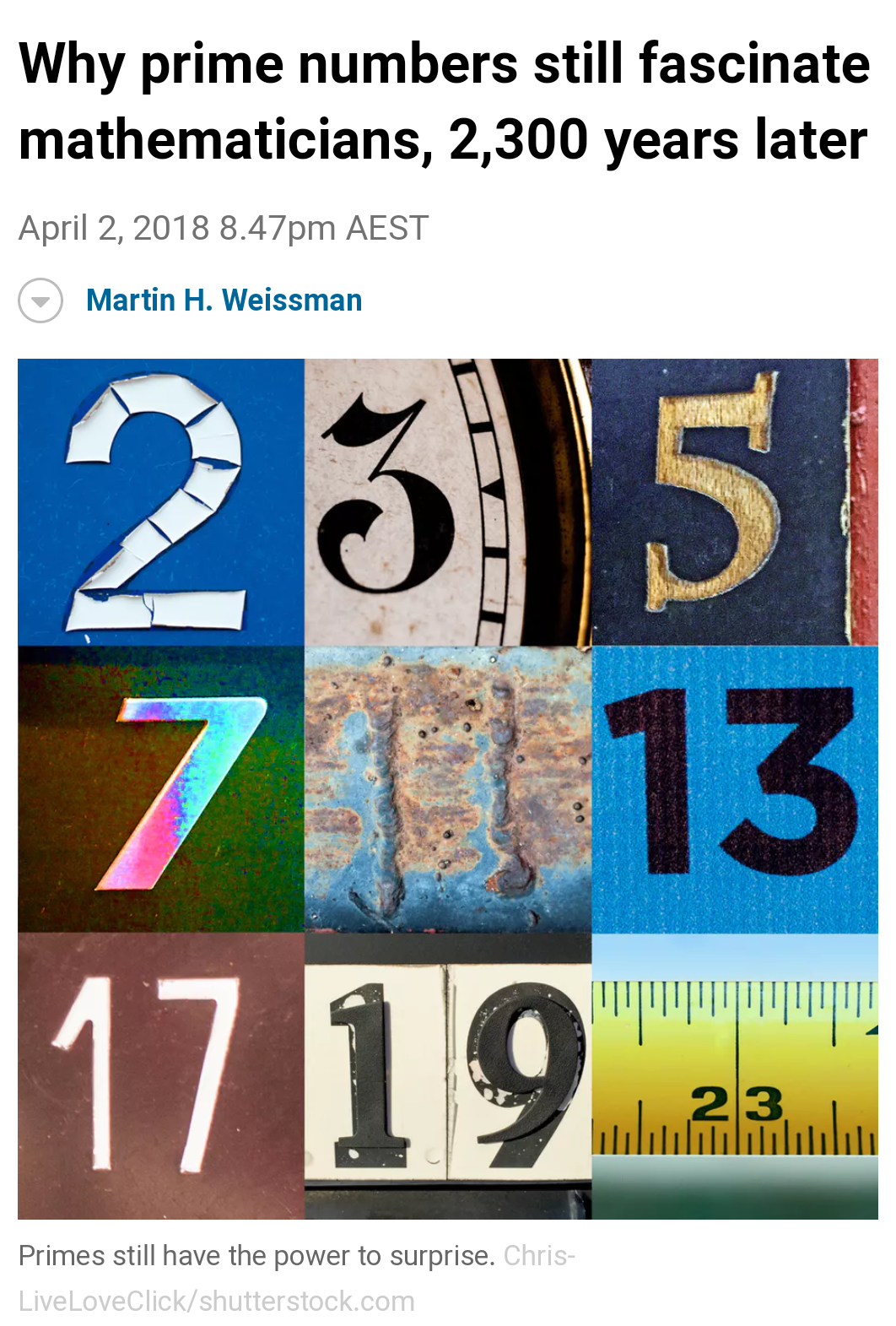
Prime Numbers since Euclid 2300 years ago remains a mystery today…
Riemann’s Hypothesis is the Top Conjecture Unsolved in 21st Century.
https://theconversation.com/why-prime-numbers-still-fascinate-mathematicians-2-300-years-later-92484
Hey! You can get S$5 when you register for PayLah! with my Referral Code WILDOF087 (last 3 digits are numbers zero-eight-seven) by 31 December 2018. Download PayLah! from http://www.dbs.com.sg/paylah now and enter the above Code during sign-up before this offer is fully redeemed. T&Cs apply.–
PayLah! can be downloaded from Apple Store or Android store (Singapore). Getting your $5 should be instantaneous. Be sure to redeem it today since there is a cap of 40000 people who can redeem. (The offer is still available now, but who knows next week it may be fully redeemed.)
Quite worrying. Based on my personal experience and online research, food in Singapore cannot be left in room temperature for more than 4 hours, due to our hot and humid temperature. To be safe, food needs to be put in the refrigerator as soon as possible if not consumed immediately.
Hope all affected students get well soon.
Source: 110 Nanyang Girls’ High students fall sick during boarding school programme
Read more at https://www.channelnewsasia.com/news/singapore/110-nanyang-girls-high-students-sick-boarding-school-programme-10097196
Homogenous D.E.

Solve the Characteristic Equation: 
Case 1) Two real roots 
Case 2) Real double root 
Case 3) Complex Conjugate root 

Non-homogenous D.E.
General solution of non-homogenous D.E.: 


Method of Undetermined Coefficients (Guess and try method)

Only works if 
Polynomial: Try 

Exponential (


Trigonometric (


Try 
Method of variation of parameters
[Step 1)] Solve the homogenous D.E. 
Get solution of the form 
[Step 2)]
Let 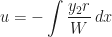


Particular solution: 
General solution: 
Forced Oscillations
Let 


where 

If 
where 
At resonance (when 
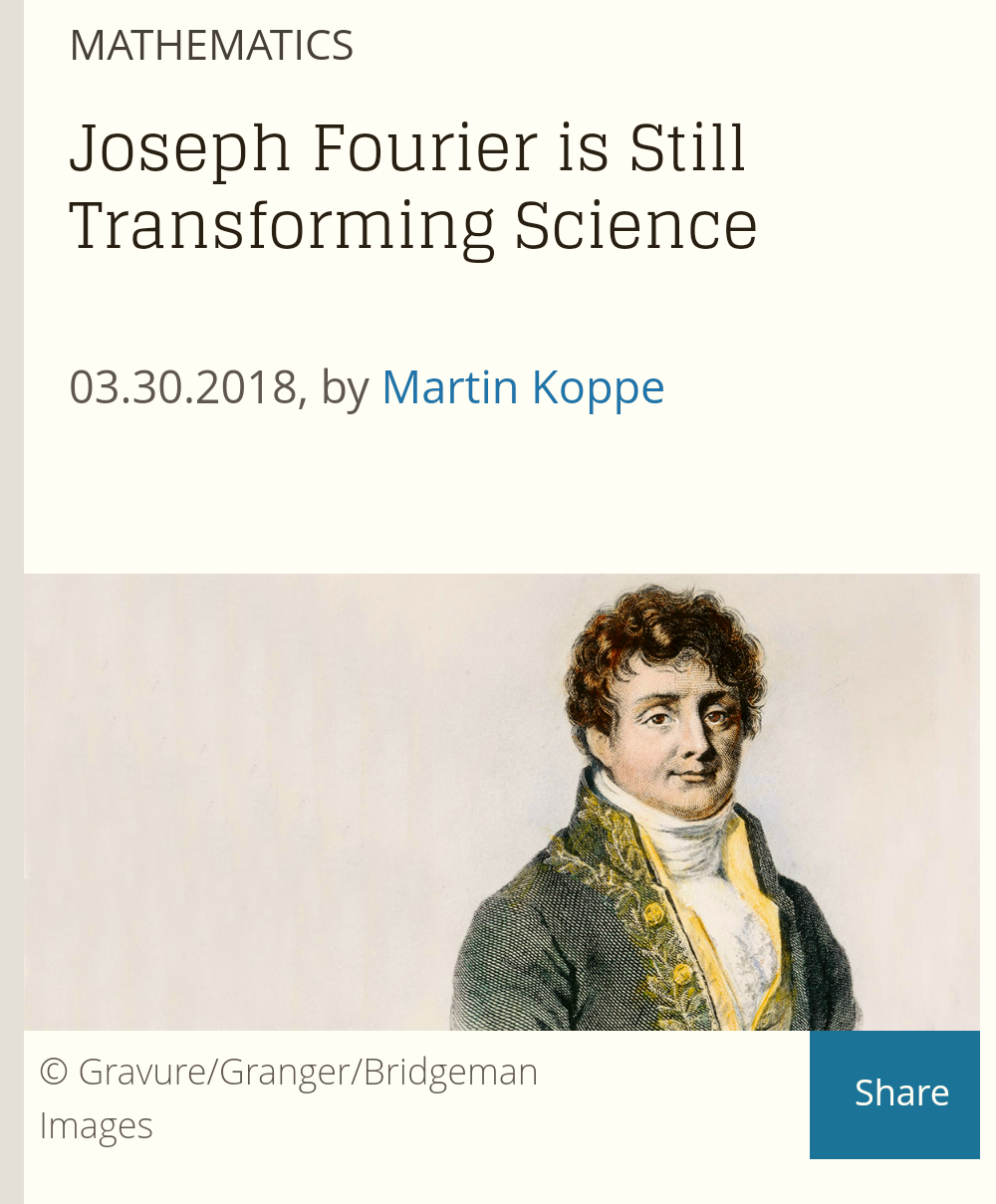 Key Words: 250 years anniversary
https://news.cnrs.fr/articles/joseph-fourier-is-still-transforming-science


![\displaystyle y(t,x)=\frac{1}{2}[f(x+ct)+f(x-ct)].](https://s0.wp.com/latex.php?latex=%5Cdisplaystyle+y%28t%2Cx%29%3D%5Cfrac%7B1%7D%7B2%7D%5Bf%28x%2Bct%29%2Bf%28x-ct%29%5D.&bg=ffffff&fg=1a1a1a&s=0&c=20201002)


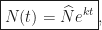


![\displaystyle L^{-1}[F(s-c)]=e^{ct}f(t).](https://s0.wp.com/latex.php?latex=%5Cdisplaystyle+L%5E%7B-1%7D%5BF%28s-c%29%5D%3De%5E%7Bct%7Df%28t%29.&bg=ffffff&fg=1a1a1a&s=0&c=20201002)

![\displaystyle L^{-1}[e^{-as}F(s)]=f(t-a)u(t-a).](https://s0.wp.com/latex.php?latex=%5Cdisplaystyle+L%5E%7B-1%7D%5Be%5E%7B-as%7DF%28s%29%5D%3Df%28t-a%29u%28t-a%29.&bg=ffffff&fg=1a1a1a&s=0&c=20201002)
![\boxed{L[\delta(t-a)]=e^{-as}}](https://s0.wp.com/latex.php?latex=%5Cboxed%7BL%5B%5Cdelta%28t-a%29%5D%3De%5E%7B-as%7D%7D&bg=ffffff&fg=1a1a1a&s=0&c=20201002)


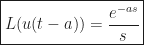





 Mathtuition88