(Continued from https://mathtuition88.com/2015/06/25/the-groupoid-properties-of-operation-on-path-homotopy-classes-proof/)
Earlier we have proved the properties (2) Right and left identities, (3) Inverse, leaving us with (1) Associativity to prove.
For this proof, it will be convenient to describe the product f*g in the language of positive linear maps.
First we will need to define what is a positive linear map. We will elaborate more on this since Munkres’ books only discusses it briefly.
Definition: If [a,b] and [c,d] are two intervals in  , there is a unique map
 ![p:[a,b]\to [c.d]](https://s0.wp.com/latex.php?latex=p%3A%5Ba%2Cb%5D%5Cto+%5Bc.d%5D&bg=ffffff&fg=1a1a1a&s=0&c=20201002) of the form p(x)=mx+k that maps a to c and b to d. This is called the positive linear map of [a,b] to [c,d] because its graph is a straight line with positive slope.
of the form p(x)=mx+k that maps a to c and b to d. This is called the positive linear map of [a,b] to [c,d] because its graph is a straight line with positive slope.
Why is it a positive slope? (Not mentioned in the book) It turns out to be because we have:
p(a) = ma+k=c
p(b) = mb+k=d
Hence, d-c = mb-ma = m(b-a)
Thus, m=(d-c)/(b-a), which is positive since d-c and b-a are all positive quantities.
Note that the inverse of a positive linear map is also a positive linear map, and the composite of two such maps is also a positive linear map.
Now, we can show that the product f*g can be described as follows: On [0,1/2], it is the positive linear map of [0,1/2] to [0,1], followed by f; and on [1/2,1] it equals the positive linear map of [1/2,1] to [0,1], followed by g.
Let’s see why this is true. The positive linear map of [0,1/2] to [0,1] is p(x)=2x. fp(x) = f(2x).
The positive linear map of [1/2,1] to [0,1] is p(x)=2x-1. gp(x)=g(2x-1).
If we look back at the earlier definition of f*g, that is precisely it!
Now, given paths, f, g, and h in X, the products f*(g*h) and (f*g)*h are defined if and only if f(1)=g(0) and g(1)=h(0), i.e. the end point of f = start point of g, and the end point of g = start point of h. If we assume that these two conditions hold, we can also define a triple product of the paths f, g, and h as follows:
Choose points a and b of I so that 0<a<b<1. Define a path  in X as follows: On [0,a] it equals the positive linear map of [0,a] to I=[0,1] followed by f; on [a,b] it equals the positive linear map of [a,b] to I followed by g; on [b,1] it equals the positive linear map of [b,1] to I followed by h. This path depends on the choice of the values of a and b, but its path-homotopy class turns out to be independent of a and b.
We can show that if c and d are another pair of points of I with 0<c<d<1, then  is path homotopic to .
Let  be the map whose graph is pictured in Figure 51.9 (taken from Munkre’s Book)
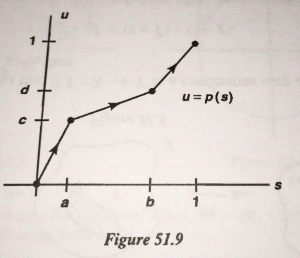
On the intervals [0,a], [a,b], [b,1], it equals the positive linear maps of these intervals onto [0,c],[c,d],[d,1] respectively. It follows that  . Let’s see why this is so.
On [0,a]  is the positive linear map of [0,a] to [0,c], followed by the positive linear map of [0,c] to I, followed by f. This equals the positive linear map of [0,a] to I, followed by f, which is precisely . Similar logic holds for the intervals [a,b] and [b,1].
 is a path in I from 0 to 1, and so is the identity map
  . Since I is convex, there is a path homotopy P in I between p and i. Then,
  is a path homotopy in X between and
  .
.
Now the question many will be asking is: What has this got to do with associativity. According to the author Munkres, “a great deal”! We check that the product  is exactly the triple product in the case where
  and
and  .
.
By definition,
![(g*h)(s)=\begin{cases} g(2s)\ &\text{for }s\in [0,\frac{1}{2}]\\ h(2s-1)\ &\text{for }s\in [\frac{1}{2},1] \end{cases}](https://s0.wp.com/latex.php?latex=%28g%2Ah%29%28s%29%3D%5Cbegin%7Bcases%7D++++g%282s%29%5C+%26%5Ctext%7Bfor+%7Ds%5Cin+%5B0%2C%5Cfrac%7B1%7D%7B2%7D%5D%5C%5C++++h%282s-1%29%5C+%26%5Ctext%7Bfor+%7Ds%5Cin+%5B%5Cfrac%7B1%7D%7B2%7D%2C1%5D++++%5Cend%7Bcases%7D&bg=ffffff&fg=1a1a1a&s=0&c=20201002)
Thus, ![f*(g*h)(s)=\begin{cases} f(2s)\ &\text{for }s\in [0,\frac{1}{2}]\\ (g*h)(2s-1)\ &\text{for }s\in [\frac{1}{2},1] \end{cases} =\begin{cases} f(2s)\ &\text{for }s\in [0,\frac{1}{2}]\\ g(4s-2)\ &\text{for }s\in [\frac{1}{2},\frac{3}{4}]\\ h(4s-3) &\text{for }s\in [\frac{3}{4},1] \end{cases}](https://s0.wp.com/latex.php?latex=f%2A%28g%2Ah%29%28s%29%3D%5Cbegin%7Bcases%7D++++f%282s%29%5C+%26%5Ctext%7Bfor+%7Ds%5Cin+%5B0%2C%5Cfrac%7B1%7D%7B2%7D%5D%5C%5C++++%28g%2Ah%29%282s-1%29%5C+%26%5Ctext%7Bfor+%7Ds%5Cin+%5B%5Cfrac%7B1%7D%7B2%7D%2C1%5D++++%5Cend%7Bcases%7D++++%3D%5Cbegin%7Bcases%7D++++f%282s%29%5C+%26%5Ctext%7Bfor+%7Ds%5Cin+%5B0%2C%5Cfrac%7B1%7D%7B2%7D%5D%5C%5C++++g%284s-2%29%5C+%26%5Ctext%7Bfor+%7Ds%5Cin+%5B%5Cfrac%7B1%7D%7B2%7D%2C%5Cfrac%7B3%7D%7B4%7D%5D%5C%5C++++h%284s-3%29+%26%5Ctext%7Bfor+%7Ds%5Cin+%5B%5Cfrac%7B3%7D%7B4%7D%2C1%5D++++%5Cend%7Bcases%7D++++&bg=ffffff&fg=1a1a1a&s=0&c=20201002)
We can also check in a very similar way that  when c=1/4 and d=1/2. Thus, the these two products are path homotopic, and we have finally proven the associativity of *.
Reference:


Topology (2nd Economy Edition)


![\int_C f(z)\ dz=\int_a^b f[z(t)]z'(t)\,dt](https://s0.wp.com/latex.php?latex=%5Cint_C+f%28z%29%5C+dz%3D%5Cint_a%5Eb+f%5Bz%28t%29%5Dz%27%28t%29%5C%2Cdt&bg=ffffff&fg=1a1a1a&s=0&c=20201002)


 be an
be an  -algebra. Define an operation
  by
by  . This algebra
  is called the opposite algebra to
  . We verify that it forms an


 :
:  ,
,  .
. , where
  . Then
  for some
  .
.  ,
,  , so
, so  is in the center
  .
. matrices, which is a n by n matrix with (i,j) entry 1, and rest zero.
 . We can write
  . Our key step is compute
  . Thus we may conclude that

 , we can conclude that
  for all
  , i.e. all diagonal entries are equal.
 gives us
  for all
  .
. for some
  .
. , we conclude that
  for all
  in
in  has to be in the center
  .
. be a convex set.
 if
if  .
. if and only if
  is an interior point of
  . This
  is often known as a Gauge or Minkowski functional.
 , so
, so  . This is the easy part. The converse holds here, if
  , then
  .
. such that for all
  ,
,  for some
  .
. . Combining with the subadditive property of the gauge, we have
  . Rearranging, we get
  . By considering the various possibilities of the sign of
  , and using the positive homogeneity of the gauge, we can obtain a contradiction. For example, if
  ,
,  . Since
  as
as  , this implies
  , a contradiction.
 there exists
  for all
  for all
  ,
,  , which leads to
  and
and  .
.
 onto the upper half plane. Reference book is
  . This is easily accomplished by
  . The factor
  is responsible for the rotation (90 degree anticlockwise), while the factor
  is responsible for the scaling.
 . Consider line
  . This line will be mapped onto the ray (from the origin) with argument
  . Since
  that “sweeps” across and covers the entire upper half plane.
 will do the job for mapping the vertical strip
  onto the upper half plane
  .
. , the n by n matrix algebra over
  is a division algebra, then
  is simple.
 , then
  .
. .
. . Therefore
  .
. , thus
  . Similarly
  . Thus
  is indeed an ideal of
  , then
  for some
  if
if  , and 0 otherwise (zero matrix).
 can be taken to be
  . We can check that
  .
. . Let
. Let  . We write
  . For any
  ,
,
 . Therefore
  . What we are actually doing here is first pick an arbitrary matrix
  . Then, we do the “shifting” process to show that any (p,q) entry in
  . Let
. Let  . We have
  for all
  . We compute that
 . We will illustrate what we are doing here by an example in the 2 by 2 case. Let us have
  . Since
  ,
,  ,
,  ,
,  are all in
  ,
,  ,
,  , all of which are still in the ideal

 under the transformation
  .
. )
) ,
,  .
. ,
,  . From the equation
  , we can conclude that
  .
. , which is the equation of a circle centered at
  with radius
  . When
  , the equation of the circle is
  . As
. As  (where
  and
and  are open sets) is an analytic function such that there exists another analytic function
  , satisfying
  and
and  .
.



 ,
,  be holomorphic inside and on a simple closed contour
  on
on  and
and  have the same number of zeroes (counting multiplicities) inside
  in the annulus
  .
. be the unit circle
  . We have
 has 2 zeroes in
  be the circle
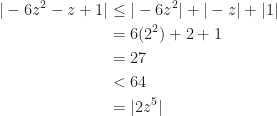
 . Chose
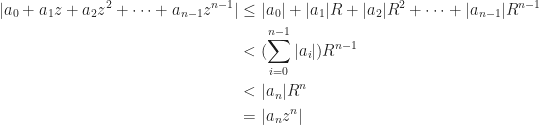
  sufficiently large so that on the circle
  ,
,
 has
has  roots inside the circle,
  , where
  , where
  ,
,  and
and  .
. in
in  is
is ![Q(\sqrt[p]{2},\omega)](https://s0.wp.com/latex.php?latex=Q%28%5Csqrt%5Bp%5D%7B2%7D%2C%5Comega%29&bg=ffffff&fg=1a1a1a&s=0&c=20201002) , where
, where  is a primitive p-th root of unity. The roots of
 ![\sqrt[p]2, \sqrt[p]2\omega, \sqrt[p]2\omega^2, \dots, \sqrt[p]2\omega^{p-1}](https://s0.wp.com/latex.php?latex=%5Csqrt%5Bp%5D2%2C+%5Csqrt%5Bp%5D2%5Comega%2C+%5Csqrt%5Bp%5D2%5Comega%5E2%2C+%5Cdots%2C+%5Csqrt%5Bp%5D2%5Comega%5E%7Bp-1%7D&bg=ffffff&fg=1a1a1a&s=0&c=20201002) .
.![\sqrt[p]2](https://s0.wp.com/latex.php?latex=%5Csqrt%5Bp%5D2&bg=ffffff&fg=1a1a1a&s=0&c=20201002) and
and ![\omega=\frac{\sqrt[p]2\omega^2}{\sqrt[p]2\omega}](https://s0.wp.com/latex.php?latex=%5Comega%3D%5Cfrac%7B%5Csqrt%5Bp%5D2%5Comega%5E2%7D%7B%5Csqrt%5Bp%5D2%5Comega%7D&bg=ffffff&fg=1a1a1a&s=0&c=20201002) . Thus
. Thus ![\mathbb{Q}(\sqrt[p]2,\omega)\subseteq K](https://s0.wp.com/latex.php?latex=%5Cmathbb%7BQ%7D%28%5Csqrt%5Bp%5D2%2C%5Comega%29%5Csubseteq+K&bg=ffffff&fg=1a1a1a&s=0&c=20201002) .
.![\mathbb{Q}(\sqrt[p]2,\omega)](https://s0.wp.com/latex.php?latex=%5Cmathbb%7BQ%7D%28%5Csqrt%5Bp%5D2%2C%5Comega%29&bg=ffffff&fg=1a1a1a&s=0&c=20201002) contains all the roots of
contains all the roots of ![\mathbb{Q}(\sqrt[p]2, \omega)](https://s0.wp.com/latex.php?latex=%5Cmathbb%7BQ%7D%28%5Csqrt%5Bp%5D2%2C+%5Comega%29&bg=ffffff&fg=1a1a1a&s=0&c=20201002) . Thus
. Thus ![K\subseteq\mathbb{Q}(\sqrt[p]2,\omega)](https://s0.wp.com/latex.php?latex=K%5Csubseteq%5Cmathbb%7BQ%7D%28%5Csqrt%5Bp%5D2%2C%5Comega%29&bg=ffffff&fg=1a1a1a&s=0&c=20201002) , since
, since ![K=\mathbb{Q}(\sqrt[p]2, \omega)](https://s0.wp.com/latex.php?latex=K%3D%5Cmathbb%7BQ%7D%28%5Csqrt%5Bp%5D2%2C+%5Comega%29&bg=ffffff&fg=1a1a1a&s=0&c=20201002) .
.![|Gal(K/\mathbb{Q})|=[K:\mathbb{Q}]](https://s0.wp.com/latex.php?latex=%7CGal%28K%2F%5Cmathbb%7BQ%7D%29%7C%3D%5BK%3A%5Cmathbb%7BQ%7D%5D&bg=ffffff&fg=1a1a1a&s=0&c=20201002) . Since
. Since ![[\mathbb{Q}(\sqrt[p]2):\mathbb{Q}]=p](https://s0.wp.com/latex.php?latex=%5B%5Cmathbb%7BQ%7D%28%5Csqrt%5Bp%5D2%29%3A%5Cmathbb%7BQ%7D%5D%3Dp&bg=ffffff&fg=1a1a1a&s=0&c=20201002) (minimal polynomial
(minimal polynomial  ), and
 ![[\mathbb{Q}(\omega):\mathbb{Q}]=p-1](https://s0.wp.com/latex.php?latex=%5B%5Cmathbb%7BQ%7D%28%5Comega%29%3A%5Cmathbb%7BQ%7D%5D%3Dp-1&bg=ffffff&fg=1a1a1a&s=0&c=20201002) (minimal polynomial the cyclotomic polynomial
(minimal polynomial the cyclotomic polynomial  ), thus
  . Here we have used the lemma that suppose
 ![[F(\alpha):F]=m](https://s0.wp.com/latex.php?latex=%5BF%28%5Calpha%29%3AF%5D%3Dm&bg=ffffff&fg=1a1a1a&s=0&c=20201002) and
and ![[F(\beta):F]=n](https://s0.wp.com/latex.php?latex=%5BF%28%5Cbeta%29%3AF%5D%3Dn&bg=ffffff&fg=1a1a1a&s=0&c=20201002) with
with  , then
 ![[F(\alpha,\beta):F]=mn](https://s0.wp.com/latex.php?latex=%5BF%28%5Calpha%2C%5Cbeta%29%3AF%5D%3Dmn&bg=ffffff&fg=1a1a1a&s=0&c=20201002) .
. be an element of the Galois group.
 ![\sigma(\sqrt[p]2)](https://s0.wp.com/latex.php?latex=%5Csigma%28%5Csqrt%5Bp%5D2%29&bg=ffffff&fg=1a1a1a&s=0&c=20201002) can possibly be
can possibly be ![\sqrt[p]2, \sqrt[p]\omega, \dots, \sqrt[p]2\omega^{p-1}](https://s0.wp.com/latex.php?latex=%5Csqrt%5Bp%5D2%2C+%5Csqrt%5Bp%5D%5Comega%2C+%5Cdots%2C+%5Csqrt%5Bp%5D2%5Comega%5E%7Bp-1%7D&bg=ffffff&fg=1a1a1a&s=0&c=20201002) , a total of
, a total of  , a total of
  choices. All these total up to
  elements, which is exactly the size of the Galois group.
 is described by how its elements act on the generators. For a more concrete representation, we can actually prove that the Galois group above is isomorphic to the group of matrices
  , where
  ,
,  . We denote the group of matrices as
  .
. , mapping
  to
to ![\sigma_{a,b}(\sqrt[p]2)=\sqrt[p]2\omega^b](https://s0.wp.com/latex.php?latex=%5Csigma_%7Ba%2Cb%7D%28%5Csqrt%5Bp%5D2%29%3D%5Csqrt%5Bp%5D2%5Comega%5Eb&bg=ffffff&fg=1a1a1a&s=0&c=20201002) ,
,  .
. is bijective. To see it is a homomorphism, we compute
  .
. be a uniformly bounded and equicontinuous sequence of real-valued continuous functions defined on a closed and bounded interval
 ![[a,b]](https://s0.wp.com/latex.php?latex=%5Ba%2Cb%5D&bg=ffffff&fg=1a1a1a&s=0&c=20201002) . Then there exists a subsequence
. Then there exists a subsequence  that converges uniformly.
 for all
  and all
 ![x\in [a,b]](https://s0.wp.com/latex.php?latex=x%5Cin+%5Ba%2Cb%5D&bg=ffffff&fg=1a1a1a&s=0&c=20201002) . The sequence is equicontinous if, for all
. The sequence is equicontinous if, for all  such that
  whenever
  for all functions
  (depending solely on
  ) works for the entire family of functions.
![g:[0,1]\times [0,1]\to [0,1]](https://s0.wp.com/latex.php?latex=g%3A%5B0%2C1%5D%5Ctimes+%5B0%2C1%5D%5Cto+%5B0%2C1%5D&bg=ffffff&fg=1a1a1a&s=0&c=20201002) be a continuous function and let
be a continuous function and let  be a sequence of functions such that
![f:[0,1]\to\mathbb{R}](https://s0.wp.com/latex.php?latex=f%3A%5B0%2C1%5D%5Cto%5Cmathbb%7BR%7D&bg=ffffff&fg=1a1a1a&s=0&c=20201002) such that
such that  for all
 ![x\in [0,1]](https://s0.wp.com/latex.php?latex=x%5Cin+%5B0%2C1%5D&bg=ffffff&fg=1a1a1a&s=0&c=20201002) .
.
 ,
,
 ,
,  .
. and
and  ,
,
 , then whenever
  . Thus the sequence is indeed equicontinuous.
 .
.


![\mathbb{Z}[i]](https://s0.wp.com/latex.php?latex=%5Cmathbb%7BZ%7D%5Bi%5D&bg=ffffff&fg=1a1a1a&s=0&c=20201002) are the set of complex numbers of the form
are the set of complex numbers of the form  , with
  integers. Originally discovered and studied by Gauss, the Gaussian Integers are useful in number theory, for instance they can be used to prove that
 ![\mathbb{Z}[i]/I](https://s0.wp.com/latex.php?latex=%5Cmathbb%7BZ%7D%5Bi%5D%2FI&bg=ffffff&fg=1a1a1a&s=0&c=20201002) is finite.
is finite. for some nonzero
 ![\alpha\in\mathbb{Z}[i]](https://s0.wp.com/latex.php?latex=%5Calpha%5Cin%5Cmathbb%7BZ%7D%5Bi%5D&bg=ffffff&fg=1a1a1a&s=0&c=20201002) . Let
. Let ![\beta\in\mathbb{Z}[i]](https://s0.wp.com/latex.php?latex=%5Cbeta%5Cin%5Cmathbb%7BZ%7D%5Bi%5D&bg=ffffff&fg=1a1a1a&s=0&c=20201002) .
. with
with  or
or  . We also note that
  .
.![\begin{aligned}\mathbb{Z}[i]/I&=\{\beta+I\mid\beta\in\mathbb{Z}[i]\}\\ &=\{r+I\mid r\in\mathbb{Z}[i],N(r)<N(\alpha)\} \end{aligned}](https://s0.wp.com/latex.php?latex=%5Cbegin%7Baligned%7D%5Cmathbb%7BZ%7D%5Bi%5D%2FI%26%3D%5C%7B%5Cbeta%2BI%5Cmid%5Cbeta%5Cin%5Cmathbb%7BZ%7D%5Bi%5D%5C%7D%5C%5C++++%26%3D%5C%7Br%2BI%5Cmid+r%5Cin%5Cmathbb%7BZ%7D%5Bi%5D%2CN%28r%29%3CN%28%5Calpha%29%5C%7D++++%5Cend%7Baligned%7D&bg=ffffff&fg=1a1a1a&s=0&c=20201002) .
.![r\in\mathbb{Z}[i]](https://s0.wp.com/latex.php?latex=r%5Cin%5Cmathbb%7BZ%7D%5Bi%5D&bg=ffffff&fg=1a1a1a&s=0&c=20201002) with
with  of an arbitrary collection of path-connected spaces
  there are isomorphisms
  for all
  is the same thing as a collection of maps
  . Taking
  to be
to be  and
and  gives the result.
 , which is the result for a product of two spaces. The general result then follows by induction.
 ,
, ![\psi([f])=([f_1],[f_2])](https://s0.wp.com/latex.php?latex=%5Cpsi%28%5Bf%5D%29%3D%28%5Bf_1%5D%2C%5Bf_2%5D%29&bg=ffffff&fg=1a1a1a&s=0&c=20201002) .
. ,
,  ,
,  where
where  are the projection maps.
![\psi ([f]+[g])=\psi([f])+\psi([g])](https://s0.wp.com/latex.php?latex=%5Cpsi+%28%5Bf%5D%2B%5Bg%5D%29%3D%5Cpsi%28%5Bf%5D%29%2B%5Cpsi%28%5Bg%5D%29&bg=ffffff&fg=1a1a1a&s=0&c=20201002) , thus
, thus  is a homomorphism.
 ,
, ![\phi([g_1],[g_2])=[g]](https://s0.wp.com/latex.php?latex=%5Cphi%28%5Bg_1%5D%2C%5Bg_2%5D%29%3D%5Bg%5D&bg=ffffff&fg=1a1a1a&s=0&c=20201002) where
where  ,
,  .
.

 and
and  are increasing functions on [0,1]. Thus by Jordan’s Theorem,
  is a function of bounded variation, but it is certainly not continuous on [0,1]!
 ), real projective plane (
 ), and the Klein bottle (
 , for
, for 
 (Here n-Torus refers to the n-dimensional torus, not the Torus with n holes)
 (usual torus with one hole in 2 dimensions)

 . Higher homology groups are zero.


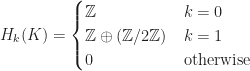
 that is a covering map. Since there are many covering spaces, we will list the universal cover instead.
 is the universal cover of
  is universal cover of real projective plane
  .
.
 and
and  , with
  . Show that
  for all
  .
. , there exists
  such that
  . This is the key “interpolation step”. Once we have this, everything flows smoothly with the help of Holder’s inequality.
 and
and  are Holder conjugates, since
  is easily verified.
 is homotopic to a constant map. Let Y be contractible space and let X be any space. Then, for any maps
  ,
,  .
. , where
  is a constant map. There exists a map
 ![F: Y\times [0,1]\to Y](https://s0.wp.com/latex.php?latex=F%3A+Y%5Ctimes+%5B0%2C1%5D%5Cto+Y&bg=ffffff&fg=1a1a1a&s=0&c=20201002) such that
such that  , for
, for  .
.  for some point
  .
.![G:X\times [0,1]\to Y](https://s0.wp.com/latex.php?latex=G%3AX%5Ctimes+%5B0%2C1%5D%5Cto+Y&bg=ffffff&fg=1a1a1a&s=0&c=20201002) where
where 
 ,
,  ,
,  . Therefore G is cts.
 ,
, .
. . This can be quite tedious.
 (Symmetric Difference is Zero). Show that F is measurable.
 , and
, and  . This in turn (using a lemma that any set with outer measure zero is measurable) implies the measurability of
  and
and  .
. . Using the fact that the collection of measurable sets is a
  is measurable.
 is the union of two measurable sets and thus is measurable.
 and
and  . Prove that if
  in
in  such that if
  , then
  .
.
 as
as  .
. .
. be a finite, non-negative, finitely additive set function on a measurable space
  . Show that
  .
. ,
,  . Then,
 .
. . Then
  implies
  .
. be mutually disjoint sets. Define
  .
. ,
,  .
.  .
.
 be a measure space, and let
 ![f:X\to [0,\infty]](https://s0.wp.com/latex.php?latex=f%3AX%5Cto+%5B0%2C%5Cinfty%5D&bg=ffffff&fg=1a1a1a&s=0&c=20201002) be a measurable function. Define the map
be a measurable function. Define the map ![\lambda:\mathcal{M}\to[0,\infty]](https://s0.wp.com/latex.php?latex=%5Clambda%3A%5Cmathcal%7BM%7D%5Cto%5B0%2C%5Cinfty%5D&bg=ffffff&fg=1a1a1a&s=0&c=20201002) ,
,  , where
  denotes the characteristic function of
  .
. is a measure and that it is absolutely continuous with respect to
 ![g:X\to[0,\infty]](https://s0.wp.com/latex.php?latex=g%3AX%5Cto%5B0%2C%5Cinfty%5D&bg=ffffff&fg=1a1a1a&s=0&c=20201002) , one has
, one has  in
in ![[0,\infty]](https://s0.wp.com/latex.php?latex=%5B0%2C%5Cinfty%5D&bg=ffffff&fg=1a1a1a&s=0&c=20201002) .
. . Let
. Let  be mutually disjoiint measurable sets.
 , then
  a.e., thus
  . Therefore
  .
. ,
,
 be a sequence of simple functions such that
  . Then by the Monotone Convergence Theorem,
  .
. , thus by MCT,
  . Note that
  . Hence,
  , and we are done.
 be a measurable function with
  . Show that for any
  such that for any measurable set
  with
with  , we have
  .
. , we define
  , for all
  .
. .
. . Then for any
  ,
,
 . By Monotone Convergence Theorem,
 .
. .
. .
.
 .
. . Note that the tricky part is that
  is not actually the usual {0,1}, but rather {0,3} (considered as part of
  ). Hence the elements of
  are {0,3}, {1, 4}, {2, 5}, which can be seen to be isomorphic to
  .
. , where
  , defined by
  .
. , then
  , and thus
  .
.
 , and surjectivity is quite clear too.
 are geometrically independent, we can show that the n-simplex is convex (i.e. given any two points, the line connecting them lies in the simplex).
 ,
,  .
. .
.
 be a sequence satisfying
 , and also
  .
. converges uniformly on A (to a function f).
 .
.  such that
  implies
  .
. ,
,
 converges uniformly.
 are of the same sign (e.g. all positive or all negative).
 converges uniformly on [0,1] and thus
  .
. , while the limit for root test is
  . Something special about these two limits is that if the former exists, the latter also exists and they are equal!
 . There exists
  such that
  .
.
 ,
, .
.

 .
. .
. .
.
 .
.![\mathbb{Z}[\sqrt{-2}]](https://s0.wp.com/latex.php?latex=%5Cmathbb%7BZ%7D%5B%5Csqrt%7B-2%7D%5D&bg=ffffff&fg=1a1a1a&s=0&c=20201002) is a
is a ![a, b\in\mathbb{Z}[\sqrt{-2}], b\neq 0](https://s0.wp.com/latex.php?latex=a%2C+b%5Cin%5Cmathbb%7BZ%7D%5B%5Csqrt%7B-2%7D%5D%2C+b%5Cneq+0&bg=ffffff&fg=1a1a1a&s=0&c=20201002) .
.![\exists q, r\in \mathbb{Z}[\sqrt{-2}]](https://s0.wp.com/latex.php?latex=%5Cexists+q%2C+r%5Cin+%5Cmathbb%7BZ%7D%5B%5Csqrt%7B-2%7D%5D&bg=ffffff&fg=1a1a1a&s=0&c=20201002) such that
such that  , with
  .
.![\frac{a}{b}=c_1+c_2 \sqrt{-2} \in \mathbb{Q}[\sqrt{-2}]](https://s0.wp.com/latex.php?latex=%5Cfrac%7Ba%7D%7Bb%7D%3Dc_1%2Bc_2+%5Csqrt%7B-2%7D+%5Cin+%5Cmathbb%7BQ%7D%5B%5Csqrt%7B-2%7D%5D&bg=ffffff&fg=1a1a1a&s=0&c=20201002) . Define
. Define  where
where  are the integers closest to
  respectively.
 , where
  .
. .
. .
.
 satisfying the following:
 for all nonzero
  ,
,  ,
,  such that
  .
.


 ) is an increasing sequence in X, then
 ) is a decreasing sequence in X and if
  , then
 . A decreasing sequence means the opposite, i.e.
  .
. for some n, then both sides of the equation are
  , and inequality holds. Henceforth, we can just consider the case
  for all n.
 and
and  for n>1. Then
  is a disjoint sequence of sets in X such that
 ,
, 
 (since (
 ) is a disjoint sequence of sets)
 , we have that
  for n>1, so the finite series on the right side telescopes to become
 , so that
  is an increasing sequence of sets in X.
![\begin{aligned} \mu (\bigcup_{n=1}^\infty E_n) &=\lim \mu (E_n)\\ &=\lim [\mu (F_1)-\mu (F_n)]\\ &=\mu (F_1) -\lim \mu (F_n) \end{aligned}](https://s0.wp.com/latex.php?latex=%5Cbegin%7Baligned%7D++++%5Cmu+%28%5Cbigcup_%7Bn%3D1%7D%5E%5Cinfty+E_n%29+%26%3D%5Clim+%5Cmu+%28E_n%29%5C%5C++++%26%3D%5Clim+%5B%5Cmu+%28F_1%29-%5Cmu+%28F_n%29%5D%5C%5C++++%26%3D%5Cmu+%28F_1%29+-%5Clim+%5Cmu+%28F_n%29++++%5Cend%7Baligned%7D&bg=ffffff&fg=1a1a1a&s=0&c=20201002)
 , it follows that
 .
.

 and measures should be additive over disjoint sets in X.
 for all
 ) of sets in X, then
 .
. , we say it is finite. More generally, if there exists a sequence
  and such that
  for all n, then we say that
  be definied on X by
  , for all
  . We can see that
  be defined by
  ,
,  if
if  .
.  . This measure is usually called Lebesgue measure (or sometimes Borel measure). It is not a finite measure since
  . But it is
  Mathtuition88