Prime numbers are numbers can only be divided by itself and 1. They are greater than 0. In this text, we will see how to test whether a number is a prime number or not. Furthermore, we will find prime numbers up to N. ( N is a number entered by user. )
For example, 2 can be divided by 2 and 1. So it is a prime number.
Prime numbers: 2, 3, 5, 7, 11 ,13, 17, 19, …
How to test a number ?
“A” is a positive number greater than 1. Let X be a number different than number A and 1. If we can find such a number divide A with remainder 0, A is not a prime number.
X can be preferred prime numbers less than square root of A. This make our program slightly faster.
Here, as opposed to previous entries, we have defined $latex \text{sinc}(t) = \sin(\pi t)/(\pi t)$ (I have had a change of heart). Then the Fourier transform of $latex x(t)$ is
$latex X(f) = \displaystyle{\sum_{n=0}^{N-1}} x(n\Delta t) e^{-i 2\pi f n \Delta t} R(n \Delta t – T_2, n \Delta t – T_1, f – 1/2\Delta t, f + 1/2 \Delta t) \,\Delta t$
Why is this called 2=1, one might ask. Here’s “proof” for something that’s wrong. If you’re able to appreciate these things, try finding the mistake.
a = b
a² = a b
a² + a² = a² + a b
2 a² = a² + a b
2 a² – 2 a b = a² + a b – 2 a b
2 a² – 2 a b = a² – a b
2 ( a² – a b ) = 1 ( a² – a b )
2 = 1
This will be the first and only geeky post, I promise.
Symbols and conventions are both ubiquitous and necessary in our every day life. They enable our culture, on the one hand. On the other hand, they limit our imagination and we need to challenge them sometimes. This is a conflict I find fascinating and would like to base…
I absolutely love this idea. I’ve done two other worksheets with this same idea (click here and click here to see them) and I’ve found it to be really successful. It’s super important to get kids familiar with the hundreds chart. Hopefully children will be so familiar with it that they can make their own hundreds chart on a piece of scratch paper during a test (since kids don’t get a printed hundreds chart on their standardized tests).Click here to see my third 10 more that/10 less than hundreds chart worksheet: hundreds chart- more than- less than OWL
So a friend of mine got a little riled up about this video:
You know, I write and read poetry, and there’s this thing that happens when I talk about poetry, a thing that I know also happens all the time when people who write and read math talk about math. People say, “I don’t like poetry.” Or sometimes, more charitably, “I don’t understand poetry.” Sometimes — if they like me — they think my interest in poetry is adorable. But they don’t want to talk about it with me. And meanwhile, I’m thinking, what do you mean you don’t like poetry? Poetry is a big thing! It’s like saying you don’t like music! Or food! There’s so much of it, I’m sure we could find something you would like.
Well. That’s poetry. Because you know what my reaction was to my friend’s curiosity about that video up there?…
… For most people anyway. Because I missed my video post yesterday, here’s a very short TED talk from Arthur Benjamin on why we should teach statistics before calculus.
Of course, calculus has it’s place and is extremely important, but statistics, probability, and data analysis are so much more useful in everyday life. It would be a tremendous leap forward in promoting scientific literacy in the US. After all, if more people knew what a p-value was or what a confidence interval actually is, society as a whole would be a lot better equipped to understand the numbers that are constantly thrown at us. Reporters might realize that if one study finds a statistically significant result which is unable to be replicated, most likely they made a type I error and the null was probably rejected by random chance error.
This week Year 10 (UK age 14-15) have been exploring different graph types and also transformations and graphs.
For homework I asked them to draw just a small number of graphs by hand but wanted them to check their work and explore further graphs using the Desmos graphing calculator. Early in the week I made sure they could all use Desmos including the use of tables so in an IT room they used the slideshow here and created several graphs of their own.
Once all the students were confident to use Desmos to create various lines and curves I asked them to explore a series of graphs so that this coming week we can discuss transformations and graphs. Using Desmos allowed them to explore many graphs in a short space of time and several students chose to take screenshots and make notes for themselves.
It’s likely that you’ve seen this book reviewed elsewhere. There has been a lot of buzz about it in the kid-lit world. And for good reason. The Boy Who Loved Math: The Improbable LIfe of Paul Erdos is a wonderful biography of a fascinating man. In case you’re ignorant like me, Paul Erdos was a Hungarian mathematician known for his work in number theory and for his eccentric personality.
Deborah Heligman strikes a perfect balance in this book between the story of Erdos’ life and an explanation of the mathematical problems that so intrigued and consumed him.The main focus of the text is on the life of Erdos: from a childhood where he was kicked out of school for not following the rules; to his ability at the age of four to quickly tell a person how old they were in seconds once he knew their birthdate and time; to…
The best MOOC (Massive Open Online Course) model will be free of exams / tests, only assignments / projects, forum discussions.
The 2 current MOOC – Coursera and Udacity – are changing the ‘bottle’ (campus-based to online virtual campus), but not the ‘wine’ (same old teaching methodology through quizzes, tests, exams, which are hated by students who are mostly working adults).
A better example will be the Khan Academy by a MIT graduate Salman Khan teaching school kids in Math and Sciences. Bill Gates and Google founder sponsored him > $6 million. His successful model is “free +no exams“.
The Chinese sage Laozi 老子 said 3,000 years ago “Wu Wei” (无为: Do something with no specific purpose) is actually “You Wei”(有为: With potential great achievement). Attending MOOC with no paper-chasing (and money making)…
Over the past couple of weeks, my 3rd graders have been working with our new set of iPads on a Garden Project. Since our school has put in learning gardens this year, I thought it would be an applicable project for them.
The premise of the problem: The school wanted to build a garden with the most space to plant our vegetables. Each group was given 18 feet of fencing (18 toothpicks) to use as their perimeter. They were to design each garden, record the dimensions, and take a picture to save in their photos. After they designed all possible rectangular gardens, they had to create a presentation in Numbers to show me which garden they wanted to build.
The instruction page looked like this (Since this was our first project, I put the app pic next to each direction to help them along the way):
As you’re probably aware, I’m a big believer in using stories to bring math to life. Especially when you’re teaching tricky concepts, using a story can be the “magic switch” that flicks on the light of understanding. Armed with story-based understanding, students can recall how to perform difficult math processes. And since people naturally like stories and tend to recall them, skills based on story-based understanding really stick in the mind. I’ve seen this over and over in my tutoring.
The kind of story I’m talking about uses an extended-metaphor, and this way of teaching is particularly helpful when you’re teaching algebra. Ask yourself: what would you rather have? Students scratching their heads (or tearing out their hair) to grasp a process taught as a collection of abstract steps? Or students grasping a story and quickly seeing how it guides them in doing the math? I think the answer is…
This will be a quick post because I have a student-posed math problem that I need some time to reason through!
Today, students found the area and perimeter of squares that increase in side length by one each time. Students used a variety of models when building their squares from Minecraft carpets, to Geoboards to graph paper. Here is the completed activity sheet from their work: I then gave them a few minutes to talk to their tablemates about things they notice in their work. Here are the answers they shared as a class and I recorded on the board:
“An even dimension by even dimension = an even area”
“An odd dimension by odd dimension = an odd area”
“The perimeter goes up by 4 every time the square gets bigger”
“The areas are square numbers.”
“The areas go up by odd skip counting: +3, +5, +7…” I was…
This 23-year-old Chinese ‘Rain Man’ Chou Wei has IQ 46, dropped out from Primary school at age 12 because his teachers and classmates discriminated him as an idiot.
This video shows he can mentally do very complex math calculations:
A big part of it — maybe as much as half it — involves nothing more than … being nice.
By that I mean being kind.
By which I mean that if someone looks at you, as a young man did today, shaking his head and saying, “It’s crazy … I don’t know what 3 x 6 is,” I don’t laugh or chuckle or say anything remotely mean or mocking. Instead I just say, “It’s o.k. Look, I tutor people every day who don’t know what 3 x 6 is. Who cares, really? Let’s just try to figure it out … or use a calculator, as long as your teacher doesn’t mind.”
Really. That is a lot of what being a math tutor is about. Being nice. Really nice. Really understanding. And being there to be accepting of people no matter…
In this excerpt from his new book, Our Mathematical Universe, M.I.T. professor Max Tegmark explores the possibility that math does not just describe the universe, but makes the universe
What’s the answer to the ultimate question of life, the universe, and everything? In Douglas Adams’ science-fiction spoof “The Hitchhiker’s Guide to the Galaxy”, the answer was found to be 42; the hardest part turned out to be finding the real question. I find it very appropriate that Douglas Adams joked about 42, because mathematics has played a striking role in our growing understanding of our Universe.
The Higgs Boson was predicted with the same tool as the planet Neptune and the radio wave: with mathematics. Galileo famously stated that our Universe is a “grand book” written in the language of mathematics. So why does our universe seem so mathematical, and what does it mean? In my new book “Our Mathematical Universe”, I argue that it means that our universe isn’t just described by math, but that it is math in the sense that we’re all parts of a giant mathematical object, which in turn is part of a multiverse so huge that it makes the other multiverses debated in recent years seem puny in comparison.
Math, math everywhere! But where’s all this math that we’re going on about? Isn’t math all about numbers? If you look around right now, you can probably spot a few numbers here and there, for example the page numbers in your latest copy of Scientific American, but these are just symbols invented and printed by people, so they can hardly be said to reflect our Universe being mathematical in any deep way.
Have you ever been befuddled by the rules for logs?
More specifically, have you ever looked at this rule:
log (v w) = log v + log w
and thought: Now why in the world is that true?! What exactly is this saying? I know that I, myself, have had that thought. And for me the desire to understand this rule never went away. Till I got it some time ago.
[By the way, keep in mind that the v and the w in the parentheses are multiplying each other, so that v w actually means: v times w]
And the good news is: I think I can explain this rule in a way so that pretty much everyone who knows basic algebra can grasp it.
O.K., first, I knew that this log rule was related to another rule, the exponent rule that says:
This term I shall be giving Cambridge’s course Analysis I, a standard first course in analysis, covering convergence, infinite sums, continuity, differentiation and integration. This post is aimed at people attending that course. I plan to write a few posts as I go along, in which I will attempt to provide further explanations of the new concepts that will be covered, as well as giving advice about how to solve routine problems in the area. (This advice will be heavily influenced by my experience in attempting to teach a computer, about which I have reported elsewhere on this blog.)
I cannot promise to follow the amazing example of Vicky Neale, my predecessor on this course, who posted after every single lecture. However, her posts are still available online, so in some ways you are better off than the people who took Analysis I last year, since you will have…
I’m encountering a sporadic bug over the past few months with the way WordPress renders or displays its LaTeX images on this blog (and occasionally on other WordPress blogs). On most computers, it seems to work fine, but on some computers, the sizes of images are occasionally way off, leading to extremely distorted and fairly unreadable versions of the images appearing in blog posts and comments. A sample screenshot (with accompanying HTML source), supplied to me by a reader, can be found here (in which an image whose dimensions should be 321 x 59 are instead being displayed as 552 x 20). Is anyone else encountering this issue? The problem sometimes can be resolved by refreshing the page, but not always, so it is a bit unclear where the problem is coming from and how one might mitigate it. (If nothing else, I can add it to the bug collection…
We are very proud to present you the new Mathist. It is a real sneak peak into the future, that allows you to easily solve and compute anything you write with a single click!
Here are some examples;
Simplify any expression to speed up problem solving,
Plot graphs,
Evaluate expressions and get approximate values,
Solve equations and inequalities (with visual representation),
Solve definite and indefinite integrals (with visual representation),
Crunch difficult logarithms,
Find derivatives and much more…
You can do all of this with just one button:
Why is this important?
Have you ever worked on a problem, that is easy to understand, but just requires too much number crunching?– So did we!
We understand that learning a million new things every day as a technology or a science student doesn’t leave too much time for crunching math. And yet in most cases you cannot solve…
TheMathist is a very unique social math note taking application. It works on every device, and is free for everyone. You can finally focus on the math, not the software.
Do I have to know TeX or similar syntax?
There is no need to learn TeX or save the notes as pictures, they will always be available to you as regular online documents that you can edit anywhere and anytime. We have built a revolutionary simple math editor, a lot of hours went research on this. Go ahead and give it a try!
Why should I use The Mathist?
Because it is simple and straightforward to use, a true breeze… Because you already take all your notes in digital form and save them in the cloud. Because it is fast and works on all devices. It does not require any software knowledge to start, and…
After many days of discovering my HUGE learning curve with Minecraft, I am finally starting to feel relatively comfortable in Creative mode…I can build a house without flooding it, planted a few trees and I no longer have random blocks floating in the sky around my world! My class has been staying with me during recess to teach me how to play and I am amazed at how fast and detail-oriented they are in their designs, such as putting lava rocks under the water blocks to form a hot tub and putting glass windows in their new greenhouses. I just kept thinking that I would love for them to use this same precision and perseverance in math class.
I must have Minecraft on the brain, because I as I was planning this weekend for the upcoming week (multiplying fractions w/arrays), all of the scenarios were about planting on an acre…
Synopsis: Some have seen philosophy embedded in episodes of The Simpsons; others have detected elements of psychology and religion. Simon Singh, bestselling author of Fermat’s Last Theorem, The Code Book and The Big Bang, instead makes the compelling case that what The Simpsons’ writers are most passionate about is mathematics. He reveals how the writers have drip-fed morsels of number theory into the series over the last twenty-five years; indeed, there are so many mathematical references in The Simpsons, and in its sister program, Futurama, that they could form the basis of an entire university course. Using specific episodes as jumping off points – from ‘Bart the Genius’ to ‘Treehouse of Horror VI’ – Simon Singh brings to life the most intriguing and meaningful mathematical concepts, ranging from pi and the paradox of infinity to the origins of numbers and the most profound outstanding problems that haunt…
Quote: “Math, art, English, science, history, sports, music, plumbing, dancing in the rain all have one thing in common: to do it well you need to practice, practice, practice.”
Math, art, English, science, history, sports, music, plumbing, dancing in the rain all have one thing in common: to do it well you need to practice, practice, practice.
Most people think that ‘cramming’ and ‘nap osmosis’ are the best ways to study. Just cause you sit at Starbucks or the library or go to tutoring for x hours a day does not equal success. Here are some tips:
Here is a website from MIT’s Center for Excellence on how best to study: http://web.mit.edu/uaap/learning/study/breaks.html. MIT, they know what they are talking about. If you don’t know, MIT is one of the top universities on Earth- perhaps even in the universe…
Hi, I am an ex-GEP student, who wish to share some tips about what books to read to prepare for GEP, or even for kids who are already in GEP. I strongly believe that IQ is not static, i.e. it is possible to increase IQ (to a certain extent of course) by reading books. (The Einstein Factor: A Proven New Method for Increasing Your Intelligence contains research that shows that IQ can be increased.)
The GEP test has 3 main sections: Logic, Math, English. This article will introduce books suitable for preparing for these 3 main sections.
Kids nowadays love electronic devices. However iPhone / iPad have too many games and thus are not ideal for educational purposes. The ideal electronic device is Amazon Kindle Ebook reader. Read more with Amazon!
WWW.QOO10.SG
I used to read a book by Mensa when I was a kid (just for interest, not for preparing for any tests), and found it to be interesting and challenging. The exact book is probably out of print already, but here are some bestsellers by Mensa on Amazon. Hope the recommendations are helpful! This list is not exhaustive, you may purchase other books you find on Amazon, they are equally likely to be as helpful.
GEP Logic Books
(Click on the image links to go to the Amazon.com page for more details)
These books are really helpful for the “Logic” part of the GEP selection test, which is not taught anywhere in the MOE syllabus and hence one of the most challenging to prepare for.
GEP Logic Sample Question
The above Logic Books are highly recommended by Amazon (4/5 stars and above)!
The following Puzzle Adventure books are also very useful for developing logical thinking and also English. Not to mention they are really fun to read for children. I have personally read the “2nd Puzzle Adventure Omnibus” book many times and enjoyed it very much. These kinds of books train both Logic and English skills.
Another good choice of books are encyclopedias. Although Encyclopedias like Britannica are almost extinct thanks to the internet, it is good to have a children’s Encyclopedia like The New Children’s Encyclopedia to have an all-round knowledge of the world and science.
Finally, you can check out the list of Recommended Math Books, which contains books useful for Math students.
Tips on How to Get Into GEP:
Based on my experience as a student, getting into GEP requires knowing and possessing skills more advanced than the age group. I.e., at the age of 9 (Primary 3), the student who gets into GEP is probably already at the level of Primary 4 and above in terms of Math and English. True genius is neither necessary nor sufficient to get into GEP, and it is not true that GEP students are smarter than others. There is a famous IMO World Number 1 in Singapore who wasn’t from the GEP. IMO (International Math Olympiad) is definitely harder than GEP Math. One can read this book 104 Number Theory Problems: From the Training of the USA IMO Team to get an idea of the IMO (International Math Olympiad).
To be honest, it is probably currently harder to get into GEP now than in the past (1990s). During my time, a Primary 6 student who knows the Gauss trick for adding a sum of an arithmetic progression (1+2+3+…+99+100) is really at the top of his/her cohort. During the 2000 PSLE, this question came out and few people could solve it. Nowadays (2015), an average Primary 3 student would know and be familiar with this technique. Hence the bar is set much higher nowadays. Math Olympiad is the way to go to get one’s Math skills honed at the highest level.
Singapore (and Asian in general) students are very academically smart. Even the average Singapore student is likely to be 2 to 3 years ahead of their American/UK/Australian counterparts in terms of Math and Science. And to get in the GEP, it is common sense that one has to perform better than the average Singapore student in the GEP selection test at least. Hence, it is not an easy task. However, one weakness of Singaporean students is that they are not a big fan of reading, to the extent that even Borders bookstore (and others) can close down in Singapore. Hence, if your child even read a few extra books you have an advantage over the rest. Check out this book by Moshe Kai Cavelin, a truly gifted kid who entered college at 8.
Ideally, only students who are genuinely interested in learning should be prepped for GEP. As the Chinese proverb 拔苗助长 tells us, there is no point pushing a child artificially beyond what he/she wishes to learn. But for those children who have curiosity to learn, books like Match Wits With Mensa: The Complete Quiz Book will be a good brainteaser for them. If one is looking for books to help prepare for GEP, the average assessment books sold in bookstores would not be of much help since they are catered to the mass market, not gifted children.
Amazon actually has a long list of books for gifted children and their parents: Books for Gifted Children. Gifted children are like raw unpolished diamonds. As the Chinese proverb 玉不琢,不成器 goes, even jade needs to be polished and cut before it can become a piece of jewellery, hence even gifted children need guidance to unlock their full potential. There is no single book that after reading it can get into the GEP. The GEP tests for a wide range of knowledge in the Math and English subjects and hence students need to read widely to acquire a broad spectrum of knowledge.
The above 3 GEP English Literature books are fun to read, and contain a lot of useful and advanced vocabulary and idioms. It is a good idea to read these books to get a hang of what GEP English is about (very different from normal mainstream English). One important technique to improve English by reading is to highlight any new words, and then record it in a notebook, followed by copying down the dictionary definition. From time to time, revise the notebook to refresh your memory. Soon, as the notebook grows, so will your vocabulary.
Remember to use the above technique of using the dictionary and recording in a notebook; simply skimming and flipping the pages is not likely to improve English! As Singapore follows British English, it is important to get a British English dictionary like Paperback Oxford English Dictionary. Try not to use Webster / Google as those are American English, which can be quite different.
Gifted students have the potential to learn material earlier and faster, to handle more complexity and abstraction, and to solve complex problems better. This potential, however, needs stimulating experiences from home and school or it will not unfold. These books are designed to help teachers provide the stimulating curricula that will nurture this potential in school. The units presented in this series are based on research into how these students actually think differently from their peers and how they use their learning styles and potential not merely to develop intellectual expertise, but to move beyond expertise to the production of new ideas.
The Math book includes units that ask students to develop a financial portfolio that includes high- and low-risk stocks, options and margins, AAA and junk bonds, mutual funds, and money markets; use math, science, engineering, technology, and art to design and build a miniature golf course; develop games based on probability; and run a real-life small business.
Grades 6–8
GEP Psychology Book
Mindset is the key to success. I highly recommend this book Mindset: The New Psychology of Success to students and parents. A psychologist has written this book, and it has many new insights. For instance, praising your child “intelligence and ability doesn’t foster self-esteem and lead to accomplishment, but may actually jeopardize success.” This is new psychological research supported by evidence. The correct way is actually to praise the child’s effort. Find out more tips and stories by reading this book.
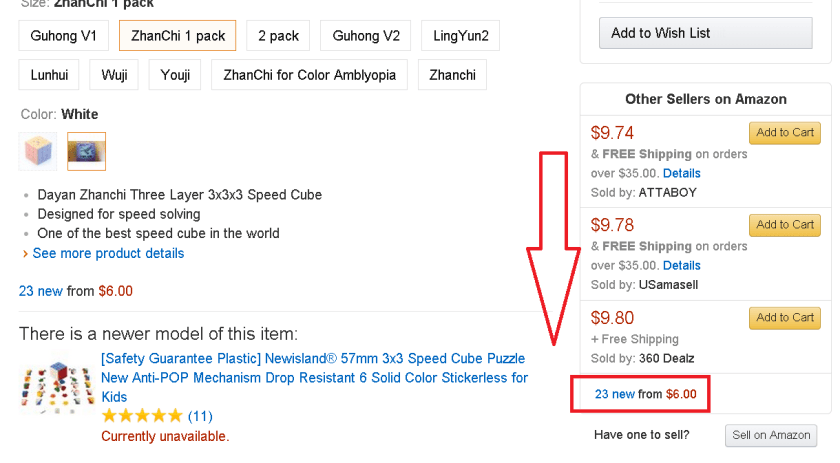
Rubik’s Cube (Dayan Zhanchi)
For parents, buying a Rubik’s cube for your child is a great investment. Playing with the Rubik’s cube is a major intellectual challenge (it has 43 quintillion permutations, only 1 of which is correct), which will develop the child’s brain for logical thinking, which is especially useful for Math and Science. Most importantly, it is fun!
Special note for buying Dayan Zhanchi from Singapore:
If you are buying the Dayan Zhanchi from Singapore, at first it seems like the Dayan ZhanChi does not ship to Singapore. It actually does! We just have to choose the correct seller, Cube Puzl, which ships to Singapore.
Even though the GEP Screening/Selection Test does not test science, it is a good idea to get acquainted with science from a young age since the Sciences (Chemistry, Physics, Biology) form the bulk of the Singapore education system from upper primary school onwards till university. For example in Junior College, 3 out of 4 subjects will be sciences, for those in the Science Stream.
As you may already know, Danica McKellar, the actress and UCLA mathematics alumnus, has recently launched her book “Math Doesn’t Suck“, which is aimed at pre-teenage girls and is a friendly introduction to middle-school mathematics, such as the arithmetic of fractions. The book has received quite a bit of publicity, most of it rather favourable, and is selling quite well; at one point, it even made the Amazon top 20 bestseller list, which is a remarkable achievement for a mathematics book. (The current Amazon rank can be viewed in the product details of the Amazon page for this book.)
I’m very happy that the book is successful for a number of reasons. Firstly, I got to know Danica for a few months (she took my Introduction to Topology class way back in 1997, and in fact was the second-best student there; the class web…
Firstly, apologies for the long gap. Very far from being Theorem of the Week, I know. Here’s another theorem for now, and I’ll do what I can to revert to a weekly post.
So, to this week’s theorem. I have previously promised to write about Fermat‘s Little Theorem, and I think it’s time to keep that promise. In that post (Theorem 10, about Lagrange’s theorem in group theory), I introduced the theorem, so I’m going to state it straightaway. If you haven’t seen the statement before, I suggest you look back at that post to see an example.
Theorem (Fermat’s Little Theorem) Let $latex p$ be a prime, and let $latex a$ be an integer not divisible by $latex p$. Then $latex a^{p-1} \equiv 1\mod{p}$.
If you aren’t comfortable with the notation of modular arithmetic, you might like to phrase the conclusion of the theorem as saying that $latex…
Senior Wrangler is the First position in the Math Tripos in Cambridge. Singapore Prime Minister Lee Hsien Loong was the Senior Wrangler in 1973, the first Singaporean student with such great honors, among other senior wranglers like Arthur Cayley (Group Theory), J.J. Sylvester (Inventor of Matrix, private tuitor of the “inventor of Nursing” Florence Nightingale), J.E. Littlewood (partnered in a twin research team with G.H. Hardy), Frank Ramsey (Ramsey’s Theorem), Stokes, Pell, etc.
Some great mathematicians like Bertrand Russell (Logician, Nobel Litterature Prize) , G.H. Hardy (20th century greatest Pure Mathematician, mentored 2 geniuses: Indian Ramanujian and Chinese Hua Luogeng 华罗庚*) were not Senior Wrangler. Prof Hardy hated Math Tripos syllabus (revealed in his autobiography: “A Mathematician’s Apology“).
1914 Brian Charles Molony
1923 Frank Ramsey
1928 Donald Coxeter
1930 Jacob Bronowski
1939 James Wilkinson
1940 Hermann Bondi
1952 John Polkinghorne
1953 Crispin Nash-Williams
1959 Jayant Narlikar 1970 Derek…
Attached below are the Formula Lists for E Maths and A Maths (O Level)
Do be familiar with all the formulas for Elementary Maths and Additional Maths inside, so that you know where to find it when needed!
Wishing everyone reading this all the best for their exams. 🙂
Synopsis: ‘I have a truly marvellous demonstration of this proposition which this margin is too narrow to contain.’
It was with these words, written in the 1630s, that Pierre de Fermat intrigued and infuriated the mathematics community. For over 350 years, proving Fermat’s Last Theorem was the most notorious unsolved mathematical problem, a puzzle whose basics most children could grasp but whose solution eluded the greatest minds in the world. In 1993, after years of secret toil, Englishman Andrew Wiles announced to an astounded audience that he had cracked Fermat’s Last Theorem. He had no idea of the nightmare that lay ahead.
In ‘Fermat’s Last Theorem’ Simon Singh has crafted a remarkable tale of intellectual endeavour spanning three centuries, and a moving testament to the obsession, sacrifice and extraordinary determination of Andrew Wiles: one man against all the odds.
First Published: 1997, Reissued: 2002| ISBN-13: 978-1841157917
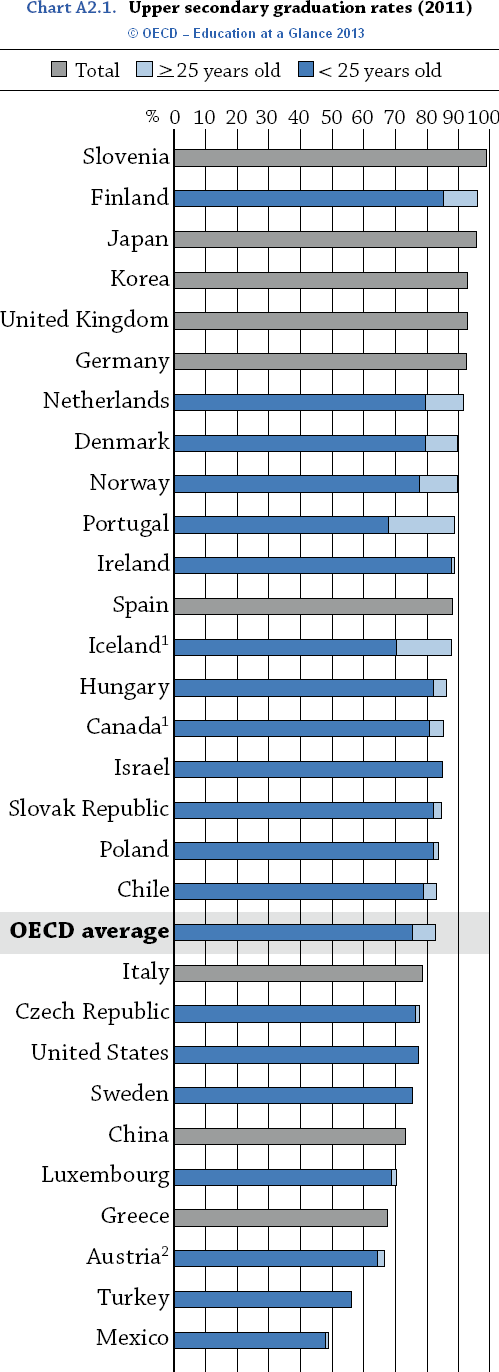
Countries which belong to the Organization for Economic Cooperation and Development (OECD) produce two-thirds of the world’s goods and services. The organization publishes reports on economic and social factors in the member states. School performance league tables are presented in the OECD report, Education at a Glance. It includes comparison tables of educational performance, class sizes, teachers’ salaries, tertiary education and more. The report can be downloaded as a PDF document.
Chart A2·1 [ page 42] ranks countries, in descending order, according to the percentage of adults who have completed an upper secondary education (the most recent data in the 2013 report is from 2011).
Chart A1·2 footnotes:
1. Year of reference 2010.
2. Some programmes not included. *China has a large rural / urban disparity in its education system.
Singapore Math emphasizes the development of strong number sense, excellent mental-math skills, and a deep understanding of place value.
The curriculum is based on a progression from concrete experience—using manipulatives—to a pictorial stage and finally to the abstract level or algorithm. This sequence gives students a solid understanding of basic mathematical concepts and relationships before they start working at the abstract level.
Singapore Math includes a strong emphasis on model drawing, a visual approach to solving word problems that helps students organize information and solve problems in a step-by-step manner.
Concepts are taught to mastery, then later revisited but not re-taught. It is said the U.S. curriculum is a mile wide and an inch deep, whereas Singapore’s math curriculum is said to be just the opposite.
The Singapore approach focuses on developing students who are problem solvers.
I suppose every reader of this ‘ere blog will know Heron’s formula for the area $latex K$ of a triangle with sides $latex a,b,c$:
$latex K = \sqrt{s(s-a)(s-b)(s-c)}$
where $latex s$ is the “semi-perimeter”:
$latex \displaystyle{s=\frac{a+b+c}{2}.}$
The formula is not at all hard to prove: see the Wikipedia page for two elementary proofs.
However, I have only recently become aware of Brahmagupta’s formula for the area of a cyclic quadrilateral. A cyclic quadrilateral, if you didn’t know, is a (convex) quadrilateral all of whose points lie on a circle:
And if the edges have lengths $latex a,b,c,d$ as shown, then the formula states that the area is given by
$latex K = \sqrt{(s-a)(s-b)(s-c)(s-d)}$
where as above $latex s$ is the semi-perimeter:
$latex \displaystyle{s=\frac{a+b+c+d}{2}.}$
This can be seen to be a generalization of Heron’s formula. Although the formula is named for Brahmagupta (598 – 670), who does indeed seem to…
Recently, in The Conversation, the Vice Chancellor of Monash University, wrote an article discussing MOOCs. He made some criticisms about the nature of assessment and grading that MOOCs offer. However, my attention was grabbed by two sentences:
The other major problem the MOOCs haven’t solved is assessment. They work very well for subjects like maths, which have objectively right and wrong answers, and can therefore be pretty easily marked by computers.
Now, here we have the Vice Chancellor of one of Australia’s leading universities – and indeed, one of the world’s leading universities (and incidently the University where I did both my Masters and my PhD) demonstrating an extraordinary lack of understanding about the fundamental nature of mathematics. He seems to think that mathematics is all about teaching students (in the fine words of John Power from Leeds University) about “finding ‘x'”. I suppose he thinks this…
WordPress.com supports LaTeX, a document markup language for the TeX typesetting system, which is used widely in academia as a way to format mathematical formulas and equations. LaTeX makes it easier for math and computer science bloggers and other academics in our community to publish their work and write about topics they care about.
If you’re a math genius — many of you are! — and you’ve blogged about equations you’ve worked on, you’ve probably used LaTeX before. If you’re just starting out (or simply curious to see how it all works), we’ve gathered a few examples of great math and computing blogs on WordPress.com that will inspire you.
In general, to display formulas and equations, you place LaTeX code in between $latex and $, like this:
$latex YOUR LATEX CODE HERE$
So for example, inserting this when you’re creating a post . . .



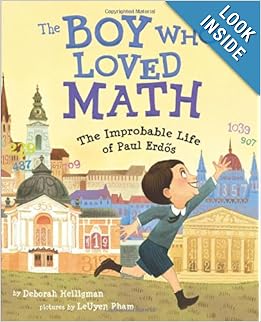 It’s likely that you’ve seen this book reviewed elsewhere. There has been a lot of buzz about it in the kid-lit world. And for good reason. The Boy Who Loved Math: The Improbable LIfe of Paul Erdos is a wonderful biography of a fascinating man. In case you’re ignorant like me, Paul Erdos was a Hungarian mathematician known for his work in number theory and for his eccentric personality.


 contains research that shows that IQ can be increased.)
 page for more details)


 to have an all-round knowledge of the world and science.

 to get an idea of the IMO (International Math Olympiad).


 (Past Official P4 GEP Literature Book)
 (P5 GEP Literature Book)
 (P6 GEP Literature Book)


 . Try not to use Webster / Google as those are American English, which can be quite different.


 to students and parents. A psychologist has written this book, and it has many new insights. For instance, praising your child “intelligence and ability doesn’t foster self-esteem and lead to accomplishment, but may actually jeopardize success.” This is new psychological research supported by evidence. The correct way is actually to praise the child’s effort. Find out more tips and stories by reading this book.






 , in descending powers of
  , the seventh term is independent of
  and the value of this term.
 since it is the seventh term (recall
  )
) (independent of

 (Ans)
(Ans) Mathtuition88

