Lebesgue’s Dominated Convergence Theorem for Convergence in Measure
If 


Proof
Let 


By the usual Lebesgue’s DCT, 
Since every subsequence of 


If
Let
By the usual Lebesgue’s DCT,
Since every subsequence of
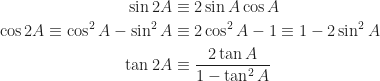
The following formulae will be useful when integrating Trigonometric functions. Taken from the MF15 formula sheet for JC.
Remark: The second identity is useful for integrating 

Remark: The factor formulae are useful for integrating 

A very famous mathematical problem known as the “Basel Problem” is solved by Euler in 1734. Basically, it asks for the exact value of 
Three hundred years ago, this was considered a very hard problem and even famous mathematicians of the time like Leibniz, De Moivre, and the Bernoullis could not solve it.
Euler showed (using another method different from ours) that 

Assume that
Then squaring this series formally,
To see why the above hold, see the following concrete example:
We assume that term by term integration is valid.
Recall that
So
Similarly
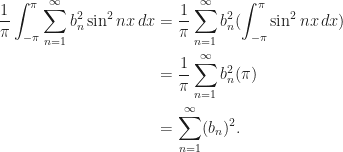
So 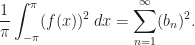

By Parseval’s identity,
Simplifying, we get
Currently, all versions of China Eastern Airlines 东方航空 websites (e.g. http://sg.ceair.com/, hk.ceair, etc) are not working.
I tried searching for a ticket in December and an error message popped out: We apologize that there are insufficient seats on ## segment of your searched flight. Please change the search options. Thank you for your cooperation!
I called the customer service and they confirmed that it is an error (their system shows that there are indeed still plenty of seats). Hope they fix it soon.
Affine Line: $latex {mathbb {A}^1}&s=3$
Six Representations of a Circle: $latex {mathbb {S}^1}&s=3$
1) Euclidean Geometry
Unit Circle : $latex x^2 + y^2 = 1$
2) Curve:
Transcendental Parameterization :
$latex boxed { e(theta) = (cos theta, sin theta) qquad
0 leq theta leq 2pi }&fg=aa0000&s=3
$
Rational Parameterisation :
$latex boxed {
e(h) = left(frac {1-h^2} {1+h^2} : , : frac {2h} {1+h^2}right) quad text { h any number or } infty
} &fg=aa0000&s=2
$

3) Affine Plane $latex {mathbb {A}^2}&s=3$
1-dim sub-Space = Lines thru Origin

4) Polygonal Representation
5) Identifying Intervals: (closed loop)
6) $latex text {Translation } (tau, {tau}^{-1}) text { on a Line } $ $latex {mathbb {A}^1}&s=3$
$latex boxed {
{mathbb {S}^1} = {mathbb {A}^1 } Big/ { langle tau , {tau}^{-1} rangle}
}&fg=aa0000&s=3
$
$latex {mathbb {S}^1} = text { Space of all orbits} $

Source: http://www.ypzihua.com/product-2793.html
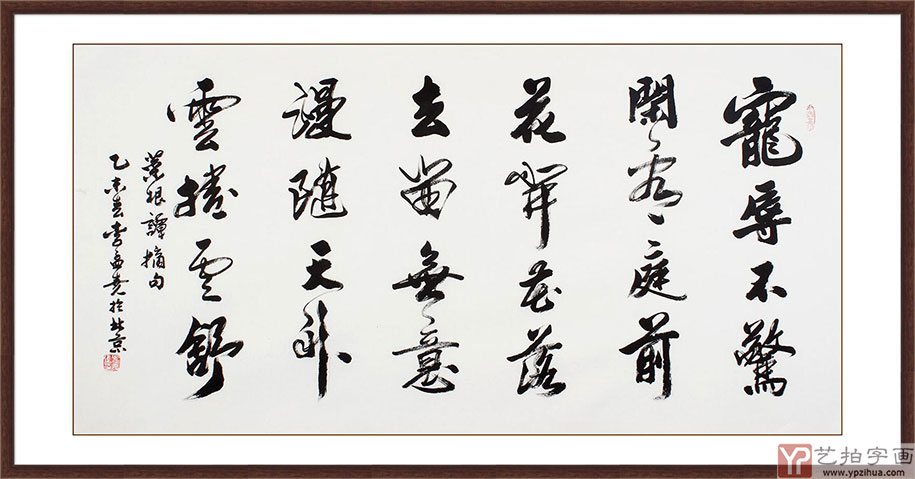
Beautiful calligraphy and meaningful words.
Chinese Characters: 宠辱不惊 闲看庭前花开花落 去留无意 漫随天外云卷云舒
Translation: “Don’t be disturbed by fortune or misfortune. Be relaxed no matter how flowers bloom and wilt. To be or not to be needs no hard decision. Take it natural no matter how clouds flow high and low.” (Source: http://www.en84.com/dianji/minyan/201410/00015499.html)
This key theorem showcases the full power of Lebesgue Integration Theory.
Let 



We have 

That is,
Since 


Simplices:
0-dim (Point) $latex triangle_0 $
1-dim (Line) $latex triangle_1 $
2-dim (Triangle) $latex triangle_2 $
3-dim (Tetrahedron) $latex triangle_3 $
Simplicial Complex: built by various Simplices under some rules.
Definitions of Simplex (S)
Face
Orientation
Boundary ($latex delta $)
$latex displaystyle boxed {
delta(S) = sum_{i=0}^{n} (-1)^i (v_0 …hat v_i …v_n)}&fg=aa0000&s=3
$

Theorem: $latex boxed { delta ^2 (S) = 0}&fg=00bb00&s=4 $
A very nice article against the philosophy of the bell curve, which is a prominent feature of examinations all over the world, including Singapore. I am sure that when Gauss invented the bell curve, he didn’t intend it to be used for examinations!
Excerpts:
The goal is to fight grade inflation, but the forced curve suffers from two serious flaws. One: It arbitrarily limits the number of students who can excel. If your forced curve allows for only seven A’s, but 10 students have mastered the material, three of them will be unfairly punished. (I’ve found a huge variation in overall performance among the classes I teach.)
The more important argument against grade curves is that they create an atmosphere that’s toxic by pitting students against one another. At best, it creates a hypercompetitive culture, and at worst, it sends students the message that the world is a zero-sum game: Your success means my failure.
Exhibit B: I spent a decade studying the careers of “takers,” who aim to come out ahead, and “givers,” who enjoy helping others. In the short run, across jobs in engineering, medicine and sales, the takers were more successful. But as months turned into years, the givers consistently achieved better results.
The results: Their average scores were 2 percent higher than the previous year’s, and not because of the bonus points. We’ve long knownthat one of the best ways to learn something is to teach it. In fact, evidence suggests that this is one of the reasons that firstborns tend to slightly outperform younger siblings on grades and intelligence tests: Firstborns benefit from educating their younger siblings. The psychologists Robert Zajonc and Patricia Mullally noted in a review of the evidence that “the teacher gains more than the learner in the process of teaching.”
Abstract Algebra is scary but not with this pretty lecturer!
1. Group
◇ Definition
◇ Symmetric Group
◇ Cayley Table
2. Linear Groups:
◇ GLn (R)
◇ SLn(R) — Determinant = 1
3. Relationship between Group Structures:
◇ Homomorphism,
◇ Isomorphism,
◇Kernel
4.Ring Definition
5. Field Definition
Suppose 


Note that 


![[(st)t]^2=s^2=1](https://s0.wp.com/latex.php?latex=%5B%28st%29t%5D%5E2%3Ds%5E2%3D1&bg=ffffff&fg=1a1a1a&s=0&c=20201002)
We claim that there are no other relations, other than ![(st)^m=t^2=[(st)t]^2=1](https://s0.wp.com/latex.php?latex=%28st%29%5Em%3Dt%5E2%3D%5B%28st%29t%5D%5E2%3D1&bg=ffffff&fg=1a1a1a&s=0&c=20201002)
Suppose to the contrary 


Thus
Math teachers / students / Math lovers do sign this petition to stop Leicester university from cutting 20% of their math researchers/lecturers. #mathisimportant
Strangely, this is my second post about Leicester in just a few months, but it’s about something a lot more depressing than the football team’s fairytale winning of the Premier League (but let me quickly offer my congratulations to them for winning their first Champions League match — I won’t offer advice about whether they are worth betting on to win that competition too). News has just filtered through to me that the mathematics department is facing compulsory redundancies.
The structure of the story is wearily familiar after what happened with USS pensions. The authorities declare that there is a financial crisis, and that painful changes are necessary. They offer a consultation. In the consultation their arguments appear to be thoroughly refuted. But this is ignored and the changes go ahead.
Here is a brief summary of the painful changes that are proposed for the Leicester mathematics department. There are…
View original post 393 more words
| Year | Ver | Code Name | Description |
| 1995 | 1.0 | Java | Applets |
| 1977 | 1.1 | Java | Event, Beans, Internationalization |
| Dec 1978 | 1.2 | Java 2 | J2SE, J2EE, J2ME, Java Card |
| 2000 | 1.3 | Java 2 | J2SE 1.3 |
| 2002 | 1.4 | Java 2 | J2SE 1.4 |
| 2004 | 1.5 | Java 5 | J2SE 1.5 |
| Nov 2006 | 6 | Java 6 | Open-Source Java SE 6. “Multithreading” by Doug Lea |
| May 2007 | OpenJDK free software | ||
| 2010 | Oracle acquired Sun | ||
| Jul 2011 | 7 | Java 7 | “Dolphin” |
| Mar 2014 | 8 | Java 8 | Lambda Function |
Javac: Java Compiler
Java Distributions:
1. JDK (Java Developer Kit )
◇JRE & Javac & tools
2. JRE (Java Runtime Environment)
◇ JVM & core class libraries
◇ Windows / Mac / Linux
Java is Object-Oriented Programming (OOP):
1. Class
public class Employee {
public int age;
public double salary;
public Employee () { [<– constructor with no arg]
}
public Employee (int ageValue, double salaryValue) { [<- constructor with args]
age…
View original post 153 more words
The French Emperor Napoleon Bonaparte was himself a Mathematician. He posed a question to his mathematician friends Monge, Laplace, Fourier etc:
How to divide a circle equally in 4 sections using only a compass ?
Note: He was more stringent than the ancient Greeks who allowed a compass and a non-marked ruler.


“Differentiating under the Integral” is a useful trick, and here we describe and prove a sufficient condition where we can use the trick. This is the Measure-Theoretic version, which is more general than the usual version stated in calculus books.
Let 


1) 


2) For almost all 

3) There is an integrable function 

Then for all
Proof:
By definition,
Let 
It follows that 
Using the Mean Value Theorem, we have 
Thus for each 
That is,
Very interesting productivity app that resembles a game. Do check it out!
A few months ago, I noticed someone in one of my Facebook groups posting about an interesting app called Habitica. It’s one of a host of time-management and productivity-increasing applications, both web- and mobile-based. What sets it apart, however, is that it turns your efforts at organizing your life into a game. Specifically, it turns your life into something reminiscent of a classic, pixelated, 8-bit RPG.
So no, the title of this post is not a metaphor. You literally get XP (and gold) for doing your tasks in real life.
View original post 2,652 more words

This limit is a useful and interesting result to know. Note especially that the method “
We will prove 
First, we will find the limit 
So 
If you are interested, you can try to prove 

The Fundamental Theorem of Galois Theory states that:
Given a field extension 
1) 


2) 


This correspondence is a one-to-one correspondence if and only if
 holds iff the inclusion of fields
  holds. is a subgroup of , then
 ![|H|=[E:E^H]](https://s0.wp.com/latex.php?latex=%7CH%7C%3D%5BE%3AE%5EH%5D&bg=ffffff&fg=1a1a1a&s=0&c=20201002) and
and ![|\text{Gal}(E/F)/H|=[E^H:F]](https://s0.wp.com/latex.php?latex=%7C%5Ctext%7BGal%7D%28E%2FF%29%2FH%7C%3D%5BE%5EH%3AF%5D&bg=ffffff&fg=1a1a1a&s=0&c=20201002) . is a normal extension of
. is a normal extension of  (or equivalently, Galois extension, since any subextension of a separable extension is separable) iff is a normal subgroup of .
As the Zika/Dengue virus has spread to Singapore, I have been researching (in my spare time) on ways to prevent Zika/Dengue. The following are some interesting ways that however eventually do not work (or worse, attract more mosquitoes), so do not waste your money trying these!

In theory, bug zappers that use electricity to kill mosquitoes sound like a great idea. However, the problem comes from the fact that bug zappers use Ultraviolet Light (UV) to attract insects. Mosquitoes are attracted by Carbon Dioxide, not UV light, so you will end up killing 99% other insects, some of which are beneficial insects. See http://insects.about.com/od/StingingBitingInsects/a/Do-Bug-Zappers-Kill-Mosquitoes.htm.
This seems to be complete BS. See http://www.mosquitoreviews.com/ultrasonic-mosquito-app.html

This sounds like a genius idea at first, since Pitcher Plants eat insects, and grow in tropical climates, exactly where Aedes Mosquitoes live. The problem is mosquito larvae can survive very well in Pitcher Plants.
4) P.S. If you have a pond with large koi fish in it, you may want to add smaller fish, since koi fish (and other large fish in general) are known not to eat mosquito larvae. “Koi may be beautiful, but they are generally too large to prey on mosquito larvae and are known for their mellow nature.”






![\displaystyle \frac 1\pi\cdot\left[\frac{x^3}{3}\right]_{-\pi}^\pi=\sum_{n=1}^\infty\frac{4}{n^2}.](https://s0.wp.com/latex.php?latex=%5Cdisplaystyle+%5Cfrac+1%5Cpi%5Ccdot%5Cleft%5B%5Cfrac%7Bx%5E3%7D%7B3%7D%5Cright%5D_%7B-%5Cpi%7D%5E%5Cpi%3D%5Csum_%7Bn%3D1%7D%5E%5Cinfty%5Cfrac%7B4%7D%7Bn%5E2%7D.&bg=ffffff&fg=1a1a1a&s=0&c=20201002)











 Mathtuition88