Topology application to Physics

Source: https://www.scientificamerican.com/article/the-strange-topology-that-is-reshaping-physics/?W

The Strange Topology That Is Reshaping Physics

Topological effects might be hiding inside perfectly ordinary materials, waiting to reveal bizarre new particles or bolster quantum computing

Charles Kane never thought he would be cavorting with topologists. “I don’t think like a mathematician,” admits Kane, a theoretical physicist who has tended to focus on tangible problems about solid materials. He is not alone. Physicists have typically paid little attention to topology—the mathematical study of shapes and their arrangement in space. But now Kane and other physicists are flocking to the field.

In the past decade, they have found that topology provides unique insight into the physics of materials, such as how some insulators can sneakily conduct electricity along a single-atom layer on their surfaces.

Some of these topological effects were uncovered in the 1980s, but only in the past few years have researchers begun to realize that they could be much more prevalent and bizarre than anyone expected. Topological materials have been “sitting in plain sight, and people didn’t think to look for them”, says Kane, who is at the University of Pennsylvania in Philadelphia.

Now, topological physics is truly exploding: it seems increasingly rare to see a paper on solid-state physics that doesn’t have the word topology in the title. And experimentalists are about to get even busier. A study on page 298 of this week’s Nature unveils an atlas of materials that might host topological effects, giving physicists many more places to go looking for bizarre states of matter such as Weyl fermions or quantum-spin liquids.

Read more at: https://www.scientificamerican.com/article/the-strange-topology-that-is-reshaping-physics/?WT.mc_id=SA_WR_20170726

What Would You Like In The Summer 2017 Mathematics A To Z?

Joseph Nebus's avatarnebusresearch

Summer 2017 Mathematics A to Z, featuring a coati (it's kind of the Latin American raccoon) looking over alphabet blocks, with a lot of equations in the background. Art courtesy of Thomas K Dye, creator of the web comic Newshounds. He has a Patreon for those able to support his work.

I would like to now announce exactly what everyone with the ability to draw conclusions expected after I listed the things covered in previous Mathematics A To Z summaries. I’m hoping to write essays about another 26 topics, one for each of the major letters of the alphabet. And, as ever, I’d like your requests. It’s great fun to be tossed out a subject and either know enough about it, or learn enough about it in a hurry, to write a couple hundred words about it.

So that’s what this is for. Please, in comments, list something you’d like to see explained.

For the most part, I’ll do a letter on a first-come, first-serve basis. I’ll try to keep this page updated so that people know…

View original post 316 more words

How to do Proof by Cases in LaTeX

If one searches online, one will find many different methods to do “proof by cases” in LaTeX. The most simple and convenient method in my opinion is to use the description environment.

Something like this:

\begin{proof} Proceed by cases.
\begin{description}
\item[Case 1: This.] And so on.
\item[Case 2: That.] And more.
\end{proof}

Source: Reddit

No additional package is needed. One drawback is there is no auto-numbering, but I am sure that is still ok, unless your proof has many many cases.

(Important Changes) PSLE Math: Arrow -> vs Equal=

Source: Facebook

For those taking PSLE, please take note of this important update regarding the difference between arrow and equal sign. Forward this to your friends taking PSLE!

Basically, I think MOE is trying to instill students to be mathematically correct. (See update below: Marks will not be deducted in most cases but proper usage is highly encouraged.)

E.g. 100%=40 is wrong as 100%=100/100=1 technically. Similarly, 10 men = 40 hours is wrong as the units do not match (nor make sense).

Trying to enforce “units” instead of “u”, and banning “10 units -> 20” is a bit strict though, in my opinion.

Update: (http://mothership.sg/2017/07/moe-clarifies-use-of-%E2%86%92-in-revamped-primary-6-math-syllabus/)

MOE responds

In response to Mothership.sg queries, a Ministry of Education spokesperson clarified that the above information was not provided by the ministry.

The information above was originally sourced from the website of a private tuition centre, whose sources are currently unverified.

While the respective uses of the arrow and equal signs are accurate in the infographic, the MOE spokesperson said full credit will still be awarded to the student even when the signs are used interchangeably, as long as the student demonstrates a full understanding of the question.

Proper use of arrow and equal signs are, nonetheless, encouraged.

SG Education News: More places for Medicine Students

Good news for those aspiring to be medical doctors.


Med school places to rise to 500 by next year

The National University of Singapore (NUS) has had more than 2,000 top students fight for the 300 spaces in its Yong Loo Lin School of Medicine …

Other top Education news:

Hong Kong, UAE, Singapore Priciest Places for Education

In Singapore, the government subsidizes schooling costs for locals and has doubled its education budget since 2005 as part of a plan to build the …

New NTU president has history of ties with Singapore

New NTU president has history of ties with Singapore … Council and the International Academic Advisory Panel of Singapore’s Ministry of Education.

Building a `Smart Nation’ in Singapore Doesn’t Come Cheap

Schooling isn’t cheap in Singapore: not just for citizens, but for the government too. The city state boasts one of the best education systems in the world …

How robots are teaching Singapore’s kids

In Singapore, admired globally for its education system, authorities are trialling the use of robotic aides to teachers in kindergartens. Two humanoid …

Unique Cars and Parts

There are hundreds if not thousands of Automotive websites to be found on the net, so often it can be a little hit and miss as to finding the best of the best that is out there. Unique Cars and Parts is just one of those sites, one of the best that there is. Well researched and covering almost every automotive topic there is, the site also boasts a mammoth array of various media types, from old auto radio commercials, TV and cinema advertising, car brochures, press releases, car launches and biographies.

Even better is the ability to sell your old car and or parts for free, or even list your auto business if you are in the trade. No cost really does mean no cost – not sure how they do it – but what they have created is brilliant. If you are a car aficionado or even have a simple passing interest in the history of automobiles, from the earliest contraptions found on the roads at the beginning of last century, the the more modern vehicles we drive today – pay this site a visit and we would recommend you bookmark it for future reference.

Click here to go to the Unique Cars and Parts Classic Car Website

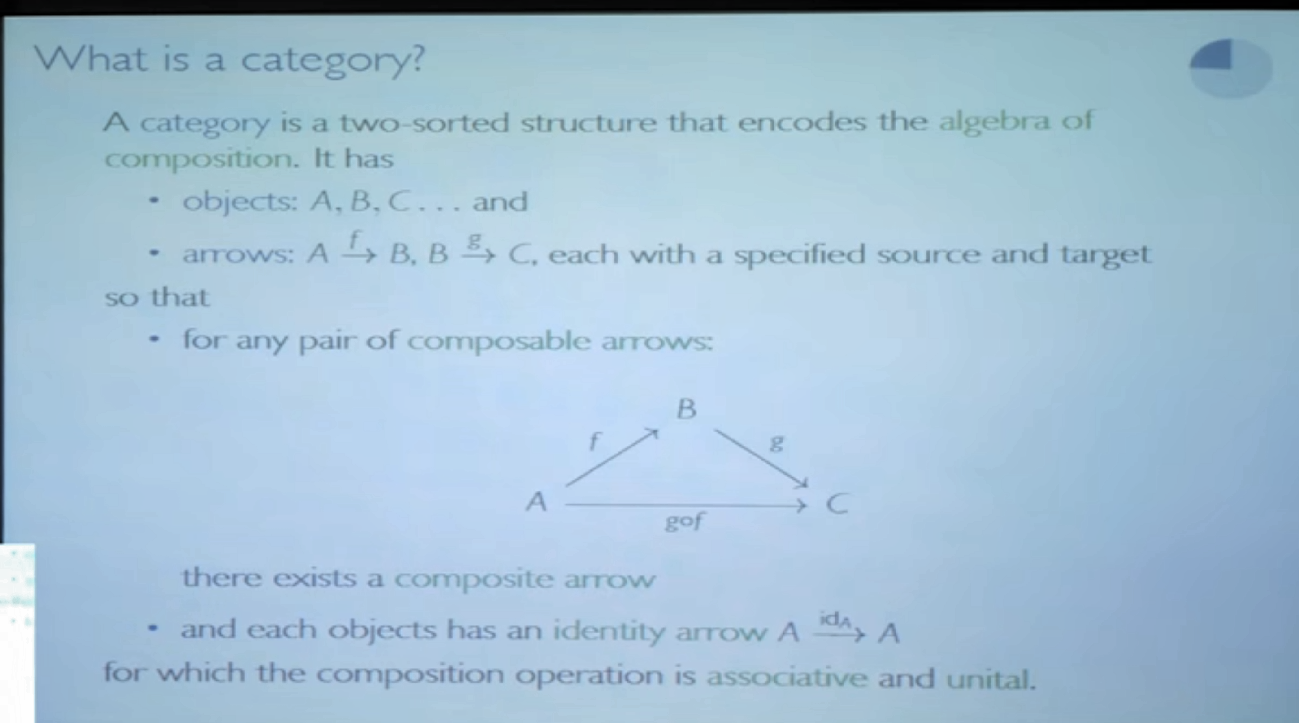
Les Categories Pour Les Nuls

ChefCouscous's avatarMath Online Tom Circle

“Categories for Dummies”
(French)

Example 1:

Paris (P) -> Rome (R) -> Amsterdam (A)
Objects: cities {P, R , A}
Morphism (Arrow): railway

  • Identity: railway within the city
  • Associative: (P -> R) -> A = P -> (R ->A)

=> Category

Example 2:
A, B are categories

functor f : A -> B

f (B) has the “information” on A, with some loss of information since f may not be a MONOMORPHISM.

Example 3: Natural Transformation

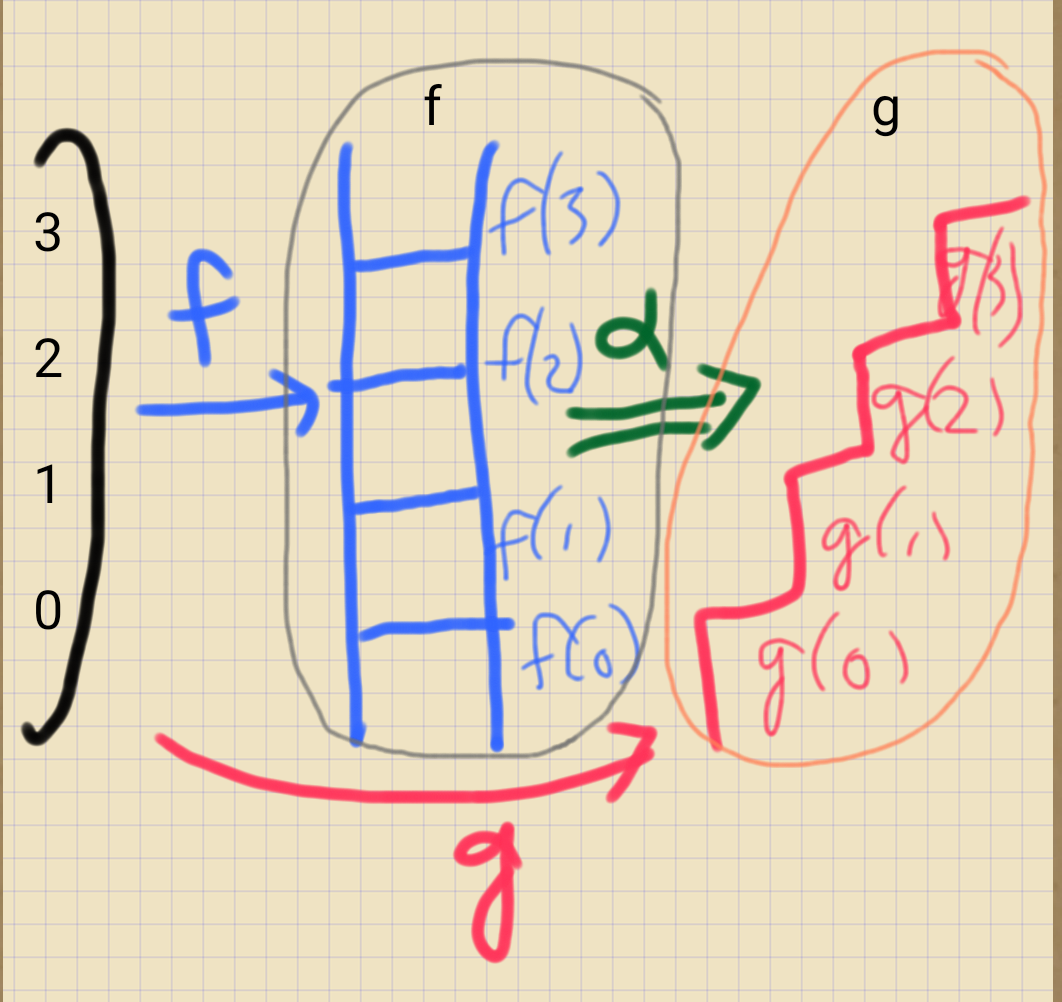
A = 0 1 2 3 4
f : A -> B

B = Ladder steps:
f(0)|
f(1)|
f(2)|
f(3)|

g : A -> B

B = Staircase steps :
g(0)||
g(1)||
g(2)||
g(3)||

Natural Transformation: =>α

α : f (i) => g (i)

f(0)| =>g(0)||
f(1)|=>g(1)||
f(2)|=>g(2)||
f(3)|=>g(3)||

α transforms naturally the Ladder to the Staircase.

View original post

An Introduction to N-Categories

ChefCouscous's avatarMath Online Tom Circle

Tom Leinster

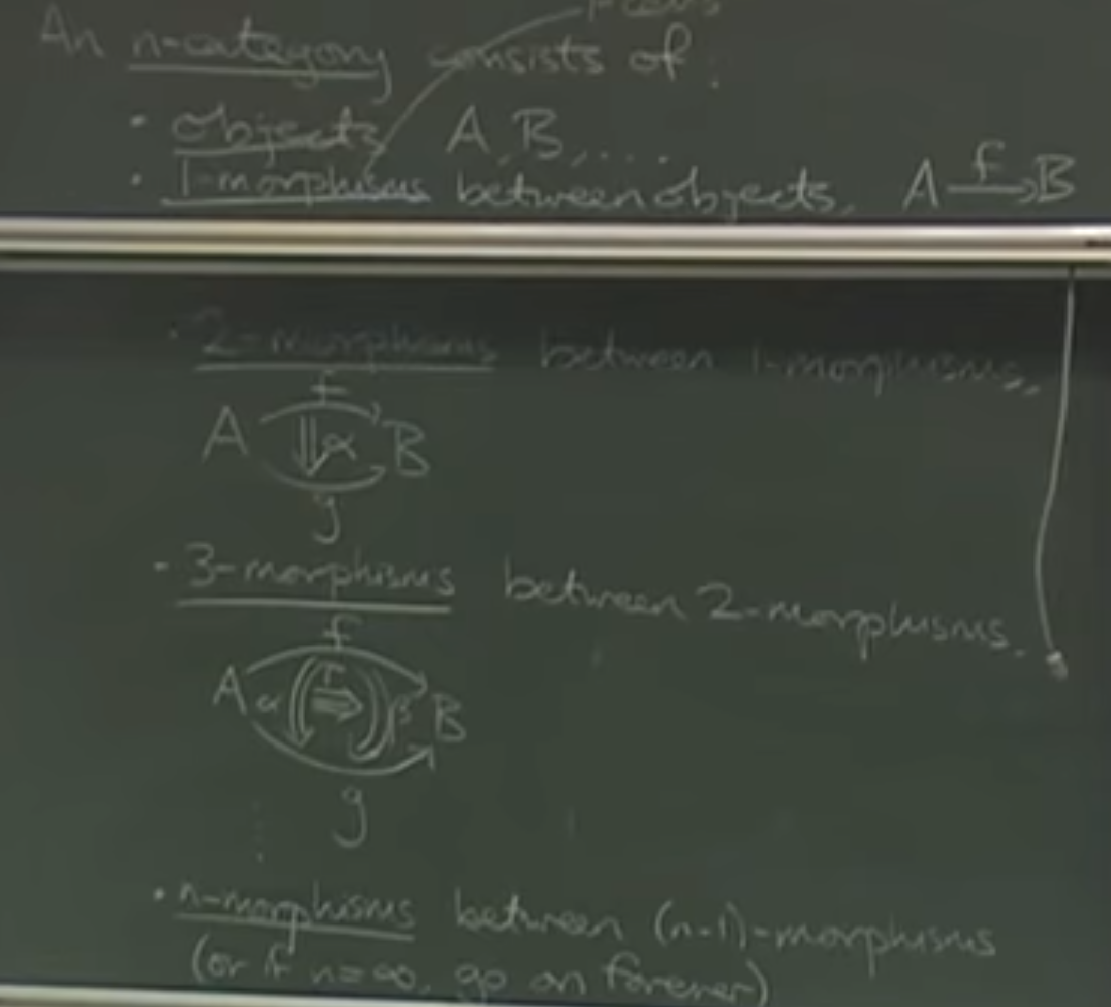
N = 0 : 0-Cat

  • => Set, 0-morphism = function

N= 1: 1-Cat

  • => Cat, 1-morphism = functor

N= 2: 2-Cat

  • => 2-morphism = Natural Transformation

$latex text {f, g : 1-morphism }$

$latex alpha :: beta text { Natural Transformations : 2-morphism }$

Definition of n-Category:

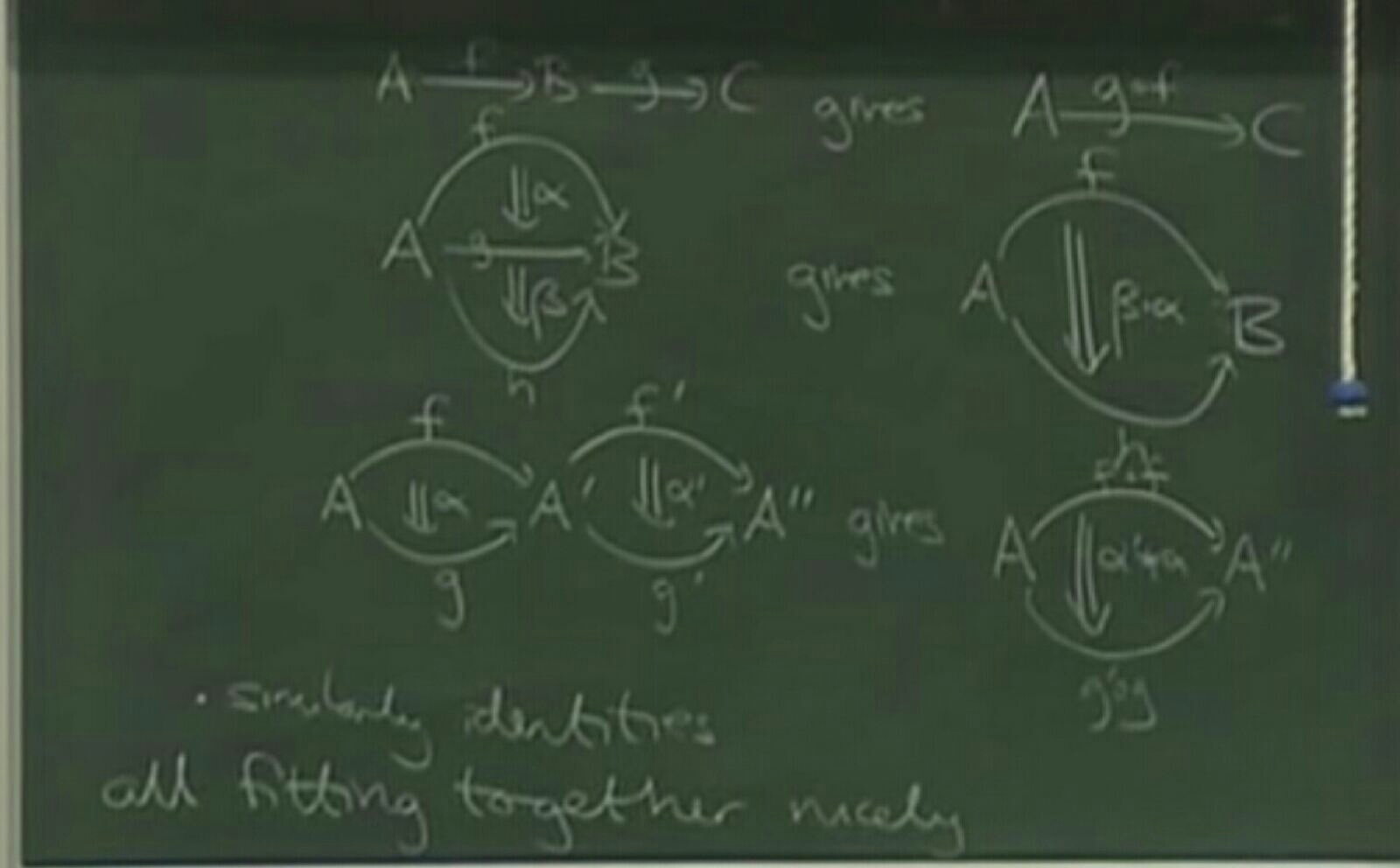
Composition:

0-Cat : Set
1-Cat : Cat

Examples of n-Categories:

  • Manifold
  • Top (Topological Space) : 2-morphism = homotopy

Ref:

Best Technical Category Theory Book (2016) by Tom Leinster (Cambridge Press): “Basic Category Theory”

(Free downloadfrom arxiv)

View original post

Category Theory : “How to Make Pi”

ChefCouscous's avatarMath Online Tom Circle

Dr. Eugenia Cheng – Professor of Category Theory (Chicago University)

Author of the Best Selling Category Book Book : (for readers from 7-year-old to high school and undergraduate students)

How to Bake Pi ?- an Edible Exploration to the Mathematics of Mathematics”

[Loan from NLB(eg. AMK Branch)]

Illustrations:

  • Factors of 30 = {2, 3, 5, 6, 10, 15, 30} which form a Cube with these factors as the vertices.
  • Knots
  • Bach music
  • Associativity: (sugar + milk + egg )
  • Button cake = order 2 group (0,1)
  • Bed mattress = rotate, flip, flop
  • Icosahedral virus


Ref:

Best Technical Category Theory Book (2016) by Tom Leinster (Cambridge Press): “Basic Category Theory”

(Free downloadfrom arxiv)

View original post

Program = Category 

ChefCouscous's avatarMath Online Tom Circle

2017

Keywords:

  • Category
  • Monad = Monoid + Endofunctor

Category Theory is replacing Set Theory as the foundation of Math. Nowadays, few Advanced Math papers are written without using Category to explain, and this trend is spreading to IT through Functional Programming languages (Google’s Kotlin, Haskell, Clojure…) - the latest paradigm to replace Object-Oriented languages like Java, C++, etc, as a safer “Strong Typed” languages for AI, BIG DATA…

$latex boxed {text {Type = Category }}&fg=aa0000&s=3$

Examples of “Types” in IT:

  • Integers
  • Real
  • Double
  • Boolean
  • String
  • etc

View original post

Free tutoring app for peer-tutoring

Do try out the new app AsknTeach. Quite a good idea, the app creator reportedly invested more than $100,000 to $200,000 into it.

Only problem I can foresee is that overall quality of answers may not be that good, since it is by peer students, also the engagement rate may not be high. The same problem may occur: more people asking questions than answering.

That being said, if the top echelon of students can be motivated to answer it, the quality of answers will be great. E.g., the top secondary school students are easily at JC level or beyond, they can easily answer questions at their level.

Source: http://www.straitstimes.com/singapore/education/tutoring-app-for-students-to-asknteach

One of the founders of free tutoring app EduSnap is back with a new peer tutoring app – AsknTeach.

Back in 2013, Mr Chia Luck Yong set up EduSnap as a social enterprise with two Singapore Management University schoolmates, Mr Anders Tan and Mr Shaun Tan, and launched the app the next year.

At the time, the free mobile platform drew attention as it positioned itself as the first of its kind helping Singapore students, and was reported about in major media outlets.

Integral Domains 整环 (Abstract Algebra)

ChefCouscous's avatarMath Online Tom Circle

Remember when you cancel a common factor at both sides of an equation, you must check if the factor is non-zero, otherwise you would miss some answers.

This is about Cancellation Law, related tofewNumber Theory Properties :

  • Zero Divisors,
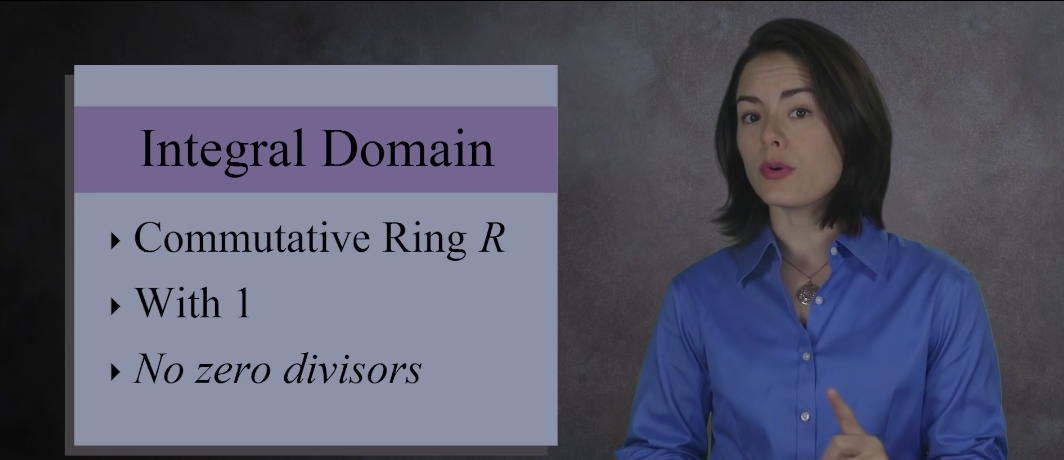
  • Integral Domain.

Origin of “Integral” => Integers

Definition of Integral Domian:

Property:Cancellation Law

Reading:

THEOREMS:(PROOF Here)

  1. Every Field is an Integral Domain.
  2. Every finite Integral Domain is a Field.

View original post