
This is the most “unique” PhD thesis I have ever seen. Very special, and humorous to read, and coming from the most elite institution Princeton, under the guidance of Fields Medalist Manjul Bhargava.

Piper Harron is a mathematician who is very happy to be here, and yes, is having a great time, despite the fact that she is standing alone awkwardly by the food table hoping nobody will talk to her.
Piper, would you care to write a mathbabe post describing your thesis, and yourself, and anything else you’d care to mention?
When Cathy (Cathy? mathbabe?) asked if I would like to write a mathbabe post describing my thesis, and myself, and anything else I’d care to mention, I said “sure!” because that is objectively the right answer. I then immediately plunged into despair.
Describe my thesis? My thesis is this thing that was initially going to be a grenade launched at my ex-prison, for better or for worse, and instead turned into some kind of positive seed bomb where flowers have sprouted beside the foundations I thought I wanted to crumble…
View original post 649 more words

 ,
,  be holomorphic inside and on a simple closed contour
  , such that
  on
on  and
and  have the same number of zeroes (counting multiplicities) inside
  in the annulus
  .
. be the unit circle
  . We have
 has 2 zeroes in
  be the circle
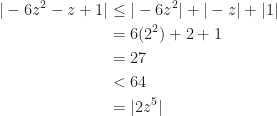
 . Chose
  sufficiently large so that on the circle
  ,
,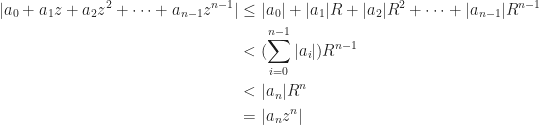
 has
has  roots inside the circle,
  can be arbitrarily large, this proves the Fundamental Theorem of Algebra.


 , where
  , where
  is an odd prime.
 ,
,  and
and  .
. in
in  is
is ![Q(\sqrt[p]{2},\omega)](https://s0.wp.com/latex.php?latex=Q%28%5Csqrt%5Bp%5D%7B2%7D%2C%5Comega%29&bg=ffffff&fg=1a1a1a&s=0&c=20201002) , where
, where  is a primitive p-th root of unity. The roots of
 ![\sqrt[p]2, \sqrt[p]2\omega, \sqrt[p]2\omega^2, \dots, \sqrt[p]2\omega^{p-1}](https://s0.wp.com/latex.php?latex=%5Csqrt%5Bp%5D2%2C+%5Csqrt%5Bp%5D2%5Comega%2C+%5Csqrt%5Bp%5D2%5Comega%5E2%2C+%5Cdots%2C+%5Csqrt%5Bp%5D2%5Comega%5E%7Bp-1%7D&bg=ffffff&fg=1a1a1a&s=0&c=20201002) .
.![\sqrt[p]2](https://s0.wp.com/latex.php?latex=%5Csqrt%5Bp%5D2&bg=ffffff&fg=1a1a1a&s=0&c=20201002) and
and ![\omega=\frac{\sqrt[p]2\omega^2}{\sqrt[p]2\omega}](https://s0.wp.com/latex.php?latex=%5Comega%3D%5Cfrac%7B%5Csqrt%5Bp%5D2%5Comega%5E2%7D%7B%5Csqrt%5Bp%5D2%5Comega%7D&bg=ffffff&fg=1a1a1a&s=0&c=20201002) . Thus
. Thus ![\mathbb{Q}(\sqrt[p]2,\omega)\subseteq K](https://s0.wp.com/latex.php?latex=%5Cmathbb%7BQ%7D%28%5Csqrt%5Bp%5D2%2C%5Comega%29%5Csubseteq+K&bg=ffffff&fg=1a1a1a&s=0&c=20201002) .
.![\mathbb{Q}(\sqrt[p]2,\omega)](https://s0.wp.com/latex.php?latex=%5Cmathbb%7BQ%7D%28%5Csqrt%5Bp%5D2%2C%5Comega%29&bg=ffffff&fg=1a1a1a&s=0&c=20201002) contains all the roots of
contains all the roots of ![\mathbb{Q}(\sqrt[p]2, \omega)](https://s0.wp.com/latex.php?latex=%5Cmathbb%7BQ%7D%28%5Csqrt%5Bp%5D2%2C+%5Comega%29&bg=ffffff&fg=1a1a1a&s=0&c=20201002) . Thus
. Thus ![K\subseteq\mathbb{Q}(\sqrt[p]2,\omega)](https://s0.wp.com/latex.php?latex=K%5Csubseteq%5Cmathbb%7BQ%7D%28%5Csqrt%5Bp%5D2%2C%5Comega%29&bg=ffffff&fg=1a1a1a&s=0&c=20201002) , since
, since ![K=\mathbb{Q}(\sqrt[p]2, \omega)](https://s0.wp.com/latex.php?latex=K%3D%5Cmathbb%7BQ%7D%28%5Csqrt%5Bp%5D2%2C+%5Comega%29&bg=ffffff&fg=1a1a1a&s=0&c=20201002) .
.![|Gal(K/\mathbb{Q})|=[K:\mathbb{Q}]](https://s0.wp.com/latex.php?latex=%7CGal%28K%2F%5Cmathbb%7BQ%7D%29%7C%3D%5BK%3A%5Cmathbb%7BQ%7D%5D&bg=ffffff&fg=1a1a1a&s=0&c=20201002) . Since
. Since ![[\mathbb{Q}(\sqrt[p]2):\mathbb{Q}]=p](https://s0.wp.com/latex.php?latex=%5B%5Cmathbb%7BQ%7D%28%5Csqrt%5Bp%5D2%29%3A%5Cmathbb%7BQ%7D%5D%3Dp&bg=ffffff&fg=1a1a1a&s=0&c=20201002) (minimal polynomial
(minimal polynomial  ), and
 ![[\mathbb{Q}(\omega):\mathbb{Q}]=p-1](https://s0.wp.com/latex.php?latex=%5B%5Cmathbb%7BQ%7D%28%5Comega%29%3A%5Cmathbb%7BQ%7D%5D%3Dp-1&bg=ffffff&fg=1a1a1a&s=0&c=20201002) (minimal polynomial the cyclotomic polynomial
(minimal polynomial the cyclotomic polynomial  ), thus
  . Here we have used the lemma that suppose
 ![[F(\alpha):F]=m](https://s0.wp.com/latex.php?latex=%5BF%28%5Calpha%29%3AF%5D%3Dm&bg=ffffff&fg=1a1a1a&s=0&c=20201002) and
and ![[F(\beta):F]=n](https://s0.wp.com/latex.php?latex=%5BF%28%5Cbeta%29%3AF%5D%3Dn&bg=ffffff&fg=1a1a1a&s=0&c=20201002) with
with  , then
 ![[F(\alpha,\beta):F]=mn](https://s0.wp.com/latex.php?latex=%5BF%28%5Calpha%2C%5Cbeta%29%3AF%5D%3Dmn&bg=ffffff&fg=1a1a1a&s=0&c=20201002) .
. be an element of the Galois group.
 ![\sigma(\sqrt[p]2)](https://s0.wp.com/latex.php?latex=%5Csigma%28%5Csqrt%5Bp%5D2%29&bg=ffffff&fg=1a1a1a&s=0&c=20201002) can possibly be
can possibly be ![\sqrt[p]2, \sqrt[p]\omega, \dots, \sqrt[p]2\omega^{p-1}](https://s0.wp.com/latex.php?latex=%5Csqrt%5Bp%5D2%2C+%5Csqrt%5Bp%5D%5Comega%2C+%5Cdots%2C+%5Csqrt%5Bp%5D2%5Comega%5E%7Bp-1%7D&bg=ffffff&fg=1a1a1a&s=0&c=20201002) , a total of
, a total of  , a total of
  choices. All these total up to
  elements, which is exactly the size of the Galois group.
 is described by how its elements act on the generators. For a more concrete representation, we can actually prove that the Galois group above is isomorphic to the group of matrices
  , where
  ,
,  . We denote the group of matrices as
  .
. , mapping
  to
to ![\sigma_{a,b}(\sqrt[p]2)=\sqrt[p]2\omega^b](https://s0.wp.com/latex.php?latex=%5Csigma_%7Ba%2Cb%7D%28%5Csqrt%5Bp%5D2%29%3D%5Csqrt%5Bp%5D2%5Comega%5Eb&bg=ffffff&fg=1a1a1a&s=0&c=20201002) ,
,  .
. is bijective. To see it is a homomorphism, we compute
  .
. between connected CW complexes induces isomorphisms
  for all
  , we have an even stronger conclusion:
  is a deformation retract of
  .
. , the homotopy may be taken to be stationary on
  . This theorem can be viewed as the CW complex analogue of the Simplicial Approximation Theorem.
 , then
  .
. and
and  with their canonical CW-structure, with one 0-cell each, and with one n-cell for
 ![[f]\in\pi_n(S^k)](https://s0.wp.com/latex.php?latex=%5Bf%5D%5Cin%5Cpi_n%28S%5Ek%29&bg=ffffff&fg=1a1a1a&s=0&c=20201002) , where
, where  is a base-point preserving map. By the Cellular Approximation Theorem,
  , where cells map to cells of same or lower dimension.
 be a uniformly bounded and equicontinuous sequence of real-valued continuous functions defined on a closed and bounded interval
 ![[a,b]](https://s0.wp.com/latex.php?latex=%5Ba%2Cb%5D&bg=ffffff&fg=1a1a1a&s=0&c=20201002) . Then there exists a subsequence
. Then there exists a subsequence  that converges uniformly.
 for all
  and all
 ![x\in [a,b]](https://s0.wp.com/latex.php?latex=x%5Cin+%5Ba%2Cb%5D&bg=ffffff&fg=1a1a1a&s=0&c=20201002) . The sequence is equicontinous if, for all
. The sequence is equicontinous if, for all  , there exists
  such that
  whenever
  for all functions
  (depending solely on
  ) works for the entire family of functions.
![g:[0,1]\times [0,1]\to [0,1]](https://s0.wp.com/latex.php?latex=g%3A%5B0%2C1%5D%5Ctimes+%5B0%2C1%5D%5Cto+%5B0%2C1%5D&bg=ffffff&fg=1a1a1a&s=0&c=20201002) be a continuous function and let
be a continuous function and let  be a sequence of functions such that
![f:[0,1]\to\mathbb{R}](https://s0.wp.com/latex.php?latex=f%3A%5B0%2C1%5D%5Cto%5Cmathbb%7BR%7D&bg=ffffff&fg=1a1a1a&s=0&c=20201002) such that
such that  for all
 ![x\in [0,1]](https://s0.wp.com/latex.php?latex=x%5Cin+%5B0%2C1%5D&bg=ffffff&fg=1a1a1a&s=0&c=20201002) .
.
 ,
,
 ,
,  .
. and
and  ,
,
 , then whenever
  . Thus the sequence is indeed equicontinuous.
 .
.


![\mathbb{Z}[i]](https://s0.wp.com/latex.php?latex=%5Cmathbb%7BZ%7D%5Bi%5D&bg=ffffff&fg=1a1a1a&s=0&c=20201002) are the set of complex numbers of the form
are the set of complex numbers of the form  , with
  integers. Originally discovered and studied by Gauss, the Gaussian Integers are useful in number theory, for instance they can be used to prove that
  is any nonzero ideal in
 ![\mathbb{Z}[i]/I](https://s0.wp.com/latex.php?latex=%5Cmathbb%7BZ%7D%5Bi%5D%2FI&bg=ffffff&fg=1a1a1a&s=0&c=20201002) is finite.
is finite. for some nonzero
 ![\alpha\in\mathbb{Z}[i]](https://s0.wp.com/latex.php?latex=%5Calpha%5Cin%5Cmathbb%7BZ%7D%5Bi%5D&bg=ffffff&fg=1a1a1a&s=0&c=20201002) . Let
. Let ![\beta\in\mathbb{Z}[i]](https://s0.wp.com/latex.php?latex=%5Cbeta%5Cin%5Cmathbb%7BZ%7D%5Bi%5D&bg=ffffff&fg=1a1a1a&s=0&c=20201002) .
. with
with  or
or  . We also note that
  .
.![\begin{aligned}\mathbb{Z}[i]/I&=\{\beta+I\mid\beta\in\mathbb{Z}[i]\}\\ &=\{r+I\mid r\in\mathbb{Z}[i],N(r)<N(\alpha)\} \end{aligned}](https://s0.wp.com/latex.php?latex=%5Cbegin%7Baligned%7D%5Cmathbb%7BZ%7D%5Bi%5D%2FI%26%3D%5C%7B%5Cbeta%2BI%5Cmid%5Cbeta%5Cin%5Cmathbb%7BZ%7D%5Bi%5D%5C%7D%5C%5C++++%26%3D%5C%7Br%2BI%5Cmid+r%5Cin%5Cmathbb%7BZ%7D%5Bi%5D%2CN%28r%29%3CN%28%5Calpha%29%5C%7D++++%5Cend%7Baligned%7D&bg=ffffff&fg=1a1a1a&s=0&c=20201002) .
.![r\in\mathbb{Z}[i]](https://s0.wp.com/latex.php?latex=r%5Cin%5Cmathbb%7BZ%7D%5Bi%5D&bg=ffffff&fg=1a1a1a&s=0&c=20201002) with
with  of an arbitrary collection of path-connected spaces
  there are isomorphisms
  for all
  is the same thing as a collection of maps
  . Taking
  gives the result.
 , which is the result for a product of two spaces. The general result then follows by induction.
 ,
, ![\psi([f])=([f_1],[f_2])](https://s0.wp.com/latex.php?latex=%5Cpsi%28%5Bf%5D%29%3D%28%5Bf_1%5D%2C%5Bf_2%5D%29&bg=ffffff&fg=1a1a1a&s=0&c=20201002) .
. ,
,  ,
,  where
where  are the projection maps.
![\psi ([f]+[g])=\psi([f])+\psi([g])](https://s0.wp.com/latex.php?latex=%5Cpsi+%28%5Bf%5D%2B%5Bg%5D%29%3D%5Cpsi%28%5Bf%5D%29%2B%5Cpsi%28%5Bg%5D%29&bg=ffffff&fg=1a1a1a&s=0&c=20201002) , thus
, thus  is a homomorphism.
 ,
, ![\phi([g_1],[g_2])=[g]](https://s0.wp.com/latex.php?latex=%5Cphi%28%5Bg_1%5D%2C%5Bg_2%5D%29%3D%5Bg%5D&bg=ffffff&fg=1a1a1a&s=0&c=20201002) where
where  ,
,  .
. . Show that the set
  is measurable.
 . This is popularly known as the graph of a function. Without loss of generality, we may assume that
  , where we split the function into two nonnegative parts.
 ,
,  .
. , where
  indicates outer measure.
 , where
  are disjoint.
 , we can conclude
  and thus
  is measurable (and has measure zero).
 , we partition
  into countable union of sets
  each with finite measure. By the same analysis, each
  is measurable (and has measure zero). Thus
  is a countable union of measurable sets and thus is measurable (has measure zero).
 is normal in a group
  is to show that “left coset = right coset”, i.e.
  for all
  . Variations of this method include showing that
  ,
,  , and so on.
![[G:H]=p](https://s0.wp.com/latex.php?latex=%5BG%3AH%5D%3Dp&bg=ffffff&fg=1a1a1a&s=0&c=20201002) , where
, where  . Show that
  by left translation.
 ,
,  .
. , and
, and  .
. . Let
. Let  .
.  for all
  , i.e.
  for all
  . In particular when
  ,
,  . This means that
  . So we have
  .
. , i.e.
 ![[H:\ker\sigma]>1](https://s0.wp.com/latex.php?latex=%5BH%3A%5Cker%5Csigma%5D%3E1&bg=ffffff&fg=1a1a1a&s=0&c=20201002) . Let
. Let  be a prime divisor of
 ![[H:\ker\sigma]](https://s0.wp.com/latex.php?latex=%5BH%3A%5Cker%5Csigma%5D&bg=ffffff&fg=1a1a1a&s=0&c=20201002) .
.![[G:\ker\sigma]=[G:H][H:\ker\sigma]=p[H:\ker\sigma]](https://s0.wp.com/latex.php?latex=%5BG%3A%5Cker%5Csigma%5D%3D%5BG%3AH%5D%5BH%3A%5Cker%5Csigma%5D%3Dp%5BH%3A%5Cker%5Csigma%5D&bg=ffffff&fg=1a1a1a&s=0&c=20201002)
 . By Lagrange’s Theorem,
 ![[G:\ker\sigma]\mid p!](https://s0.wp.com/latex.php?latex=%5BG%3A%5Cker%5Csigma%5D%5Cmid+p%21&bg=ffffff&fg=1a1a1a&s=0&c=20201002) , i.e.
, i.e. ![p[H:\ker\sigma]\mid p!](https://s0.wp.com/latex.php?latex=p%5BH%3A%5Cker%5Csigma%5D%5Cmid+p%21&bg=ffffff&fg=1a1a1a&s=0&c=20201002) . This implies
. This implies ![[H:\ker\sigma]\mid(p-1)!](https://s0.wp.com/latex.php?latex=%5BH%3A%5Cker%5Csigma%5D%5Cmid%28p-1%29%21&bg=ffffff&fg=1a1a1a&s=0&c=20201002) . Finally,
. Finally,  implies
  .
.![q\mid [H:\ker\sigma]](https://s0.wp.com/latex.php?latex=q%5Cmid+%5BH%3A%5Cker%5Csigma%5D&bg=ffffff&fg=1a1a1a&s=0&c=20201002) implies
implies ![q\mid[G:\ker\sigma]=\frac{|G|}{|\ker\sigma|}](https://s0.wp.com/latex.php?latex=q%5Cmid%5BG%3A%5Cker%5Csigma%5D%3D%5Cfrac%7B%7CG%7C%7D%7B%7C%5Cker%5Csigma%7C%7D&bg=ffffff&fg=1a1a1a&s=0&c=20201002) which implies
which implies  .
. and therefore
  we can conclude that the polynomial
  has no roots on the circle
  when
when  .
. induces isomorphisms
  for all
  .
. is a homomorphism and also bijective (surjective and injective).
![p_*([f]):=[pf]](https://s0.wp.com/latex.php?latex=p_%2A%28%5Bf%5D%29%3A%3D%5Bpf%5D&bg=ffffff&fg=1a1a1a&s=0&c=20201002)
![p_*([f]+[g])=[p(f+g)]](https://s0.wp.com/latex.php?latex=p_%2A%28%5Bf%5D%2B%5Bg%5D%29%3D%5Bp%28f%2Bg%29%5D&bg=ffffff&fg=1a1a1a&s=0&c=20201002)
![p(f+g)(s_1,s_2,\dots,s_n)=\begin{cases}pf(2s_1,s_2,\dots,s_n)&s_1\in[0,\frac 12]\\ pg(2s_1-1,s_2,\dots,s_n)&s_1\in[\frac 12,1] \end{cases}](https://s0.wp.com/latex.php?latex=p%28f%2Bg%29%28s_1%2Cs_2%2C%5Cdots%2Cs_n%29%3D%5Cbegin%7Bcases%7Dpf%282s_1%2Cs_2%2C%5Cdots%2Cs_n%29%26s_1%5Cin%5B0%2C%5Cfrac+12%5D%5C%5C++++pg%282s_1-1%2Cs_2%2C%5Cdots%2Cs_n%29%26s_1%5Cin%5B%5Cfrac+12%2C1%5D++++%5Cend%7Bcases%7D&bg=ffffff&fg=1a1a1a&s=0&c=20201002)
![p_*[f]+p_*[g]=[pf]+[pg]](https://s0.wp.com/latex.php?latex=p_%2A%5Bf%5D%2Bp_%2A%5Bg%5D%3D%5Bpf%5D%2B%5Bpg%5D&bg=ffffff&fg=1a1a1a&s=0&c=20201002)
![(pf+pg)(s_1,s_2,\dots,s_n)= \begin{cases}pf(2s_1,s_2,\dots,s_n)&s_1\in[0,\frac 12]\\ pg(2s_1-1,s_2,\dots,s_n)&s_1\in[\frac 12,1] \end{cases}](https://s0.wp.com/latex.php?latex=%28pf%2Bpg%29%28s_1%2Cs_2%2C%5Cdots%2Cs_n%29%3D++++%5Cbegin%7Bcases%7Dpf%282s_1%2Cs_2%2C%5Cdots%2Cs_n%29%26s_1%5Cin%5B0%2C%5Cfrac+12%5D%5C%5C++++pg%282s_1-1%2Cs_2%2C%5Cdots%2Cs_n%29%26s_1%5Cin%5B%5Cfrac+12%2C1%5D++++%5Cend%7Bcases%7D&bg=ffffff&fg=1a1a1a&s=0&c=20201002) , which we can see is the same.
, which we can see is the same. with
with  of
of  .
.![[f]\in\pi_n(X,x_0)](https://s0.wp.com/latex.php?latex=%5Bf%5D%5Cin%5Cpi_n%28X%2Cx_0%29&bg=ffffff&fg=1a1a1a&s=0&c=20201002) , where
, where  . Since
  . Thus
  . By Proposition 1.33, a lift
  of
of  .
.![\boxed{p_*[\tilde{f}]=[p\tilde{f}]=[f]}](https://s0.wp.com/latex.php?latex=%5Cboxed%7Bp_%2A%5B%5Ctilde%7Bf%7D%5D%3D%5Bp%5Ctilde%7Bf%7D%5D%3D%5Bf%5D%7D&bg=ffffff&fg=1a1a1a&s=0&c=20201002) . Hence
. Hence ![[\tilde{f}_0]\in\ker p_*](https://s0.wp.com/latex.php?latex=%5B%5Ctilde%7Bf%7D_0%5D%5Cin%5Cker+p_%2A&bg=ffffff&fg=1a1a1a&s=0&c=20201002) , where
, where  with a homotopy
  of
of  to the trivial loop
  .
. of
of  that lifts
  , i.e.
  . There is a lifted homotopy of loops
  starting with
 ![[\tilde{f}_0]=0](https://s0.wp.com/latex.php?latex=%5B%5Ctilde%7Bf%7D_0%5D%3D0&bg=ffffff&fg=1a1a1a&s=0&c=20201002) in
in  and thus
  -complex of the Klein Bottle.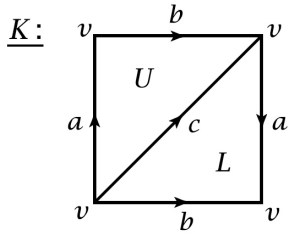
 .
. , the free group generated by the vertex
  , because there is only one vertex!
 . Thus
  .
. .
. .
.  ,
,  . To learn more about calculating
  , check out the diagram on page 105 of Hatcher.
 , where we got
  from adding the two previous generators
  .
. .
. , implies that
  , thus
  can be expressed as a linear combination of
  , thus is not a generator of
  .
.  implies that
  , which gives us the
  part.
part. , and also for
  ,
,  since there are no simplices of dimension greater than or equal to 3. Thus, the second homology group onwards are all zero.
 , then for any
  , there exists
  such that
  .
.![g:[0,1]\to\mathbb{R}](https://s0.wp.com/latex.php?latex=g%3A%5B0%2C1%5D%5Cto%5Cmathbb%7BR%7D&bg=ffffff&fg=1a1a1a&s=0&c=20201002) ,
,  . By the Mean Value Theorem for one variable, there exists
  such that
  , i.e.
 . Here we are using the chain rule for multivariable calculus to get:
  .
. , then
  as required.

 are increasing functions on [0,1]. Thus by Jordan’s Theorem,
  is a function of bounded variation, but it is certainly not continuous on [0,1]!

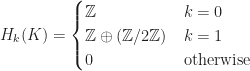
 ), real projective plane (
 ), and the Klein bottle (
 , for
, for 
 (Here n-Torus refers to the n-dimensional torus, not the Torus with n holes)
 (usual torus with one hole in 2 dimensions)

 . Higher homology groups are zero.


 that is a covering map. Since there are many covering spaces, we will list the universal cover instead.
 is the universal cover of the unit circle
 is the universal cover of
  is universal cover of real projective plane
  .
. Mathtuition88