
Given a quadratic equation 


How do we prove this? It is actually due to the quadratic formula!
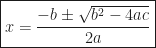
Recall that the quadratic formula gives the roots of the quadratic equation as:
Now, we can let
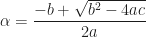

Hence,

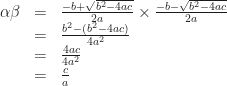
In the above proof, we made use of the identity

The above formulas are also known as Vieta’s formulas (for quadratic). There we have it, this is how we prove the formula for the sum and product of roots!

 Mathtuition88
http://zh.wikipedia.org/zh-sg/%E8%B5%B5%E7%88%BD
The Chinese mathematician Zhou
Shuang 趙爽 (222 AD) of the 吳国 (Wu state) in 3 Kingdoms era (三国) had discovered 1,300 years earlier than the French mathematician Vièta.
LikeLike
Zhao Shuang 趙爽
LikeLike