Exact sequence (Quotient space)
If 

where 



Reduced homology of spheres (Proof)


For 



Exactness of the sequence then implies that the maps 



Exact sequence (Quotient space)
If
where
Reduced homology of spheres (Proof)
For
Exactness of the sequence then implies that the maps
Define the reduced homology groups 


Relation between 
Since 






Algorithm for Fields
In this section we describe an algorithm for computing persistent homology over a field.
We use the small filtration as an example and compute over 
A filtered simplicial complex with new simplices added at each stage. The integers on the bottom row corresponds to the degrees of the simplices of the filtration as homogenous elements of the persistence module.
The persistence module corresponds to a ![\mathbb{Z}_2[t]](https://s0.wp.com/latex.php?latex=%5Cmathbb%7BZ%7D_2%5Bt%5D&bg=ffffff&fg=1a1a1a&s=0&c=20201002)


We have 

In general, any representation 



We need to represent 

We compute the representations inductively in dimension. Since 


For the inductive step, we need to compute a homogeneous basis for 



Source: “Computing Persistent Homology” by Zomorodian & Carlsson
A singular 



The singular homology group is defined as 
If 


This can be used to prove the following proposition:
A chain map 


Proof:
The relation 




For 


Chain Complex
A sequence of homomorphisms of abelian groups 


Elements of 

This post will be a guide on how to calculate Homology Groups, focusing on the example of the Klein Bottle. Homology groups can be quite difficult to grasp (it took me quite a while to understand it). Hope this post will help readers to get the idea of Homology. Our reference book will be Hatcher’s Algebraic Topology (Chapter 2: Homology). I will elaborate further on the Hatcher’s excellent exposition on Homology.
This is also Exercise 5 in Chapter 2, Section 2.1 of Hatcher.
The first step to compute Homology Groups is to construct a 
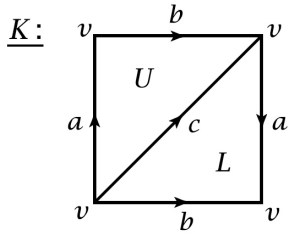
One thing to note for
The key formula for Homology is: 
We have 

Next, we have 

Therefore 
Next, we have 


We then have 


Thus 
To intuitively understand the above working, we need to use the idea that elements in the quotient are “zero”. Hence 


Finally we note that 


In conclusion, we have
This video follows after the previous video on Simplicial Complexes.
If you are looking for quality Math textbooks to study from (including Linear Algebra and Calculus, the two most popular Math courses), check out my page on Recommended Math Books for students!

![\displaystyle M_1=\begin{bmatrix}[c|ccccc] &ab &bc &cd &ad &ac\\ \hline d & 0 & 0 & t & t & 0\\ c & 0 & 1 & t & 0 & t^2\\ b & t & t & 0 & 0 & 0\\ a &t &0 &0 &t^2 &t^3 \end{bmatrix}.](https://s0.wp.com/latex.php?latex=%5Cdisplaystyle+M_1%3D%5Cbegin%7Bbmatrix%7D%5Bc%7Cccccc%5D++%26ab+%26bc+%26cd+%26ad+%26ac%5C%5C+%5Chline++d+%26+0+%26+0+%26+t+%26+t+%26+0%5C%5C++c+%26+0+%26+1+%26+t+%26+0+%26+t%5E2%5C%5C++b+%26+t+%26+t+%26+0+%26+0+%26+0%5C%5C++a+%26t+%260+%260+%26t%5E2+%26t%5E3++%5Cend%7Bbmatrix%7D.&bg=ffffff&fg=1a1a1a&s=0&c=20201002)
![\displaystyle \partial_n(\sigma)=\sum_i(-1)^i\sigma|[v_0,\dots,\widehat{v_i},\dots,v_n].](https://s0.wp.com/latex.php?latex=%5Cdisplaystyle+%5Cpartial_n%28%5Csigma%29%3D%5Csum_i%28-1%29%5Ei%5Csigma%7C%5Bv_0%2C%5Cdots%2C%5Cwidehat%7Bv_i%7D%2C%5Cdots%2Cv_n%5D.&bg=ffffff&fg=1a1a1a&s=0&c=20201002)


 Mathtuition88