Our Daily Story #1 : The Fermat’s Last Theorem

tomcircle's avatarMath Online Tom Circle

While reading “Our Daily Bread” during my daily Bible reading time, it strikes me an idea to create a series of “Our Daily Story” for our Math studying time.
The former makes the Bible alive, connected to our daily life in the context of scriptures; the later will make Math alive, motivate the interest and curiosity of the students to the otherwise cold (and scary, boring) subject, connecting Math to their familiar world.

It is encouraged by Math educationists that a10-minute math story time before class will enthuse the students, to want to know more about the Math topic relating to the mathematician in the story.

My first story will start from The Fermat’s Last Theorem (or FLT), simply because I admire the amateur mathematicians who, for all better choices to spend their spare times, are attracted by the beauty of Math and to become great mathematician…

View original post 156 more words

Our Daily Story #3: The Math Genius Who Failed Math Exams Twice

tomcircle's avatarMath Online Tom Circle

To prove the FLT, Prof Andrews Wiles used all the math tools developed from the past centuries till today. One of the key tool is the Galois Group,  invented by a 19-year-old French boy in 19th century, Evariste Galois. His story is a tragedy – thanks to the 2 ‘incompetent’ examiners of the Ecole Polytechnique (a.k.a. “X”), the Math genius failed in the Concours (Entrance Exams) not only once, but twice in consecutive years.
Rejected by universities and the ugly French politics and academic world, Galois suffered set back one after another, finally ended his life in a ‘meaningless’ duel at 20.

He wrote down his Math findings the eve before he died – “Je n’ai pas le temps” (I have no more time) – begged his friend to send them to two foreigners (Gauss and Jacobi) for review of its importance. “Group Theory”…

View original post 24 more words

Creating Computer Games with Maths

makingpi's avatarmakingpi

Computer games – some people like them and some people hate them (usually parents).  However at Gastrells Primary School the students  make computer games.  These computer games  have a difference, the student design them to teach Maths.  The first project they undertook was the development of their own coordinate game. This was so successful that the students have volunteered to teach the whole class how to develop coordinate games.  Furthermore, the school has gained some great homegrown resources.

View original post

(Finite) Fields — A Primer

Jeremy Kun's avatarMath ∩ Programming

So far on this blog we’ve given some introductory notes on a few kinds of algebraic structures in mathematics (most notably groups and rings, but also monoids). Fields are the next natural step in the progression.

If the reader is comfortable with rings, then a field is extremely simple to describe: they’re just commutative rings with 0 and 1, where every nonzero element has a multiplicative inverse. We’ll give a list of all of the properties that go into this “simple” definition in a moment, but an even more simple way to describe a field is as a place where “arithmetic makes sense.” That is, you get operations for $latex +,-, cdot , /$ which satisfy the expected properties of addition, subtraction, multiplication, and division. So whatever the objects in your field are (and sometimes they are quite weird objects), they behave like usual numbers in a very…

View original post 2,648 more words

7. How are theorems in circles used? How are trigonometric functions embedded?

akkiara's avatarAkkiara Symonn May Sawali's

Ferris Wheel :)

In a Ferris wheel, the circle is used as the main shape of the ride and makes the ride continuous. A circle is special and useful in this situation in the aspect that all the carts are equally distant from the center point and the wheel rotates 360 degrees. The second picture shows a slide from one of the rides in Star City that when it was built, people calculated the right slope in order to give excitement to the riders but not that much for safety. The concept of slope was used then.

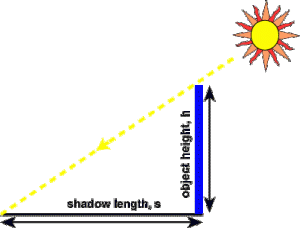
SUUUN SHADOW YEAHHH

Trigonometric Functions are used to “solve” or think of a solution to everyday life problems even though we don’t see them all. For example, the picture above shows a sketch that we can solve by using trigonometry. There are many other examples like:

a. Hula Hoop-concept of tangents is used. Every time it rotates one side…

View original post 42 more words

Clash of Clans Math: Mortar Damage Per Hit

Today, we will use Math to calculate the Mortar Damage (Per Hit) for the popular game Clash of Clans!

Mortar6Mortar7Mortar8

Reference: http://clashofclans.wikia.com/wiki/Mortar

The formula needed is Damage per second (DPS) = Damage / Time.

Hence, Damage = DPS x Time!

The Mortar takes 5 seconds to fire. Hence, take the DPS reading from the game, and multiply it by 5, and you will get the actual damage done by the Mortar!

For instance, Mortar Level 1 has 4 DPS. Hence, each shot does 4×5=20 damage.

The full stats are listed here:

Level Damage per Second Damage per Shot
1 4 20
2 5 25
3 6 30
4 7 35
5 8 40
6 9 45
7 11 55
8 13 65

Subscribe to our free newsletter, for updates on Math, Education and other General Knowledge topics!

Enter your email address to subscribe to this blog and receive notifications of new posts by email.

The Power of Maths

Nice post about “The Power of Maths”

drdeblogs's avatardrdeblogs

Image 1 My kids have invented a number called “one-finity”. It seems to be bigger than any other number they know but still finite, so they could theoretically have one-finity chocolate bars or one-finity birthday presents. It’s a word I hear frequently and I wonder if they’ll eventually brainwash me into using it.

Recently I’ve been thinking a lot about maths education. How can we improve students’ experience? Are the majority of students leaving with maths skills relevant to their future plans? Are we explaining why the techniques we teach are useful? The list goes on.

Despite recent suggestions in the media, there is one thing I have never questioned: if maths is worth teaching to everyone. I believe teaching maths is as essential as teaching a child to read. Whether we are buying groceries, choosing medical treatment, taking out a pension, reading a news article or refitting a kitchen, our lives…

View original post 129 more words

Quantum Groups

The subject of quantum groups is a fascinating and new area of mathematics.

The term “quantum groups” was first introduced by Vladimir Drinfeld in the 1980s. There is no formal definition for the term “quantum groups”, but in general it stands for certain special Hopf algebras.
In some of the literature, a quantum group is defined as a noncommutative and noncocommutative Hopf algebra.
Quantum groups have close connections with many areas of mathematics and physics.

A starting approach is to study the theory of quantum groups, and related topics like Hopf algebras. An example can be as follows.
Chapter 1 introduces the definition of Hopf algebras and its properties.
Chapter 2 focuses on the theory of quantum groups. Chapter 3 includes examples of quantum groups, with some examples from physics.
The main reference for the project can be Quantum Groups by C. Kassel ([2]).

For a project, one can refer to Part One of the book, from Chapter I to VII. Before researching on quantum groups, one can also study Hopf algebras, including viewing online lectures by F. Ardila ([3]).
A good project topic is to study and write a summary and a brief introduction to the vast subject of quantum groups.

Ampere’s Law Project

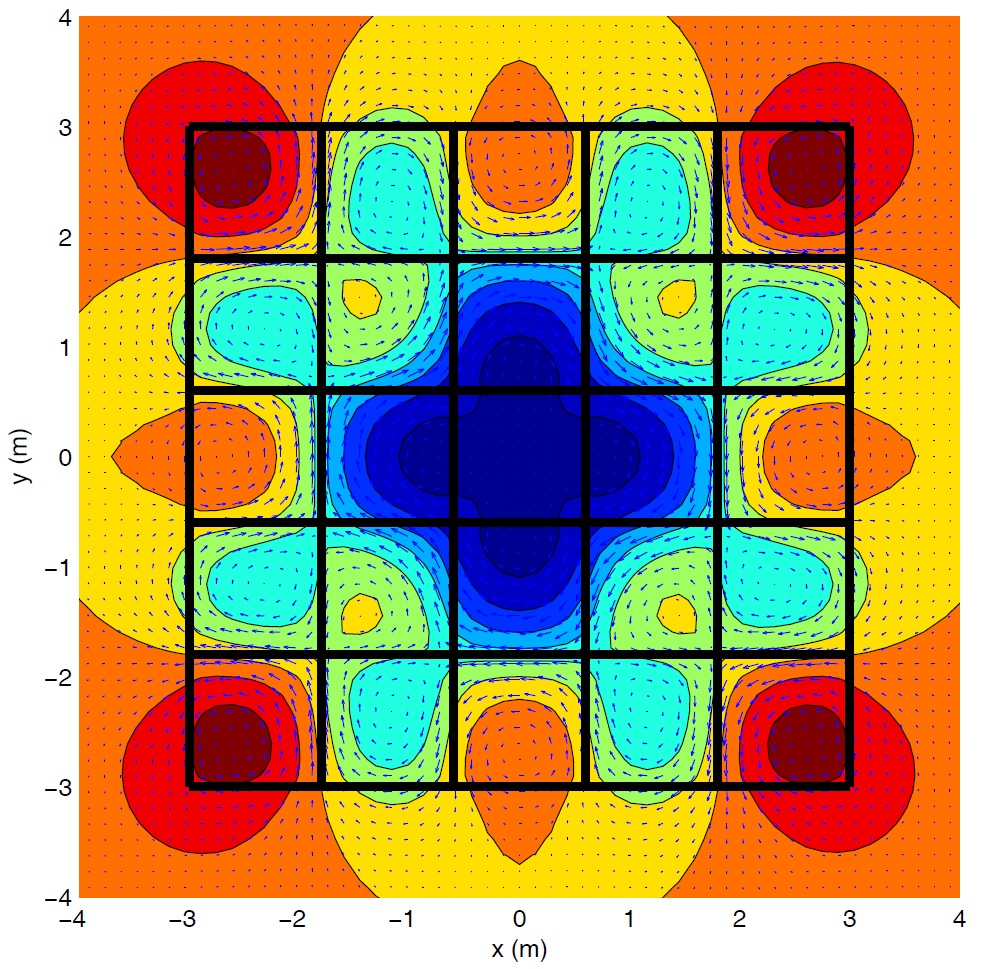
In this project, we investigate Ampere’s Law by considering a 2D problem
with the axis of the wire perpendicular to the plane. We calculate the magnetic potential A_z for a certain current density, and generate and plot the magnetic field.
Later, we generalize the approach to two wires with parallel currents and
antiparallel currents.
Finally, we adapt the code to plot for three wires, wire of other shapes
(\pi shape), and a 5×5 grid of 25 wires.
For the 5×5 grid of wires, we consider a case whereby each wire is
switched on one at a time, in a certain pattern. The objective is to observe
the interactions of magnetic fields.

wire

PSLE Exam Dates

Source: http://www.seab.gov.sg/examCalendar.html

Please double check with the above source for confirmation!

2014 PSLE EXAMINATION CALENDAR (TENTATIVE) Registration Mon, 10 March – Fri, 28 March 2014


Oral Examination Thu, 14 August – Fri, 15 August 2014


Listening Comprehension Fri, 19 September 2014


Written Examination


Thu, 25 September – Wed, 01 October 2014


Marking Exercise Tue, 14 October – Fri, 17 October 2014


Design and Technology tuition

For other subjects besides Mathematics, request for a tutor at Startutor! Startutor is Singapore’s most popular online agency, providing tutors to your home. There are no extra costs for making a request. (Website: http://startutor.sg/request,wwcsmt)

Startutor is suitable for English Tuition, Social Studies Tuition, Geography Tuition, Physics Tuition, Chemistry Tuition, Biology Tuition, Chinese Tuition, Economics Tuition and more!

General Paper (GP) Tuition

For other subjects besides Mathematics, request for a tutor at Startutor! Startutor is Singapore’s most popular online agency, providing tutors to your home. There are no extra costs for making a request. (Website: http://startutor.sg/request,wwcsmt)

Startutor is suitable for English Tuition, Social Studies Tuition, Geography Tuition, Physics Tuition, Chemistry Tuition, Biology Tuition, Chinese Tuition, Economics Tuition and more!

Economics Tuition

For other subjects besides Mathematics, request for a tutor at Startutor! Startutor is Singapore’s most popular online agency, providing tutors to your home. There are no extra costs for making a request. (Website: http://startutor.sg/request,wwcsmt)

Startutor is suitable for English Tuition, Social Studies Tuition, Geography Tuition, Physics Tuition, Chemistry Tuition, Biology Tuition, Chinese Tuition, Economics Tuition and more!

Chinese Tuition 华文补习

For other subjects besides Mathematics, request for a tutor at Startutor! Startutor is Singapore’s most popular online agency, providing tutors to your home. There are no extra costs for making a request. (Website: http://startutor.sg/request,wwcsmt)

Startutor is suitable for English Tuition, Social Studies Tuition, Geography Tuition, Physics Tuition, Chemistry Tuition, Biology Tuition, Chinese Tuition, Economics Tuition and more!

Biology Tuition

For other subjects besides Mathematics, request for a tutor at Startutor! Startutor is Singapore’s most popular online agency, providing tutors to your home. There are no extra costs for making a request. (Website: http://startutor.sg/request,wwcsmt)

Startutor is suitable for English Tuition, Social Studies Tuition, Geography Tuition, Physics Tuition, Chemistry Tuition, Biology Tuition, Chinese Tuition, Economics Tuition and more!

Chemistry Tuition

For other subjects besides Mathematics, request for a tutor at Startutor! Startutor is Singapore’s most popular online agency, providing tutors to your home. There are no extra costs for making a request. (Website: http://startutor.sg/request,wwcsmt)

Startutor is suitable for English Tuition, Social Studies Tuition, Geography Tuition, Physics Tuition, Chemistry Tuition, Biology Tuition, Chinese Tuition, Economics Tuition and more!

Physics Tuition

For other subjects besides Mathematics, request for a tutor at Startutor! Startutor is Singapore’s most popular online agency, providing tutors to your home. There are no extra costs for making a request. (Website: http://startutor.sg/request,wwcsmt)

Startutor is suitable for English Tuition, Social Studies Tuition, Geography Tuition, Physics Tuition, Chemistry Tuition, Biology Tuition, Chinese Tuition, Economics Tuition and more!

Geography Tuition

For other subjects besides Mathematics, request for a tutor at Startutor! Startutor is Singapore’s most popular online agency, providing tutors to your home. There are no extra costs for making a request. (Website: http://startutor.sg/request,wwcsmt)

Startutor is suitable for English Tuition, Social Studies Tuition, Geography Tuition, Physics Tuition, Chemistry Tuition, Biology Tuition, Chinese Tuition, Economics Tuition and more!

English Tuition

For other subjects besides Mathematics, request for a tutor at Startutor! Startutor is Singapore’s most popular online agency, providing tutors to your home. There are no extra costs for making a request. (Website: http://startutor.sg/request,wwcsmt)

Startutor is suitable for English Tuition, Social Studies Tuition, Geography Tuition, Physics Tuition, Chemistry Tuition, Biology Tuition, Chinese Tuition, Economics Tuition and more!

Maths- Tessellations, rotational symmetry and art

schooledwa's avatarschooledwa

This week the students have been learning a bit about geometric properties. We look at what symmetrical means and where we find it in real life. The students found out how to find lines of symmetry and what it means to have rotational symmetry. By looking at the work of MC Escher the students began making their own tessellating shape patterns using regular shapes and creating their own jigsaw pieces. The jigsaw pieces were made by drawing a random squiggle on one side of a square piece of card and then sticking it to the vertically opposite side. I hope you agree the work they have produced is pretty amazing!

20140223-113524.jpg

20140223-113543.jpg

View original post

History Included part 1

kaleb40's avatarTo Accumulate a Rate --- Integrate!

20140222-135422.jpg

Doesn’t it seem like we should teach math with it’s history attached. Wouldn’t adding a historical perspective while teaching and learning about Mathematics help bring the concepts to life? Sometimes it’s hard to know the exact approach to include it and sometimes it’s hard because we are not very familiar with the history. And let’s face it, textbooks do a horrible job including the history, occasionally attaching mere tidbits here and there that usually are superficially related to the content on the surrounding pages.
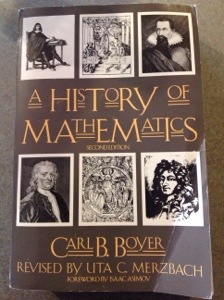
I’m going to read, “A History of Mathematics,” by Carl Boyer to help me learn more of the history and get some perspective on including it in lessons. Hopefully I’ll come up with some great ideas about embedding historical motivation for the discovery of Mathematics into my teaching.
More to come….

View original post

For your students’ sake: Don’t stop being a learner

Andrew's avatarMr. Shauver - Learner Educator

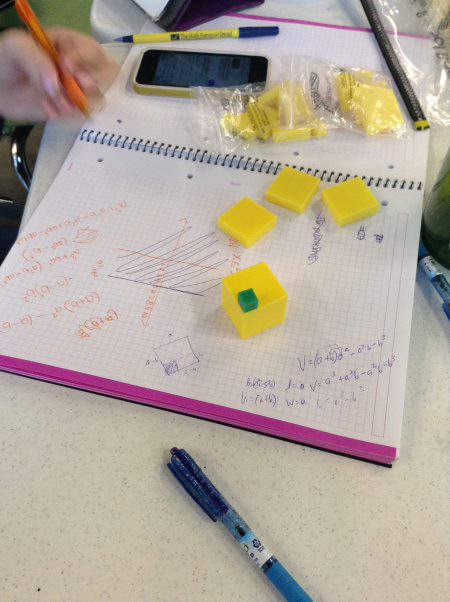
Yesterday, we designed an Algebra II lesson using 3D modeling to derive the factored formula for difference of cubes. As we began to finish up, Sheila (@mrssheilaorr), the math teacher sitting beside me made a passing reference to being frustrated trying to prove the sum of cubes formula. Me, being a geometry teacher by trade decided to give it a try perhaps hoping to offer a fresh perspective. I mean, I was curious. It looked like this:

2014-02-20 13.26.00

On the surface, it didn’t seem unapproachable. I quickly became frustrated as well. Most frustrating was the mutual feeling that we were so stinkin’ close to cracking the missing piece. Finally, Luann, a math teaching veteran sat down beside us, commented on her consistently getting stuck in the same spot we were stuck and then, as the three of us talked about it, the final piece fell in and it all made sense (it’s…

View original post 467 more words

Threes: A Simple and Addictive Grid-based Math Puzzle for iOS

kunalchheda05's avatarTechGrade

Let’s be honest. One of the most dangerous things about trying new games every now and then on the iPhone or other iOS devices is that you risk finding something cheap and addictive that can seriously take away from your free time. And the fact that in most cases these games can be played using just one hand makes them even more fun.

Threes-Review

View original post 397 more words

Free Resources for Higher Math

linklady's avatarGratisLearning

InteractiveMathematics There is something for those who are learning everything from integers to higher (gulp) calculus here. There is also the option to download a variety of graph paper from the site as well. In addition to the examples, answers and explanations of a wide variety of math levels, there are also some games thrown in, just in case you didn’t get enough math fun in for the day. I love that this site, and all of the other free math sites exist, I just wish all of this free help had been around in my day…(sighs)

WolframMathWorld While this site is primarily geared toward higher math, it’s an invaluable resource to have “at the ready” for when your student (or you) venture into this level of mathematics. A worthy site to keep on hand!

View original post

The Study of Change

danielg421's avatarMathematically Inclined

Calculus is the mathematical study of change. The way that we examine what happens at one point, and how things change when we examine the same concept somewhere else. Today we’re going to get a basic understanding of what Calculus is, what we can use it for and why it’s so scary.

According to Dr. Derek Martinez, a Math professor at UNM, Calculus classes have two purposes. The explicit purpose is to teach students how to do the math. The implicit purpose is to make engineering and medical students mentally stronger and intellectually prepared for future careers.

Many a student has made it through Algebra and Trigonometry classes only to be cut down to size by the dreaded Calc 1 or worse, Calc 2. When you meet a surprisingly smart Psych major, or a meticulously picky Foreign Languages major, that probably means they decided at some point that integrals are…

View original post 354 more words

More Math Links

linklady's avatarGratisLearning

Purplemath  This site has everything from preliminary topics such as fractions and absolute value to the beginnings of trig. Each unit of study is broken up into groups/categories to help you zoom in on exactly what you need. A problem is shown, then the step-by-step explanation is given out beside it, with diagrams/drawings to go along with it where necessary. This site would be helpful for many, especially those going through any stage of learning algebra.

PatrickJMT  Here you will find numerous math videos ranging from basic arithmetic to trigonometry, all provided for free. The videos are very clearly listed by categories, then more specific subcategories beneath. The site is very straightforward and easy to navigate, which is great when you are frustrated already and trying to find very specific help for a very specific math problem.

VisualFractions  While this site is devoted to, you guessed it, fractions, it…

View original post 84 more words

This Week: STEM Subjects and Possibilities

snowwhitehair's avatarSnow White

STEM subjects are at the forefront of the media’s focus on education. What are they? It’s simple; Science, Technology, Engineering, and Mathematics. Why are they so important? Well, they’re the future of our world. These fields are making rapid advancements and needing more brain power to do so. (Which they’d have if not for the sexism that exists within these fields perpetuating the idea that women are not adept in such studies.) Besides that though, there is a need to generate interest in STEM subjects that has been greatly diminished by the social norm of finding them ‘uncool.’

There is, of course, great reward in entering these fields. Especially engineering, with some starting salaries higher than the median salary of my future career (clinical psychology). As shown by the chart I’ve attached, there is a much higher percentage of people earning more than those at an…

View original post 24 more words

After 400 years, mathematicians find a new class of shapes

Akshat Rathi's avatarAkshat Rathi

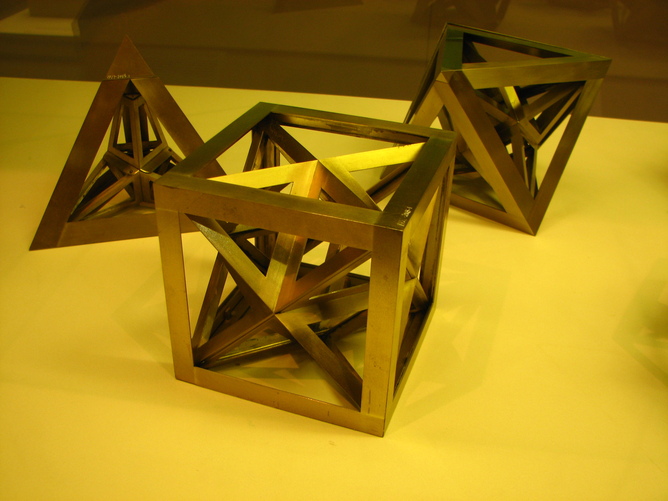
The works of the Greek polymath Plato have kept people busy for millennia. Mathematicians have long pondered Platonic solids, a collection of geometric forms that are highly regular and are frequently found in nature.

Platonic solids are generically termed equilateral convex polyhedra. In the millennia since Plato’s time, only two other collections of equilateral convex polyhedra have been found: Archimedean solids (including the truncated icosahedron) and Kepler solids (including rhombic polyhedra). Nearly 400 years after the last class was described, mathematicians claim that they may have now identified a new, fourth class, which they call Goldberg polyhedra. In the process of making this discovery, they think they’ve demonstrated that an infinite number of these solids could exist.

Platonic love for geometry

Equilateral convex polyhedra share a set of characteristics. First, each of the sides of the polyhedra needs to be the same length. Second, the shape must be completely solid—that…

View original post 783 more words

Online Math Resource Treasures

bethandshannon's avatarcoaches corner blog

In staying with the same vein as last week, we wanted to share a few new math resources appropriate for middle and high school level.

1.  Symbaloo – This is a bookmarking website that has real potential.  We really like how visual it is! You can create a symbaloo for your students or parents of students of tutorial sites, virtual manipulative sites, and textbook sites.  Or, you can create a symbaloo for your own organization of sites you frequent regularly.  They can be organized on the board by color, icon, and location.  It takes very little time to create.   The math half of us started one called CCSS Math – Parvankin.  It is full of math sites that are often referenced.  And, not to be outdone, the Literacy half of us started one called CCSS Literacy – Elliot including Literacy Resources featured last week here, as well…

View original post 251 more words

5 Common Myths about Dyscalculia

Dr. Dan Pezzulo's avatarDr. Dan Pezzulo

Myth #1: All children with dyscalculia have the same difficulties with math.

Fact:Dyscalculia actually refers to a wide range of math issues, so your child’s trouble spots may be different from another child’s. For example, some kids with dyscalculia have a hard time with basic number concepts. Others have difficulty with the kind of visual-spatial thinking that’s needed for geometry. What most kids with dyscalculia have in common, though, is challenges remembering basic math facts and completing math problems.

Myth #2: Dyscalculia is another name for math anxiety.

Fact: Dyscalculia and math anxiety are not the same thing. It’s understandable that people confuse the two, though. It’s common for kids who struggle with math—like kids with dyscalculia—to become anxious about doing math homework or going to math class. Learn more about key differences between dyscalculia and math anxiety.

Myth #3: Dyscalculia is basically dyslexia for math.

Fact: Although dyscalculia…

View original post 180 more words

Introduction to Apollonian circle packings (tangent)

yenergy's avatarBaking and Math

This is not my area of research at all, but I think it’s super cool.  The first time I heard of Apollonian circle packings was at that conference I went to in Marseille last month, during the first lecture of Hee Oh’s minicourse.  So here’s a quick write up  background of the first third of that lecture.

These packings and all this theory come from one dude, Apollonius of Perga, who wrote a bunch of math books back around 200 BC.  Literally this math has been around for 2200 years.  Here’s a paper submitted a month ago which is a generalization of Apollonius’s problem from circles to spheres.  Math is so amazing!  We live in history!

To understand the problem, we’ll have to do a quick geometry brush up.  We say that two shapes or curves or lines in the plane are tangent if they touch at exactly…

View original post 1,181 more words

张益唐在伯克利的演讲絮记 (转载)

bluepanda5's avatarbluepanda5

图片
张的主要结果是一流的,他证明了关于素数分布的一个里程碑式的定理。
— 美国数学年鉴审稿人,2013年5月
基本上,这个领域里没有人知道他(张益唐),而现在,仿似一夜之间,他证明了一个可以名列数论历史上最伟大结果之一的定理。这个领域内的世界顶级专家已经竭尽全力的使用这类方法去解决这个大问题,而他并非一个知名专家,却在所有专家倒下的地方成功的站了起来。
                                              —  Adrew Granville
【Note】本文作者的数学修养和知识都极其有限,对于数学专业的人来说,基本上是数学盲。因此本文只属于絮记 —- 从一个非数学专业的业余爱好者的角度描写旁听张老师在伯克利演讲的部分过程,并附带一些小花絮。行文中如有幼稚之处请谅解,还有期待专业报道或评论的人士请出门左拐并客气一些,谢谢。

by 灵致

如果评选本年度最值得华人世界为之骄傲的事,张益唐奇迹般的崛起绝对是其中一个,至少在我眼里是如此。 无论时光过去多少年,当我们都老去,离开了这个世界,张先生的故事都将流传下去,直到最后的最后。
 图片
就在两天前,我突然收到系里一个同学的邮件,令我惊讶的提到张益唐先生将于本周四的下午在伯克利演讲他在素数有界距离方面的最新工作。
从今年的五月份开始, 我在美国媒体以及周围的社交网络的各种报道开始爆炸式发展的时候开始,就和很多人一样密切关注张先生的各种消息,分析以及评价。那个时候,曾经一度冷清的MITBBS数学版罕见式的大爆发,持续数月的讨论张的结果。虽然大部分都是八卦类的,但是大家对于数学的热情似乎一下子被那么一簇火点燃了。
图片
张的文章很快就在网上可以下载,虽然我完全不懂,但觉得非常厉害,于是很崇敬的下载下来,读了最前面3页。然后的然后,在符号介绍完毕进入证明技术细节的时候,我就lost了。但是网友写的证明总结和评论,以及陶哲轩的blog文章,我都看了,所以在大的picture上知道他大概是如何做到的,然后是如何的不易。
这一次,我居然有机会去听一听— 哪怕一窍不通,但张老师的学问和人品也足以让我放下手头的一切去旁听一下。
应该说,我是满怀期待并内心很激动的。
图片
可是昨天才发现演讲的时间和我们组会时间冲突,然后接到导师的邮件,说本来准备来我们组会给talk的人困在洛杉矶无法如期到达,于是导师问我可不可以由我来讲点自己暑假做的东西。 我当时觉得很遗憾,但是还是硬着头皮答应了。不过,我想到一个点子— 因为组会时间和张的演讲时间只有半个小时交集,我可以压缩我的talk时间,然后说不定组会提前结束,我可以赶过去。
结果是,因为有教授过来访问并参加了组会,加上大家讨论很积极,原本我计划好一个小时速战速决的talk足足用了一个半小时。而且我讲的中间,google calendar还跳出来提醒说“Yitang Zhang 给talk 啦!”, 众人都笑了。等我急匆匆的放好东西赶到Evans的60号教室时,居然里面在上课— 放着二战的电影。正在我一头黑线不明其里的时候,门口有人告诉我talk改在了4点钟开始。我当时高兴极了,想着总算没有错过。
那个教室很快下课,学生鱼贯而出。
我在前面找了个不错的位置,在余下的四十分钟时间里静静的等待。
突然,旁边有人叫道,哇,那就是他!
图片
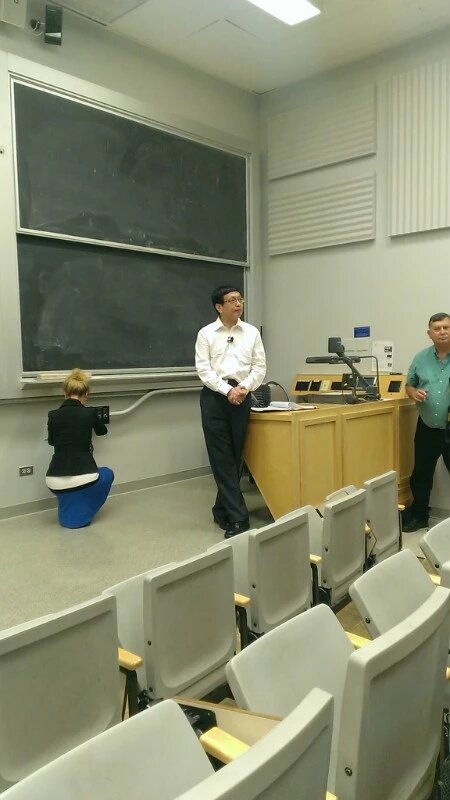
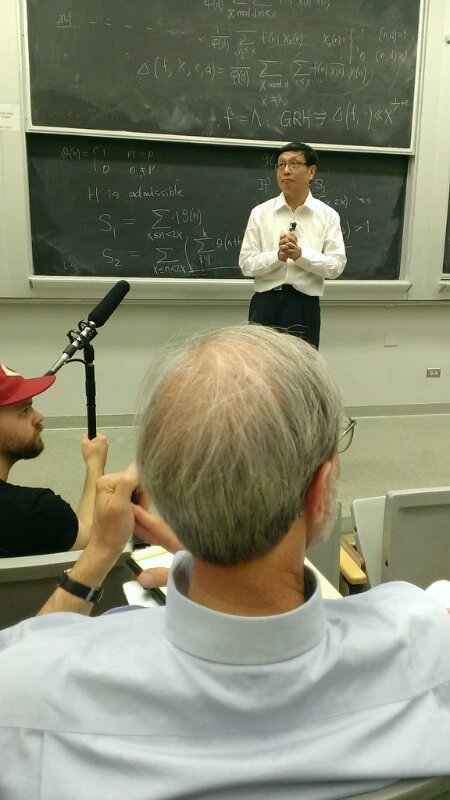
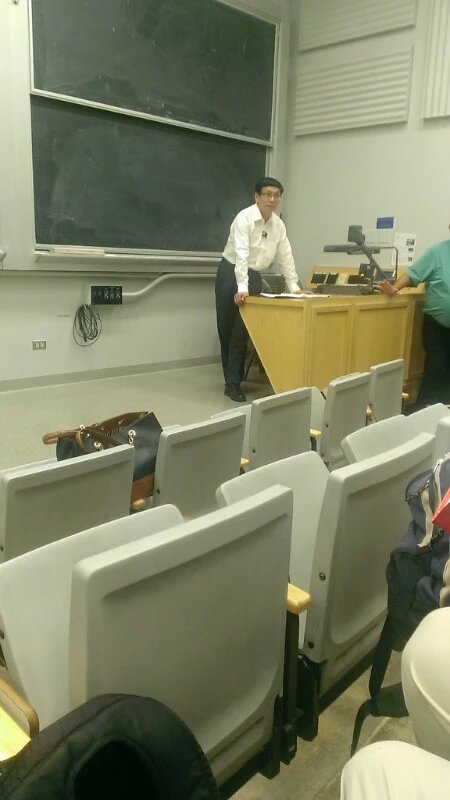
我抬头,几个数学系的老教授和一个白衬衫黑西装裤打扮的中国人聊得火热。那个中国人,就是张老师了。
旁边似乎是媒体的人架着摄像头在跟拍。几个设备支持人员围着他,帮他带上麦克风等设备。
因为这边有所谓的伯克利时间的传统(可以比规定的时间迟到10分钟),那会儿人还不多。张老师一边走,一边看了一眼我们几个人,正好看到我的时候,我脑子一抽经,脱口就甩出一句中文:“张老师好!”, 他双手摆摆,说“你好你好!”。
图片
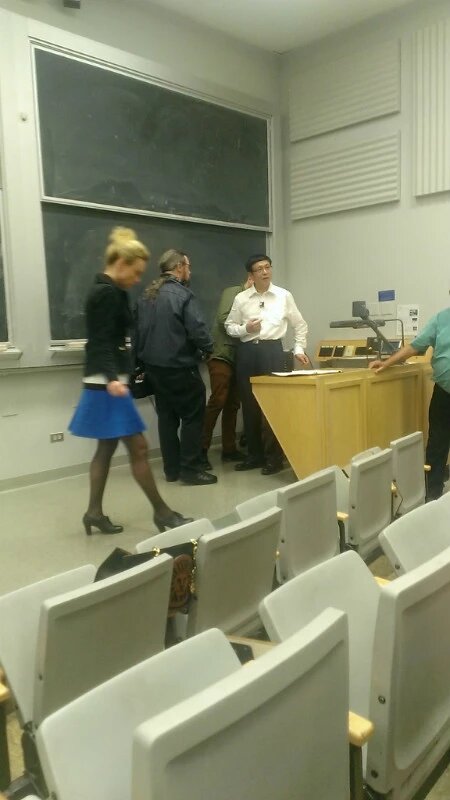
不一会儿,talk快开始了,人越来越多,空位置越来越少。我看到很多平常不经常出现的老教授也陆续赶来。
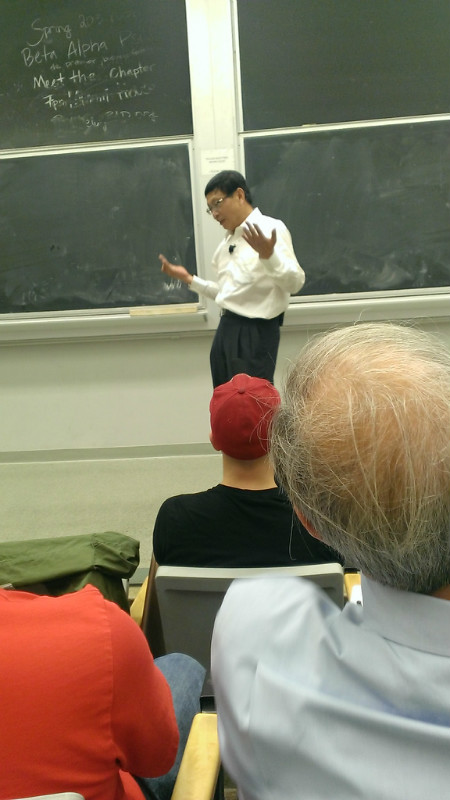
在主持人简短的介绍完毕之后,全场热烈鼓掌表示欢迎。张老师双手微微张开持续向大家挥手致谢。
之后,他就开口讲话了。
说实在的,他的口语是比较重的中式口音,我们听起来毫无问题,但是估计有一些美国人会被虐得不行。
图片
他开始就说要讲的内容是素数分布算术数列的最新进展。
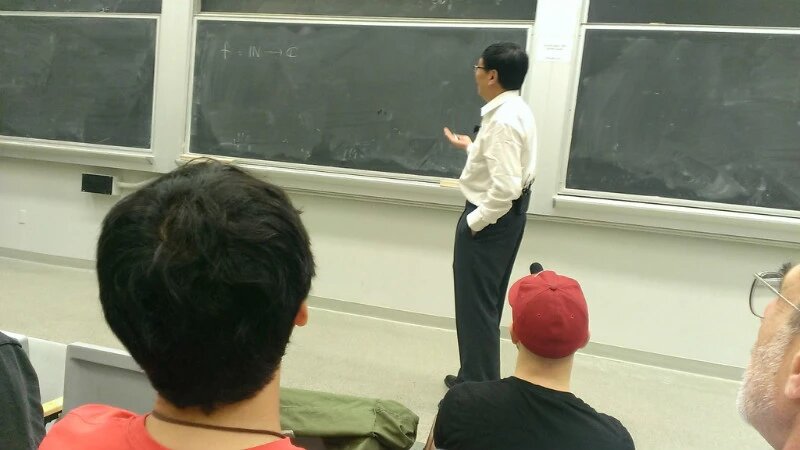
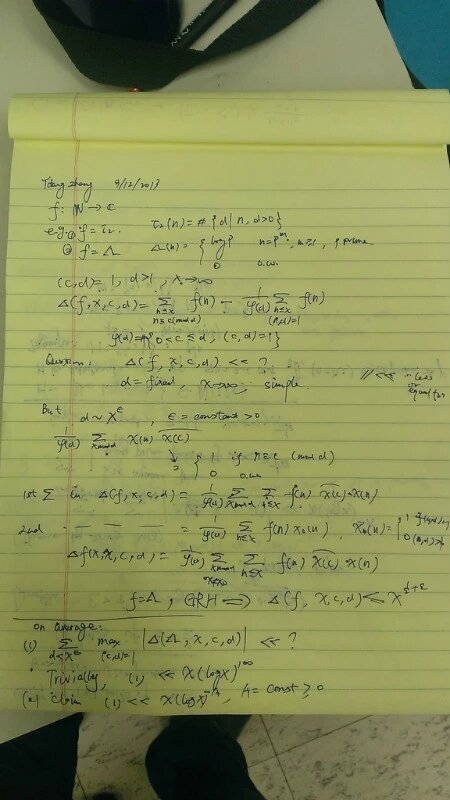
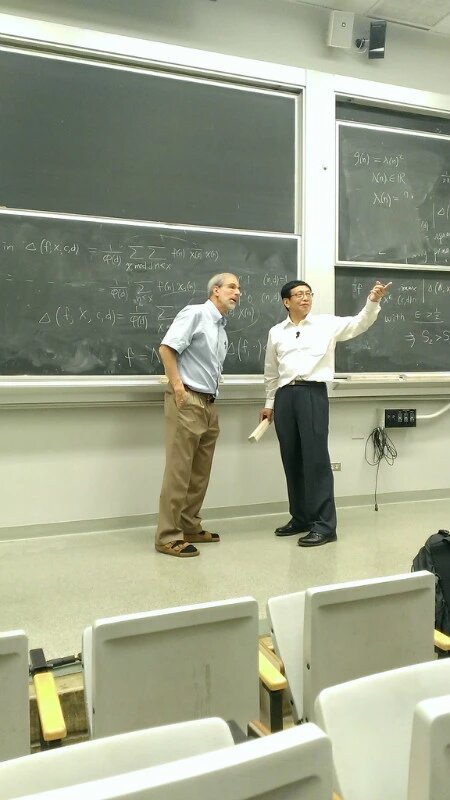
然后就掠起袖子拿起粉笔开始在黑板上写divisor function和von Mangoldt function等,并由此开始定义Delta函数,以及后面的广义黎曼猜想和他的结果和思路。从开始到最后持续了四十五分钟左右,他一路讲得很顺畅。尽管不懂,但我认真记笔记。其中一些数学的技术细节,因为我数学水平不够,无法做出好的评论。他的talk,总共用了8快黑板,我抄了3页笔记。
 图片
其中有一次他电话响,他连声道歉并把电池拔了下来(那种很老式的翻盖手机),大家宽容的笑。
直到讲到最后,他面向观众,说由此,我们可以证明素数距离有界。全场再次爆发以热烈的掌声,持续很长时间—- 这可以看出大家对他是很尊敬的。
图片
接下来是问题时间,却突然全场冷场,没有人提问。我们都环顾四周,不知道为何那些数学大牛不趁机提点问题,气氛似乎一下子紧张了一些。我这个时候脑子又抽经了,举了手,张老师注意到我,然后主持人示意我可以提问。
我当时知道很多人在看我,也知道我有可能很丢脸,但似乎在这种时候我犯二的精神总能让我无所畏惧。我吸了一口气,说我要问一个很幼稚的问题。他点头示意。我就说,我注意到你的证明中有一个参数用了一个数 1/2 + 1/584, 以及有个重要的步骤约束条件用的是d小于x的1/1168次方,我不知道为什么你会特别的选择这些数字(比如584和1168而非其他),而不是其他数字。尽管我的本意是说我理解证明了这些特例,就证明了最后的结果,但是对于选择这些数字,显然不是任意的,肯定需要满足某种特别的性质或者其他动机而不是随手挑一个就可以的,否则他肯定会选择符合条件的比较优美自然一点的数字。
他最后解释说是因为他自己简单的验算,这些数字正好符合要求而且他那时候太累了,就直接用了。
图片

后来气氛活跃了一些,有个老教授问他用计算机算的么。他用手在空中画了一个小方框,说我用普通的计算器算的。全场大笑。

在另外一个明显很懂的教授问了一个技术问题后,没有人问题了,演讲就此结束。人们开始陆续离开,我反正之后也没有啥事,就坐着没动。
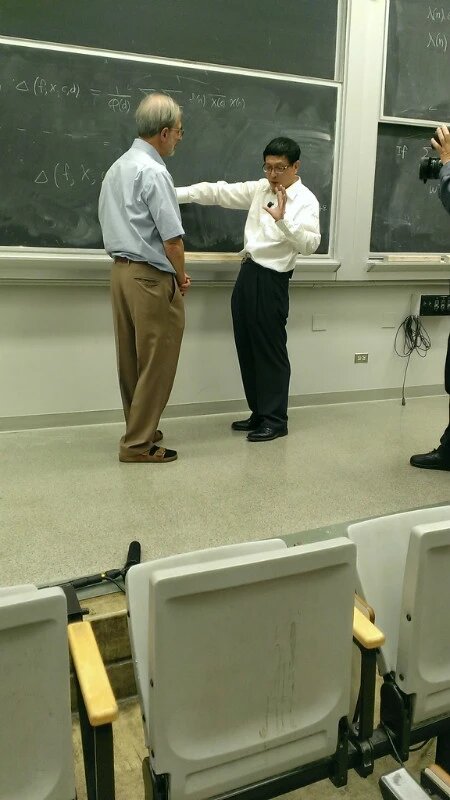
张老师很恭敬的向坐在前排的一个老教授致意,然后似乎想和他讨论其中一个技术问题,那个老教授起身去和他讨论。旁边的一个似乎是媒体的工作人员觉得这镜头不错,立马跑上去跟拍他们讨论的过程。张老师很大气的讲着,丝毫没有看镜头和受到干扰。
 图片
最后教室里只剩下几个人的时候,他又掠起袖子,在离开之前想把擦黑板檫干净。这点很令人感动。中间几次有人打断他檫黑板和他聊两句,他很礼貌的停下来和别人说话,之后接着檫,直到最后一块的时候,有个老教授说你不用檫了,留着挺好,他才停下来。
不一会儿,他接到一个电话,是他太太打过来的。他立马变成了中文模式,普通话甩得可标准了。那时他看到坐在座位上翻笔记的我,示意性的笑了笑。
图片
我起身离开的时候,正好在出门的时候遇到他。我问他之后要去干嘛,他说他太太过来接他,要在一个灯塔下面见面。
我内心想笑,因为这是我第一次听到有人把伯克利的钟塔叫灯塔,感觉像海边的信号塔似的。
一边正要出门,我说,你说的是不是校园中心的那个塔?
他说是啊是啊,就是那个灯塔。
我出了教室门左拐,看他往右拐,似乎迷惑住了不知道往何处走。Evans hall的结构是比较不容易摸清方向。 我就问他是不是不知道往哪里走?他很憨厚的笑了笑点着头。
我就说要不我带你过去把,走近道几步就到了。他连声说谢谢。
走的路上,我问他是不是讲的很累,他说很okay啊,这算很轻松的了。
然后我就说我也下了你的论文,可惜我啥都不懂,但我觉得你开头两页写的真好,连我这种一窍不通的人都读懂了。
他就看着我笑,然后顿了顿,说其实啊,我很用心的写的,但是第五页写的最用心,因为那一页如果写不清楚,很多人会觉得你是胡闹。最后也是写好了那小部分,才觉得一切就很明了。
图片
他还说,他在投稿前两个月的时间里累得精疲力尽,但是自我检查是必不可少的。最后,当他通过各种角度去验证都没有发现证明的错误的时候,就松了一口气,放心的投了出去。
我和他开玩笑说这听起来就好比是多次随机采样,反复验证直到你确定正确的置信度达到了95%以上才放手。他又笑。
期间我们谈到他太太,可以透露的内容是,他太太在Mountain View工作,从事的工作不是大家一致猜测的程序员,而是一个我个人觉得很不错的工作(尽管他用比较搞笑的语言描述的)。而且,在我看他讲他太太的神情和语气可以看出,他们的感情很好。 我把他带到萨瑟塔(Sather Tower)下面朝向金门大桥的地方,站了一会儿也没有看到他太太的人。 我就提议他给太太打电话,然后等她过来。
之后,我和他告别,就离开了。
其实,他并不知道我的名字。但我想他应该知道,有很多人,包括我,是很敬佩他的。
有很多人关心他能不能继续做出世界顶级的工作,比如攻克广义黎曼猜想等等,也有很多人质疑和辩论他是否够格称作大师, 所谓排名几何或者和陶哲轩比谁更牛等。但是我,相信和不少人一样,只是希望他未来能够过得更开心和幸福。其他的,不那么重要了。
 图片
灵致
2013年9月12日
加州·湾区
附事件概要
时间:2013年9月12日
地点:Evans Hall, Room 60.
主讲:张益唐
听众:数学系教授和学生,还有一半啥都不懂只为瞻仰而去的听众,比如我。

View original post

Dissecting The Riemann Zeta Function

Prateek Joshi's avatarPerpetual Enigma

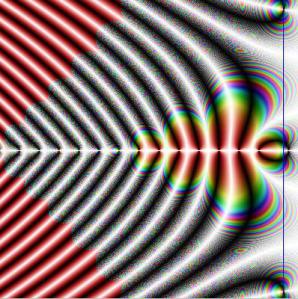
1 mainThe Riemann Zeta function is an extremely important special function of mathematics and physics. It is intimately related with very deep results surrounding the prime numbers. Now why would we want to care about prime numbers? Well, the entire concept of web security is built around prime numbers. Most of the algorithms for banking security, cryptography, networking, communication, etc are constructed using these prime numbers and the related theorems. The reason we do this is because of the inherently sporadic nature of prime numbers. You never know where the next one is going to appear on the number line! So what does that have to do with the Reimann zeta function? If prime numbers are random, what’s the point of looking into them?  
View original post 1,248 more words

MM4B Quadratic Functions

pgwoolfe's avatarMr Woolfe's Maths Heaven

MM4B Quadratic Functions. This video re-visits Quadratic Functions, presents a summary of the features of Quadratic Functions, shows the various ways of solving quadratic equations, talks about the use of the discriminant and then show how completing the square can be used to describe the transformation steps from the basic function of a quadratic to a new variant in turning point form. The video was made for students studying Mathematical Methods (CAS) in Year 12, a course fully prescribed by the Victorian Curriculum and Assessment Authority in the State of Victoria, Australia

View original post