(This is Example 4.11 in Hatcher’s book).
Cellular Approximation for Pairs: Every map  of CW pairs can be deformed through maps
  to a cellular map
  .
.
What “map of CW pairs” mean, is that  is a map from
  to
to  , and the image of
  under is contained in
  . CW pair
  means that is a cell complex, and
  is a subcomplex.
First, we use the ordinary Cellular Approximation Theorem to deform the restriction  to be cellular. We then use the Homotopy Extension Property to extend this to a homotopy of on all of . Then, use Cellular Approximation Theorem again to deform the resulting map to be cellular staying stationary on .
We use this to prove a corollary: A CW pair is n-connected if all the cells in  have dimension greater than
  . In particular the pair
  is n-connected, hence the inclusion
  induces isomorphisms on
  for
for  and a surjection on
  .
.
First we note that being n-connected means that the space is non-empty, path-connected, and the first n homotopy groups are trivial, i.e.  for
for  .
.
Proof: First, we apply cellular approximation to maps  with
with  , thus the map is homotopic to a cellular map of pairs
  . Since all the cells in have dimension greater than , the n-skeleton of must be inside . Therefore is homotopic to a map whose image is in , and thus it is 0 in the relative homotopy group
  . This proves that the CW pair is n-connected. Note that 0-connected means path-connected.
Consider the long exact sequence of the pair :

Since it is an exact sequence, the image of any map equals the kernel of the next. Thus,  (since
  ). Thus
  is surjective. Since , the later terms in the long exact sequence are also 0, thus, the inclusion induces isomorphisms on for , since the first n homotopy groups all vanish.








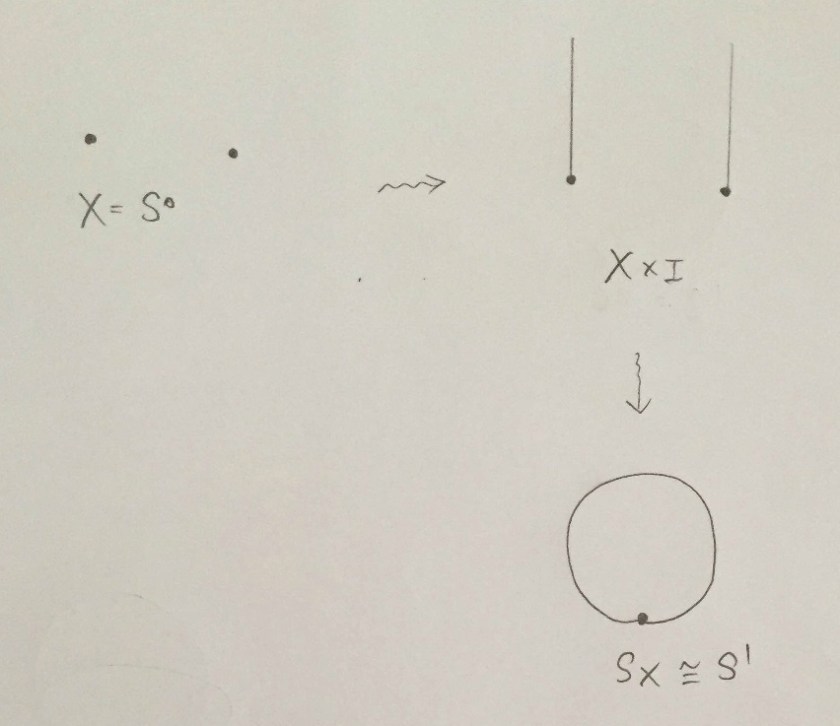
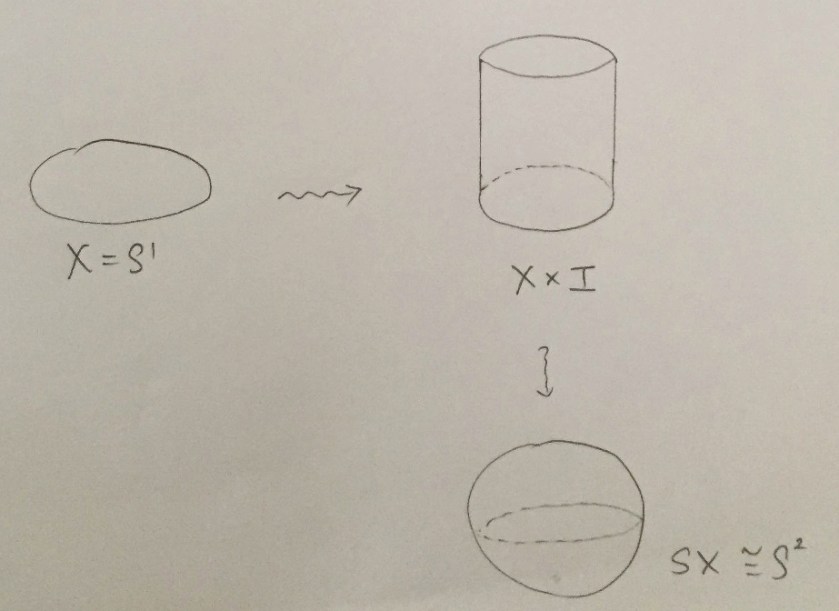
 , with
  , and
, and  are complex constants, is called a linear fractional transformation, or Mobius transformation.
 ,
,  ,
,  onto the points
  ,
,  ,
,  . (Question taken from
  )
)
 ,
,  and
and  .
. :
:  ,
,  ,
,  . Substituting back into the Mobius Transformation gives us the answer.
 (where
  and
and  are open sets) is an analytic function such that there exists another analytic function
  , satisfying
  and
and  .
.

 Mathtuition88