Let 


Solution:
The solution strategy is to use simple functions (common tactic for measure theory questions).
Let 

Consider the set 


Then,

Let
Solution:
The solution strategy is to use simple functions (common tactic for measure theory questions).
Let
Consider the set
Then,
Interesting Career Personality Test (Free): https://mathtuition88.com/free-career-quiz/
Let 
![f:X\to [0,\infty]](https://s0.wp.com/latex.php?latex=f%3AX%5Cto+%5B0%2C%5Cinfty%5D&bg=ffffff&fg=1a1a1a&s=0&c=20201002)
![\lambda:\mathcal{M}\to[0,\infty]](https://s0.wp.com/latex.php?latex=%5Clambda%3A%5Cmathcal%7BM%7D%5Cto%5B0%2C%5Cinfty%5D&bg=ffffff&fg=1a1a1a&s=0&c=20201002)


(a) Show that 

(b) Show that for any measurable function ![g:X\to[0,\infty]](https://s0.wp.com/latex.php?latex=g%3AX%5Cto%5B0%2C%5Cinfty%5D&bg=ffffff&fg=1a1a1a&s=0&c=20201002)

![[0,\infty]](https://s0.wp.com/latex.php?latex=%5B0%2C%5Cinfty%5D&bg=ffffff&fg=1a1a1a&s=0&c=20201002)
Proof: For part (a), we routinely check that


If 


(b) We note that when 

Hence the equation holds. By linearity, we can see that the equation holds for all simple functions. Let 


Note that 


Many people have feedback to me that the Career Quiz Personality Test is surprisingly accurate. E.g. people with peaceful personality ended up as Harmonizer, those who are business-minded ended up as Entrepreneur. Do give it a try at https://mathtuition88.com/free-career-quiz/. Please help to do, thanks a lot!
Also, some recent news regarding PSLE Maths is that a certain question involving weight of $1 coins appeared. It is very interesting, and really tests the common sense and logical thinking skills of kids.
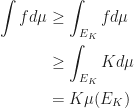
Markov inequality is a useful inequality that gives a rough upper bound of the measure of a set in terms of an integral. The precise statement is: Let 


The proof is rather neat and short. Let 
Therefore, 

URL: https://career-test.com/s/sgamb?reid=210
The results of this Personality Test is quite surprisingly accurate, do give it a try to see if you are a Careerist, Entrepreneur, Harmonizer, Idealist, Hunter, Internationalist or Leader?
Do try out this Free Career Guidance Personality Test at https://career-test.com/s/sgamb?reid=210 while it is still available!
Benefits of doing the (Free) Career Test:
Let 


This proof has a cute solution that is potentially very short. We will elaborate more on this proof. Other approaches include using Markov’s Inequality / Chebyshev’s inequality.
Proof: Consider 
Note that for each 


Integrating with respect to 
(=>) Now assuming f is integrable, i.e. 


(<=) Conversely, if 

We are done.
Note: For a more rigorous proof of 
Let 


Do try out this Free Career Guidance Personality Test at https://career-test.com/s/sgamb?reid=210 while it is still available!
Benefits of doing the (Free) Career Test:
Let 


Proof: For 


Then 
Let 

Note that 

Therefore 
We can choose 

Then
We are done!
Source: Elements of Integration
Students studying Mathematical Analysis, Advanced Calculus, or probability would sooner or later come across the term a.e. or “almost everywhere”.
In layman’s terms, it means that the proposition (in the given context) holds for all cases except for a certain subset which is very small. For instance, if f(x)=0 for all x, and g(x)=0 for all nonzero x, but g(0)=1, the function f and g would be equal almost everywhere.
For formally, a certain proposition holds 


Two functions 


Similarly, this notation can be used in the case of convergence, for example 
The idea of “almost everywhere” is useful in the theory of integration, as there is a famous Theorem called “Lebesgue criterion for Riemann integrability”.
(From Wikipedia)
A function on a compact interval [a, b] is Riemann integrable if and only if it is bounded and continuous almost everywhere (the set of its points of discontinuity has measure zero, in the sense of Lebesgue measure). This is known as the Lebesgue’s integrability condition or Lebesgue’s criterion for Riemann integrability or the Riemann—Lebesgue theorem.[4] The criterion has nothing to do with the Lebesgue integral. It is due to Lebesgue and uses his measure zero, but makes use of neither Lebesgue’s general measure or integral.
Reference book:
(Continued from https://mathtuition88.com/2015/06/20/what-is-a-measure-measure-theory/)
Lemma: Let 
(a) If (
(b) If 

Note: An increasing sequence of sets (

Proof: (Elaboration of the proof given in Bartle’s book)
(a) First we note that if 


Let 


Since


By an earlier lemma 

Thus, we indeed have proved (a).
For part (b), let 

We can then apply the results of part (a).
Since we have 
Comparing the above two equations, we get our desired result, i.e. 
In layman’s terms, “measures” are functions that are intended to represent ideas of length, area, mass, etc. The inputs for the measure functions would be sets, and the output would be a real value, possibly including infinity.
It would be desirable to attach the value 0 to the empty set 
Definition (from Bartle): A measure is an extended real-valued function
(i)
(ii) 
(iii) 

If a measure does not take on 


(a) Let X be any nonempty set and let X be the 


Let 


The most famous measure is definitely the Lebesgue measure. If X=R, and X=B, the Borel algebra, then (shown in Bartle’s Chapter 9) there exists a unique measure 

Sometimes, it is desirable to define measurability for a function f from one measurable space (X,X) into another measurable space (Y,Y). In this case one can define f to be measurable if and only if the set 
This definition of measurability appears to differ from Definition 2.3 (earlier in the book), but Definition 2.3 is in fact equivalent to this definition in the case that Y=R and Y=B.
First, lets recap what is Definition 2.3:
A function f on X to R is said to be X-measurable (or simply measurable) if for every real number 

Let (X,X) be a measurable space and f be a real-valued function defined on X. Then f is X-measurable if and only if 
Thus there is a close analogy between the measurable functions on a measurable space and continuous functions on a topological space.







![\begin{aligned} \mu (\bigcup_{n=1}^\infty E_n) &=\lim \mu (E_n)\\ &=\lim [\mu (F_1)-\mu (F_n)]\\ &=\mu (F_1) -\lim \mu (F_n) \end{aligned}](https://s0.wp.com/latex.php?latex=%5Cbegin%7Baligned%7D++++%5Cmu+%28%5Cbigcup_%7Bn%3D1%7D%5E%5Cinfty+E_n%29+%26%3D%5Clim+%5Cmu+%28E_n%29%5C%5C++++%26%3D%5Clim+%5B%5Cmu+%28F_1%29-%5Cmu+%28F_n%29%5D%5C%5C++++%26%3D%5Cmu+%28F_1%29+-%5Clim+%5Cmu+%28F_n%29++++%5Cend%7Baligned%7D&bg=ffffff&fg=1a1a1a&s=0&c=20201002)



 Mathtuition88