Amazon CPM Ads VS WordPress WordAds

I have implemented Amazon CPM Ads to my other site http://mathtuition88.blogspot.sg/ which is currently mainly used to host my Javascript Apps like:

Revenue wise, Amazon CPM Ads beats WordAds hands down. Amazon CPM Ads pays at least 3 times the amount WordAds pays, for the same amount of traffic. It can also be integrated with Amazon Associates via the “passback” ad, so that when the CPM Ad is not filled, it shows the Amazon Associates affiliate ad instead.

For WordPress.com, the only form of ad allowed is WordAds, which is still in the development phase.

Engineering matters for Singapore’s future, says PM Lee Hsien Loong

Source: http://www.straitstimes.com/politics/engineering-key-to-singapores-future-as-smart-nation-pm

Excerpt:

Singapore has boosted its water supply by recycling water and increased its physical size by reclaiming land – all feats of engineers.

Indeed, just as engineering helped transform Singapore into a modern state, it will continue to play a key role as the country strives to be a smart nation and overcome its lack of resources, said Prime Minister Lee Hsien Loong yesterday.

But it has since become harder to attract top students to study engineering and do engineering jobs, as many opt for the humanities, business and finance, he noted.

Engineering is among the major professions here with the most vacancies in the past few years.

Cauchy-Riemann Equations

Cauchy-Riemann Equations

Let f(x+iy)=u(x,y)+iv(x,y). The Cauchy-Riemann equations are:

\begin{aligned}  u_x&=v_y\\  u_y&=-v_x.  \end{aligned}

Alternative Form (Wirtinger Derivative)

The Cauchy-Riemann equations can be written as a single equation \displaystyle \frac{\partial f}{\partial\bar z}=0 where \displaystyle \frac{\partial}{\partial\bar z}=\frac 12(\frac{\partial}{\partial x}+i\frac{\partial}{\partial y}) is the Wirtinger derivative with respect to the conjugate variable.

Goursat’s Theorem

Suppose f=u+iv is a complex-valued function which is differentiable as a function f:\mathbb{R}^2\to\mathbb{R}^2. Then f is analytic in an open complex domain \Omega iff it satisfies the Cauchy-Riemann equations in the domain.
dz and dz bar: How to derive the Wirtinger derivatives

Something interesting in Complex Analysis is the Wirtinger derivatives:

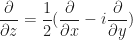
\displaystyle\boxed{\frac{\partial}{\partial z}:=\frac 12(\frac{\partial}{\partial x}-i\frac{\partial}{\partial y})}

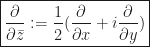
\displaystyle\boxed{\frac{\partial}{\partial \bar z}:=\frac 12(\frac{\partial}{\partial x}+i\frac{\partial}{\partial y})}

They are often simply defined as such, but one would be curious how to derive them, at least heuristically.

How to derive Wirtinger derivatives

It turns out we can derive them as such. Any complex function f(z) can be viewed as a function f(x,y) by considering z=x+iy. Since x=\frac 12 (z+\bar z), y=-\frac 12 i(z-\bar z), we can also view f(x,y) as f(z,\bar z).

Then by the Chain Rule (for multivariable calculus), we have \displaystyle\frac{\partial}{\partial x}=\frac{\partial z}{\partial x}\frac{\partial}{\partial z}+\frac{\partial\bar z}{\partial x}\frac{\partial}{\partial\bar z}=\frac{\partial}{\partial z}+\frac{\partial}{\partial\bar z}.

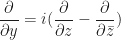
Similarly, we get \displaystyle\frac{\partial}{\partial y}=i(\frac{\partial}{\partial z}-\frac{\partial}{\partial\bar z}).

Then, solving the simultaneous equations we get the Wirtinger derivatives.

\displaystyle i\frac{\partial}{\partial x}+\frac{\partial}{\partial y}=2i\frac{\partial}{\partial z}. Thus, \displaystyle\frac{\partial}{\partial z}=\frac 12(\frac{\partial}{\partial x}-i\frac{\partial}{\partial y}).

Similarly, we can get that \displaystyle\boxed{\frac{\partial}{\partial \bar z}:=\frac 12(\frac{\partial}{\partial x}+i\frac{\partial}{\partial y})}.

Using Wirtinger derivatives, we can express the Cauchy-Riemann equations in a succinct manner: A function satisfies the Cauchy-Riemann equations iff \displaystyle\frac{\partial f}{\partial\bar z}=0.