A weak homotopy equivalence is a map that induces isomorphisms
for all
and all choices of basepoint
.
In other words, Whitehead’s theorem says that a weak homotopy equivalence between CW complexes is a homotopy equivalence. Just to recap, a map is said to be a homotopy equivalence if there exists a map
such that
and
. The spaces
and
are called homotopy equivalent.
It turns out that for any space there exists a CW complex
and a weak homotopy equivalence
. This map
is called a CW approximation to
.
Excision for Homotopy Groups
According to Hatcher (Chapter 4.2), the main difficulty of computing homotopy groups (versus homology groups) is the failure of the excision property. However, under certain conditions, excision does hold for homotopy groups:
Theorem (4.23): Let be a CW complex decomposed as the union of subcomplexes
and
with nonempty connected intersection
. If
is m-connected and
is n-connected,
, then the map
induced by inclusion is an isomorphism for
and a surjection for
.
Miscellaneous Definitions
Suspension: Let be a space. The suspension
is the quotient of
obtained by collapsing
to one point and
to another point.
The definition of suspension is similar to that of the cone in the following way. The cone is the union of all line segments joining points of
to one external vertex. The suspension
is the union of all line segments joining points of
to two external vertices.
The classical example is , when
with the two “suspension points” at the north and south poles of
, the points
.
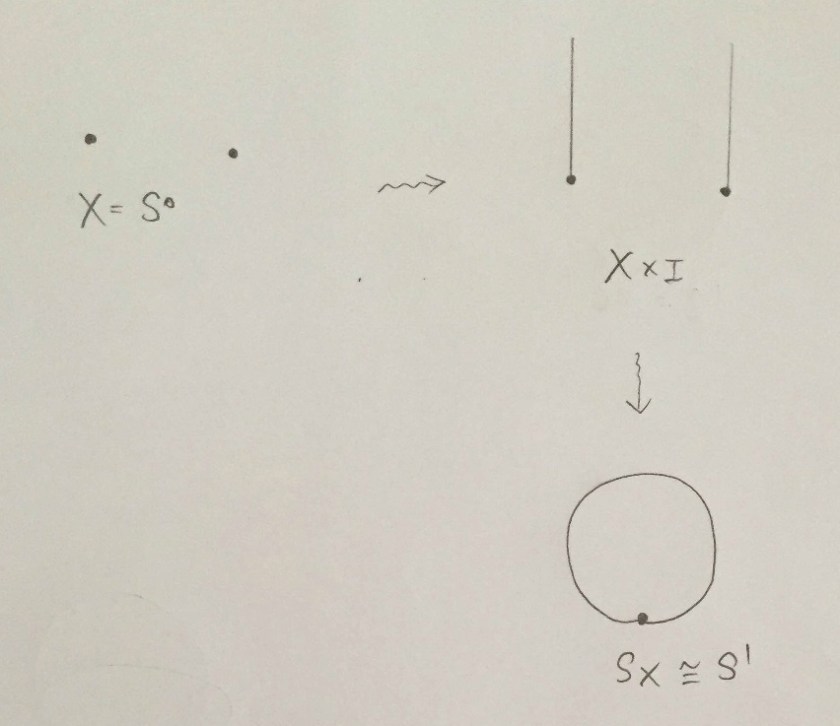
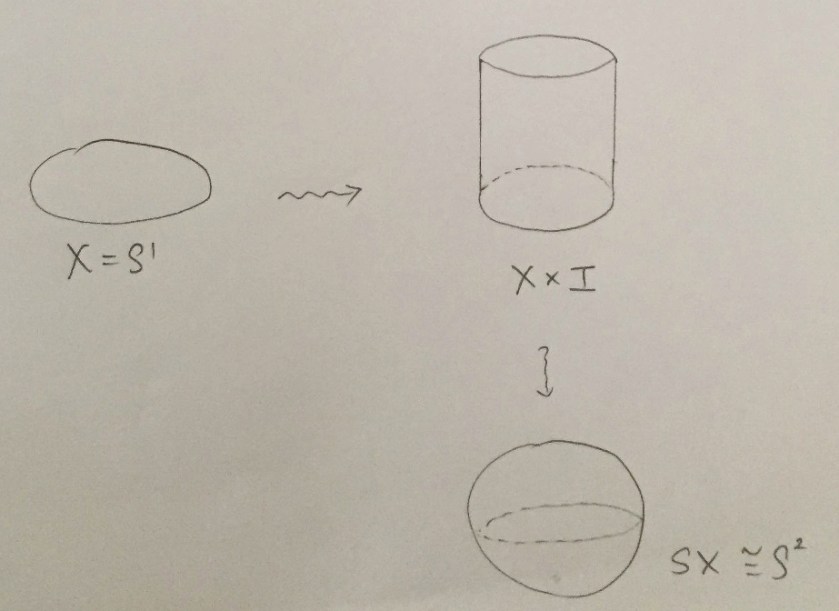
Here are some graphical sketches of the case where is the 0-sphere and the 1 sphere respectively.