We summarize the work so far and relate it to previous results. Our input is a filtered complex  and we wish to find its
  th homology
  . In each dimension the homology of complex
  becomes a vector space over a field, described fully by its rank
  . (Over a field
  , is a -module which is a vector space.)
We need to choose compatible bases across the filtration (compatible bases for  and
and  ) in order to compute persistent homology for the entire filtration. Hence, we form the persistence module
  corresponding to , which is a direct sum of these vector spaces (
 ). By the structure theorem, a basis exists for this module that provides compatible bases for all the vector spaces.
Specifically, each  -interval
  describes a basis element for the homology vector spaces starting at time
  until time
  . This element is a -cycle
  that is completed at time , forming a new homology class. It also remains non-bounding until time
  , at which time it joins the boundary group
  .
.
A natural question is to ask when  is a basis element for the persistent groups
  . Recall the equation
  Since
Since  for all
  , hence
  for
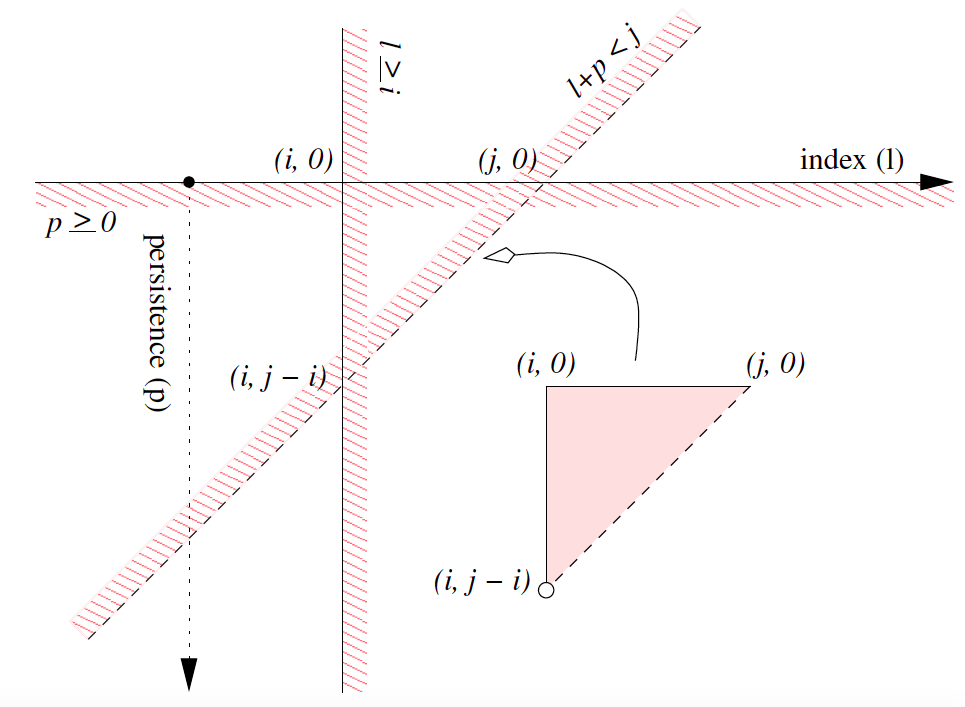
for  . The three inequalities
  define a triangular region in the index-persistence plane, as shown in Figure below.

The triangular region gives us the values for which the -cycle is a basis element for . This is known as the -triangle Lemma:
Let  be the set of triangles defined by -intervals for the -dimensional persistence module. The rank
  of is the number of triangles in containing the point
  .
.
Hence, computing persistent homology over a field is equivalent to finding the corresponding set of -intervals.
Source: “Computing Persistent Homology” by Zomorodian and Carlsson


 Mathtuition88
Reblogged this on Math Online Tom Circle.
LikeLike