Laurent Series (Example)

The Laurent series is something like the Taylor series, but with terms with negative exponents, e.g. z^{-1}. The below Laurent Series formula may not be the most practical way to compute the coefficients, usually we will use known formulas, as the example below shows.

Laurent Series

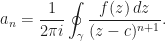
The Laurent series for a complex function f(z) about a point c is given by: \displaystyle f(z)=\sum_{n=-\infty}^\infty a_n(z-c)^n where \displaystyle a_n=\frac{1}{2\pi i}\oint_\gamma\frac{f(z)\, dz}{(z-c)^{n+1}}.

The path of integration \gamma is anticlockwise around a closed, rectifiable path containing no self-intersections, enclosing c and lying in an annulus A in which f(z) is holomorphic. The expansion for f(z) will then be valid anywhere inside the annulus.

Example

Consider f(z)=\frac{e^z}{z}+e^\frac{1}{z}. This function is holomorphic everywhere except at z=0. Using the Taylor series of the exponential function \displaystyle e^z=\sum_{k=0}^\infty\frac{z^k}{k!}, we get
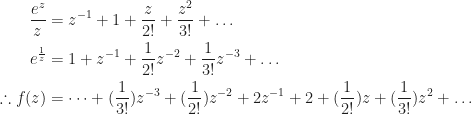
\begin{aligned}  \frac{e^z}{z}&=z^{-1}+1+\frac{z}{2!}+\frac{z^2}{3!}+\dots\\  e^\frac{1}{z}&=1+z^{-1}+\frac{1}{2!}z^{-2}+\frac{1}{3!}z^{-3}+\dots\\  \therefore f(z)&=\dots+(\frac{1}{3!})z^{-3}+(\frac{1}{2!})z^{-2}+2z^{-1}+2+(\frac{1}{2!})z+(\frac{1}{3!})z^2+\dots  \end{aligned}
Note that the residue (coefficient of z^{-1}) is 2.
Unknown's avatar

Author: mathtuition88

Math and Education Blog

Leave a comment

This site uses Akismet to reduce spam. Learn how your comment data is processed.