Fundamental Theorem of Calculus

The Fundamental Theorem of Calculus is one of the most amazing and important theorems in analysis. It is a non-trivial result that links the concept of area and gradient, two seemingly unrelated concepts.

Fundamental Theorem of Calculus

The first part deals with the derivative of an antiderivative, while the second part deals with the relationship between antiderivatives and definite integrals.

First part

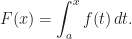
Let f be a continuous real-valued function defined on a closed interval [a,b]. Let F be the function defined, for all x in [a,b], by \displaystyle F(x)=\int_a^x f(t)\,dt.

Then F is uniformly continuous on [a,b], differentiable on the open interval (a,b), and \displaystyle F'(x)=f(x) for all x in (a,b).

Second part

Let f and F be real-valued functions defined on [a,b] such that F is continuous and for all x\in (a,b), \displaystyle F'(x)=f(x).

If f is Riemann integrable on [a,b], then \displaystyle \int_a^b f(x)\,dx=F(b)-F(a).

Unknown's avatar

Author: mathtuition88

Math and Education Blog

Leave a comment

This site uses Akismet to reduce spam. Learn how your comment data is processed.