dz and dz bar: How to derive the Wirtinger derivatives

Something interesting in Complex Analysis is the Wirtinger derivatives:

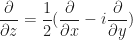
\displaystyle\boxed{\frac{\partial}{\partial z}:=\frac 12(\frac{\partial}{\partial x}-i\frac{\partial}{\partial y})}

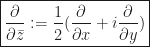
\displaystyle\boxed{\frac{\partial}{\partial \bar z}:=\frac 12(\frac{\partial}{\partial x}+i\frac{\partial}{\partial y})}

They are often simply defined as such, but one would be curious how to derive them, at least heuristically.

How to derive Wirtinger derivatives

It turns out we can derive them as such. Any complex function f(z) can be viewed as a function f(x,y) by considering z=x+iy. Since x=\frac 12 (z+\bar z), y=-\frac 12 i(z-\bar z), we can also view f(x,y) as f(z,\bar z).

Then by the Chain Rule (for multivariable calculus), we have \displaystyle\frac{\partial}{\partial x}=\frac{\partial z}{\partial x}\frac{\partial}{\partial z}+\frac{\partial\bar z}{\partial x}\frac{\partial}{\partial\bar z}=\frac{\partial}{\partial z}+\frac{\partial}{\partial\bar z}.

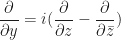
Similarly, we get \displaystyle\frac{\partial}{\partial y}=i(\frac{\partial}{\partial z}-\frac{\partial}{\partial\bar z}).

Then, solving the simultaneous equations we get the Wirtinger derivatives.

\displaystyle i\frac{\partial}{\partial x}+\frac{\partial}{\partial y}=2i\frac{\partial}{\partial z}. Thus, \displaystyle\frac{\partial}{\partial z}=\frac 12(\frac{\partial}{\partial x}-i\frac{\partial}{\partial y}).

Similarly, we can get that \displaystyle\boxed{\frac{\partial}{\partial \bar z}:=\frac 12(\frac{\partial}{\partial x}+i\frac{\partial}{\partial y})}.

Using Wirtinger derivatives, we can express the Cauchy-Riemann equations in a succinct manner: A function satisfies the Cauchy-Riemann equations iff \displaystyle\frac{\partial f}{\partial\bar z}=0.

Unknown's avatar

Author: mathtuition88

Math and Education Blog

Leave a comment

This site uses Akismet to reduce spam. Learn how your comment data is processed.