
This post will be a guide on how to calculate Homology Groups, focusing on the example of the Klein Bottle. Homology groups can be quite difficult to grasp (it took me quite a while to understand it). Hope this post will help readers to get the idea of Homology. Our reference book will be Hatcher’s Algebraic Topology (Chapter 2: Homology). I will elaborate further on the Hatcher’s excellent exposition on Homology.
This is also Exercise 5 in Chapter 2, Section 2.1 of Hatcher.
The first step to compute Homology Groups is to construct a 
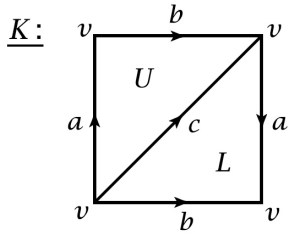
One thing to note for
The key formula for Homology is: 
We have 

Next, we have 

Therefore 
Next, we have 


We then have 


Thus 
To intuitively understand the above working, we need to use the idea that elements in the quotient are “zero”. Hence 


Finally we note that 


In conclusion, we have


 Mathtuition88
One thought on “How to calculate Homology Groups (Klein Bottle)”