
Interesting post about Quadrilateral Midpoint Theorem (QMT), which states that if you connect, in order, the midpoints of the four sides of a quadrilateral–any quadrilateral–even if the quadrilateral is concave or if its sides cross–the resulting figure will always be a parallelogram.

I didn’t encounter the Quadrilateral Midpoint Theorem (QMT) until I had been teaching a few years. Following is a minor variation on my approach to the QMT this year plus a fun way I leveraged the result to introduce similarity.
In case you haven’t heard of it, the surprisingly lovely QMT says that if you connect, in order, the midpoints of the four sides of a quadrilateral–any quadrilateral–even if the quadrilateral is concave or if its sides cross–the resulting figure will always be a parallelogram.
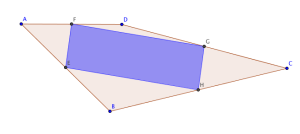


This is a cool and easy property to explore on any dynamic geometry software package (GeoGebra, TI-Nspire, Cabri, …).
SKETCH OF THE TRADITIONAL PROOF: The proof is often established through triangle similarity: Whenever you connect the midpoints of two sides of a triangle, the resulting segment will be parallel to and half the length of the triangle’s third side…
View original post 547 more words

 Mathtuition88