Underrated Complex Analysis Theorem: Schwarz Lemma

The Schwarz Lemma is a relatively basic lemma in Complex Analysis, that can be said to be of greater importance that it seems. There is a whole article written on it.

The conditions and results of Schwarz Lemma are rather difficult to memorize offhand, some tips I gathered from the net on how to memorize the Schwarz Lemma are:

Conditions: f:D\to D holomorphic and fixes zero.

Result 1: |f(z)|\leq|z| can be remembered as “Range of f” subset of “Domain”.

|f'(0)|\leq 1 can be remembered as some sort of “Contraction Mapping”.

Result 2: If |f(z)|=|z|, or |f'(0)|=1, then f=az where |a|=1. Remember it as “f is a rotation”.

If you have other tips on how to remember or intuitively understand Schwarz Lemma, please let me know by posting in the comments below.

Finally, we proceed to prove the Schwarz Lemma.

Schwarz Lemma

Let D=\{z:|z|<1\} be the open unit disk in the complex plane \mathbb{C} centered at the origin and let f:D\to D be a holomorphic map such that f(0)=0.

Then, |f(z)|\leq |z| for all z\in D and |f'(0)|\leq 1.

Moreover, if |f(z)|=|z| for some non-zero z or |f'(0)|=1, then f(z)=az for some a\in\mathbb{C} with |a|=1 (i.e.\ f is a rotation).

Proof

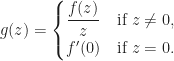
Consider g(z)=\begin{cases}  \dfrac{f(z)}{z} &\text{if }z\neq 0,\\  f'(0) &\text{if }z=0.  \end{cases}
Since f is analytic, f(z)=0+a_1z+a_2z^2+\dots on D, and f'(0)=a_1. Note that g(z)=a_1+a_2z+\dots on D, so g is analytic on D.

Let D_r=\{z:|z|\leq r\} denote the closed disk of radius r centered at the origin. The Maximum Modulus Principle implies that, for r<1, given any z\in D_r, there exists z_r on the boundary of D_r such that \displaystyle |g(z)|\leq|g(z_r)|=\frac{|f(z_r)|}{|z_r|}\leq\frac{1}{r}.

As r\to 1 we get |g(z)|\leq 1, thus |f(z)|\leq|z|. Thus
\begin{aligned}  |f'(0)|&=|\lim_{z\to 0}\frac{f(z)}{z}|\\  &=\lim_{z\to 0}|\frac{f(z)}{z}|\\  &\leq1.  \end{aligned}
Moreover, if |f(z)|=|z| for some non-zero z\in D or |f'(0)|=1, then |g(z)|=1 at some point of D. By the Maximum Modulus Principle, g(z)\equiv a where |a|=1. Therefore, f(z)=az.

Unknown's avatar

Author: mathtuition88

Math and Education Blog

Leave a comment

This site uses Akismet to reduce spam. Learn how your comment data is processed.