
Our next few posts on complex analysis will focus on evaluating real integrals like 
To calculate those real integrals, the first step is to study the theory of residues and poles. This can be found in Chapter 6 of Churchill’s book Complex Variables and Applications (Brown and Churchill)
The extremely powerful theorem that one first needs to know is called Cauchy’s Residue Theorem:
Let 


A Summary of the 3 types of Isolated Singular Points:
- Pole of order
. The coefficients
of the Laurent series contain a finite (nonzero) number of nonzero terms, i.e.
.
- Removable singular point. Every
- Essential singular point. An infinite number of the coefficients
Shortcut for calculating Residues at Poles
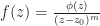
Theorem: An isolated singular point 





This is a very short crash course on the theorems needed. The next blog post on complex analysis will go into calculating some actual integrals.

 Mathtuition88